

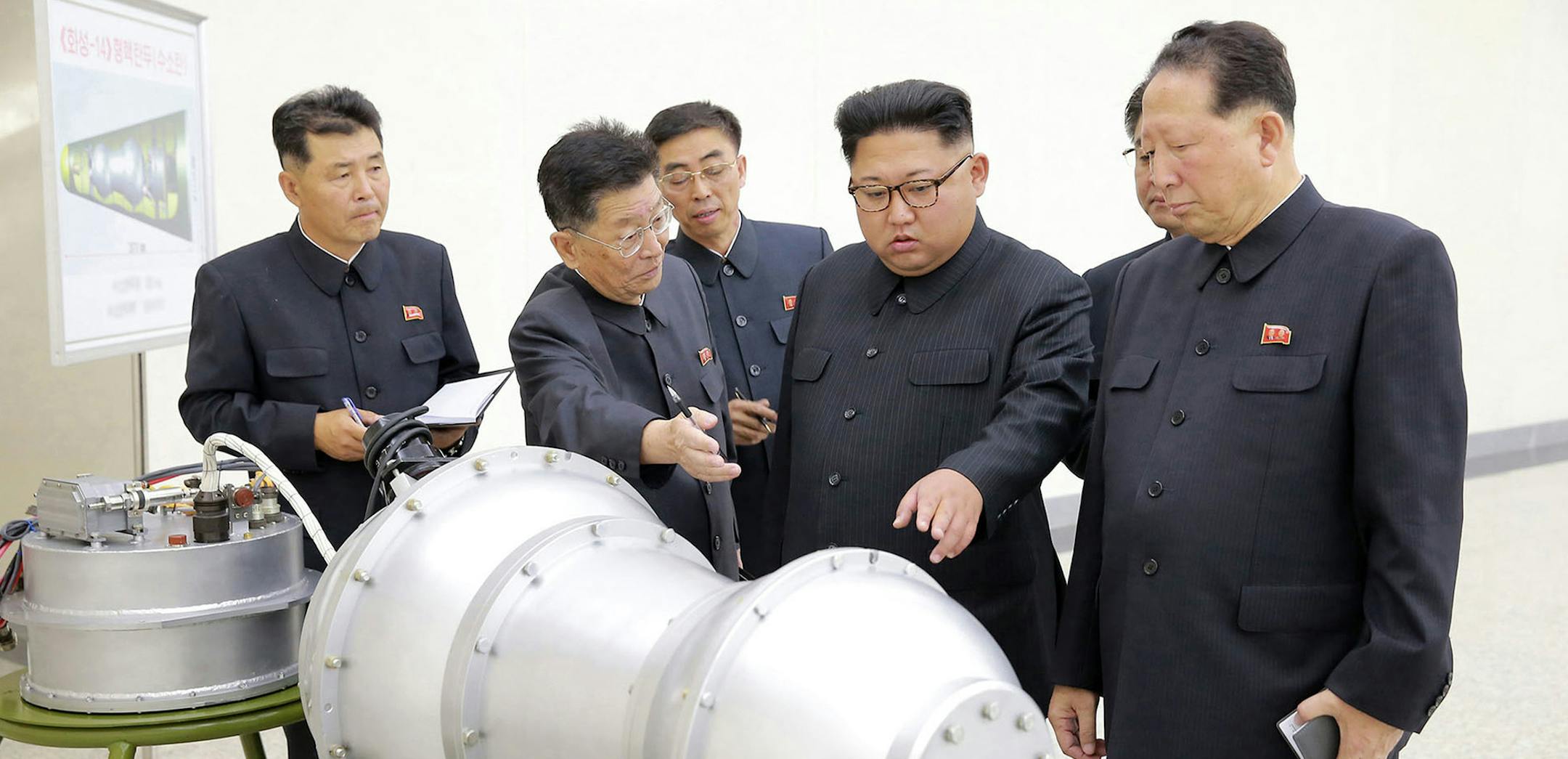
While North Korea's latest nuclear weapons test is an alarming acceleration of that nation's capabilities, it's consistent with efforts to further develop its already dangerous weapons program.
"It's just a steady progress toward what [North Korean leader] Kim Jong Un clearly wants to do," Douglas Paal, vice president for studies at the Carnegie Endowment for International Peace, told an editorial writer. "He is determined to get the pistol that he wants to take to the bargaining table."
It's up to world leaders — despite deep differences between them — to get Kim to the bargaining table and to ensure that the pistol is never fired. United Nations Secretary General Antonio Guterres is right to call for a unified U.N. Security Council strategy and to note that any solution "must be political" because "the potential consequences to military action are too horrific." That warning has been underscored by U.S. Defense Secretary Jim Mattis, who has said war on the Korean Peninsula would be "catastrophic" and "the worst in most people's lifetimes."
This doesn't mean that the Trump administration is wrong to stress deterrence by proposing to sell more advanced weaponry to allies in Seoul and Tokyo, and to hasten the deployment of the THAAD (Terminal High Altitude Area Defense) antimissile system in South Korea. But in general, President Donald Trump's bellicose rhetoric has been counterproductive.
First, Trump risks setting red lines he will not enforce, something he and other Republicans (and even some Democrats) rightly accused former President Barack Obama of doing regarding Syria.
Second, Trump's war of words will make it even more difficult to build the multilateral consensus necessary to impose even more meaningful sanctions on North Korea, something the Security Council is considering after an emergency meeting on Monday, as well as create the cohesion Guterres stressed as essential to solve the crisis diplomatically.
Trump also picked the wrong time to suggest a renegotiation of the U.S.-South Korea free trade agreement. Now is the time to stand by our imperiled ally, not to threaten it with an unnecessary jolt to its economy.
Sanctions alone have not yet convinced Kim to reverse course, and it's less likely that China — the key country trading with North Korea — will soon ramp up the economic pressure. For one, Chinese President Xi Jinping seeks to quell any controversy before seeking another five-year term at the upcoming Communist Party Congress, and more profoundly, China fears a unified, Western-leaning Korea on its border.


