

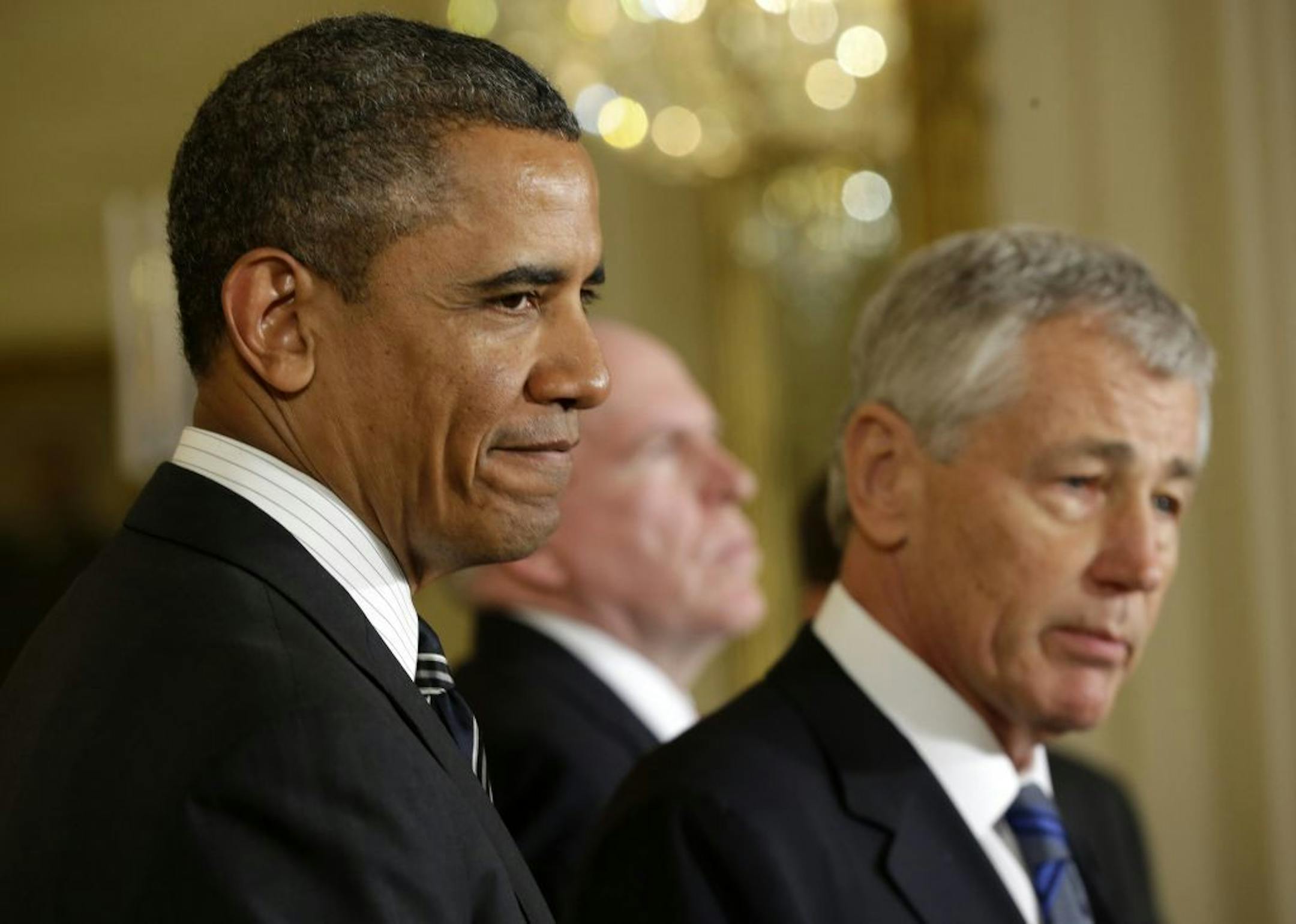
It's good news that President Obama is nominating Chuck Hagel as his secretary of defense, despite the frantic campaign against Hagel by certain Republicans.
I don't think that Obama chose Hagel because of the opposition. It's generally not his style to pick a fight for its own sake (see Rice, Susan). He's an issues man, and he faces many fights on other pressing matters. If he thought that someone less controversial could do the job at the Pentagon, he'd have gone with that person in a flash (see Kerry, John).
The real question is what kind of job Obama wants his next secretary of defense to do. I have no inside knowledge, but judging from some of the president's actions and remarks on matters of national defense, Hagel seems to be the right choice. And that's what disturbs the most outspoken Hagel-resisters.
These resisters have four main concerns. They fear that Hagel will cut the military budget. They fear that he'll roll over if Iran builds a nuclear weapon. They fear that he's too reluctant to use military force generally. And they fear he doesn't much like Israel; the extremists on this point claim he's anti-Semitic.
Let's take these points one by one.
It is true that Hagel once said the defense budget was "bloated." Does anyone doubt this? Even if sequestration is avoided, the military services are coming in for some cuts, maybe drastic ones. That always happens after a war, with good reason; the money spent on those wars is no longer needed.
The baseline military budget (excluding the costs of the wars) amounts to $525 billion. Adjusting for inflation, that's only 7 percent less than what President Ronald Reagan spent on defense at the peak of the Cold War -- when massive Soviet tank armies were poised on the German border and a nuclear-arms race was spiraling out of control. It's hard to argue that we need more money for defense than we spent back then.
It's also true that Hagel isn't keen on going to war with Iran. The same is true of the Joint Chiefs of Staff and most of the American people. Second, ultimately, the point is irrelevant. The president makes these sorts of decisions. Obama has said that he will not allow Iran to get a nuclear weapon. Some Republicans say they don't believe him and that by picking Hagel -- who would have a loud say in deliberations on the issue -- the president is confirming their worst suspicions.


