

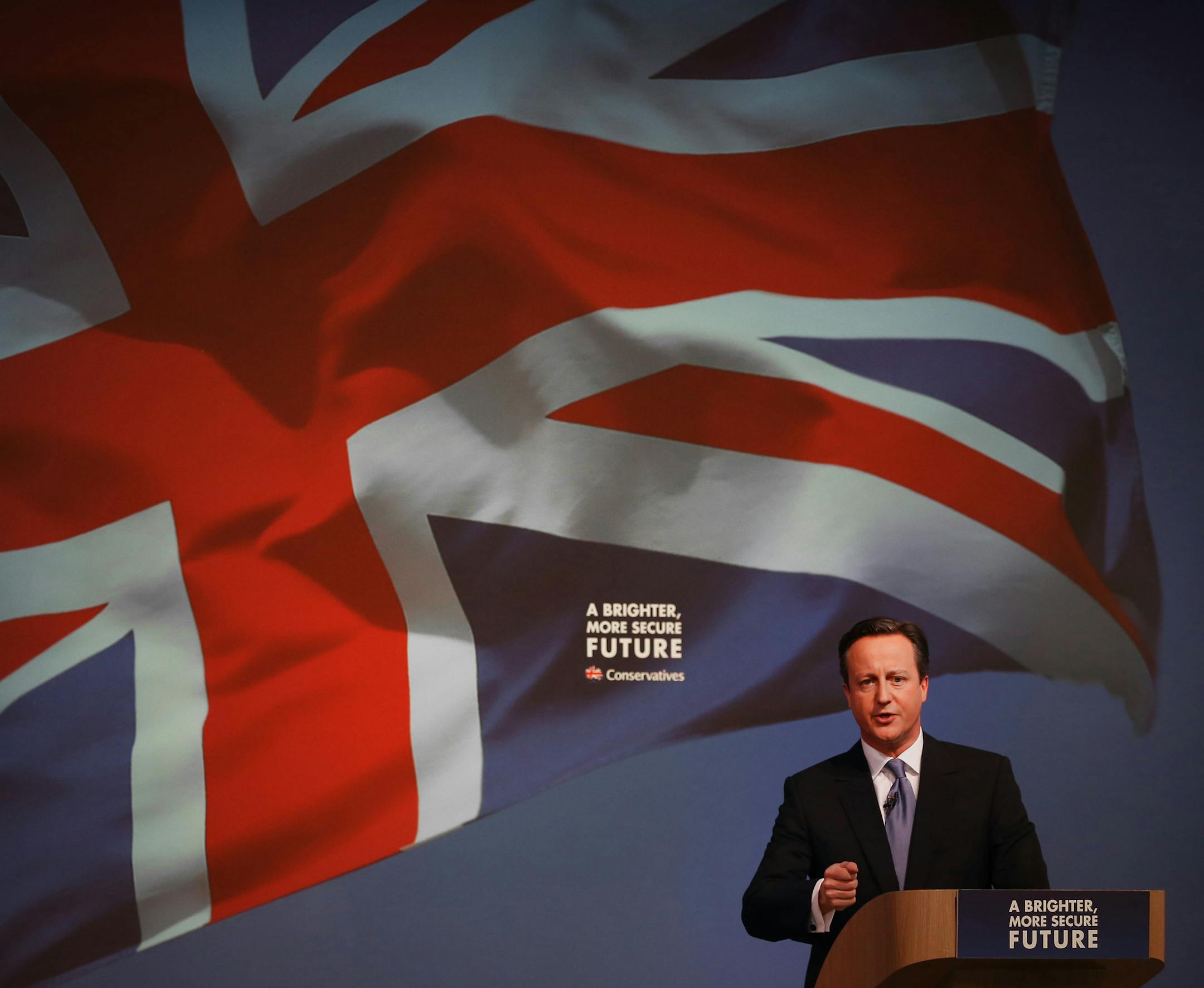
The British elections on Thursday revealed a fascinating contrast with the United States. Britain's once-rigid political parties now look pragmatic and flexible in comparison with sharply divided Washington, D.C. They offer a model for reform on this side of the Atlantic.
The elections were outstanding news for the Conservative Party, which has been in power in the United Kingdom for the past five years thanks to the support of the Liberal Democratic Party. While polls before Thursday had predicted a close contest, Conservatives picked up 100 new seats to win an outright majority of 327 — the first ruling party to expand its power since Margaret Thatcher's Conservatives in the 1983 election. This was a disastrous result for the Labor Party, which had hoped to regain the governing power it enjoyed from 1997 to 2010. Not only did Labor fail to unseat the Conservatives but its long-standing hold over Scotland was decimated by the nationalist party there and its dynamic new leader Nicola Sturgeon.
Beyond the results, though, there is a deeper reality about British politics today.
Thanks to an invitation from Oxford University, I had a front-row seat for much of the campaign. And what became impressively clear was that, no matter who won, the result seemed likely to produce a government more practical and functional than what we've usually seen in America over the past few decades.
The pragmatic turn in British politics is startling to students of political science. Until recently, generations of American political observers described Labor and Conservative lawmakers as rigidly divided into intractable ideological blocks on domestic policies.
This contrasted sharply with U.S. politics from the 1950s to the early 1980s, when fluid coalitions of Democrats and Republicans formed to make compromises across a wide range of policies from civil rights to Social Security and Medicare to tax cuts and deregulation.
The cause of the difference seemed simple: unwavering class loyalties in Britain vs. supple responsiveness in America to local constituents and a broad middle class filled with centrist voters.
Our era has brought a striking reversal. The unbridgeable divides of ideology that once shaped British politics now define the U.S. scene. American-style pragmatism and the political convergence of old are showing signs of life in the United Kingdom.


