

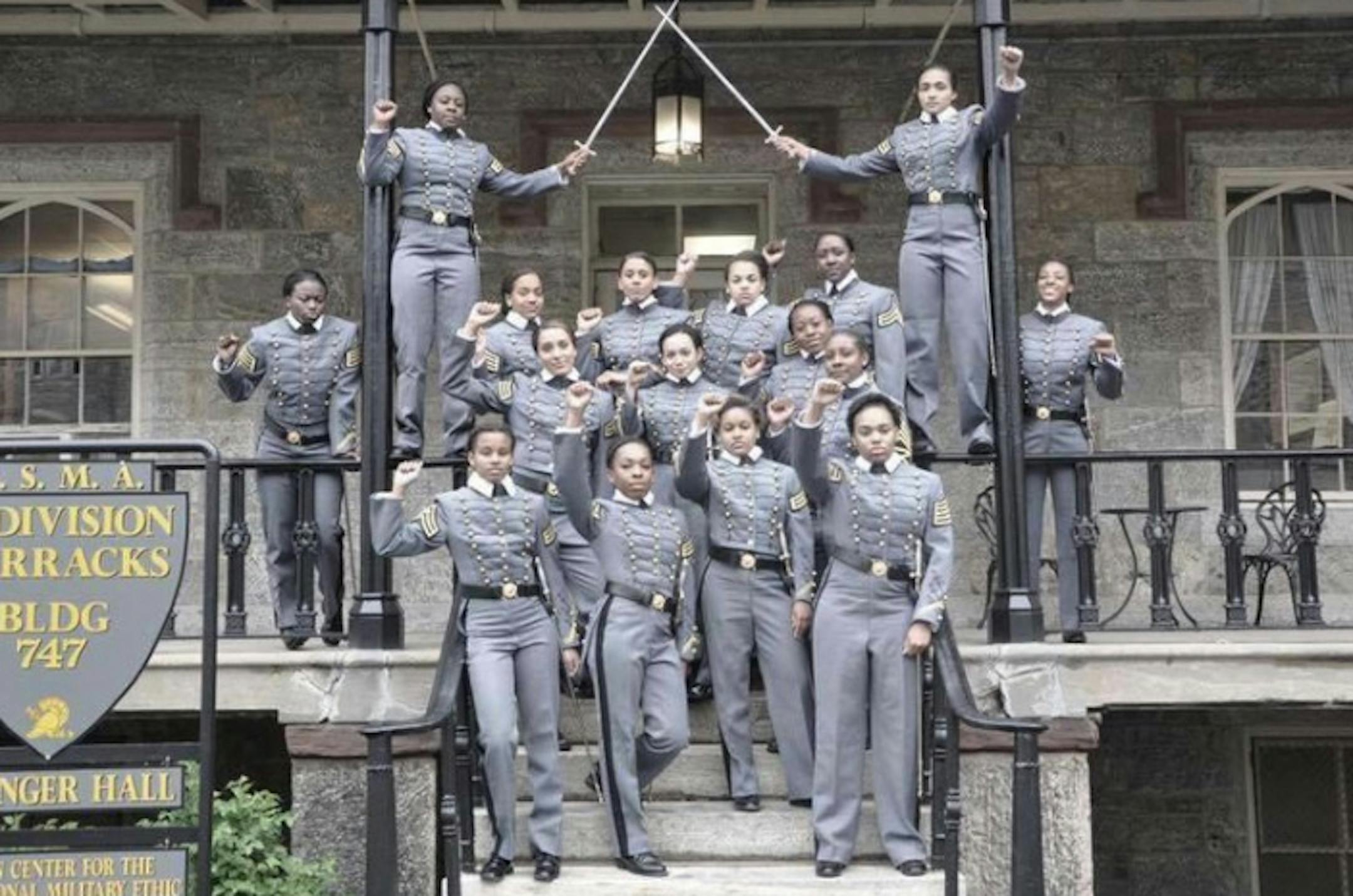
Army leadership found itself in uncomfortable terrain earlier this month when 16 black women West Point cadets posed, in uniform, with raised fists in an unofficial photo. There were other pictures taken, with other poses, but this one made the Internet rounds, with commentator John Burk criticizing the cadets, interpreting the image as a sign of support for groups "calling for the deaths of police officers, and even going so far as to call for the deaths of white Americans." West Point officials concluded there was no ill intent behind the photo (unlike civilians, cadets are prohibited from publicly expressing overt political views) but decided that, before graduation, these seniors would receive additional instruction to underscore the message that "a symbol or gesture that one group of people may find harmless may offend others."
Which sounds like a pretty evenhanded way to address the issue — until you consider that the Army is pretty selective about what it classifies as offensive when those under scrutiny aren't black women.
Consider that when they begin their military careers, it's likely some of these cadets will be assigned to bases like Fort Gordon and Fort Benning, just two of the 10 Army installations named after prominent Confederates — men who fought against the United States in order to preserve the institution of slavery. But as newly commissioned officers, these women will have to serve their country while looking past the legacies of Gen. John Brown Gordon, cited as a prominent member of the Georgia Ku Klux Klan, and Gen. Henry Lewis Benning, who decried "the fate which abolition will bring upon the white race."
After last year's shooting at Charleston's Emanuel AME Church, when many, like writer Jamie Malanowski, called on senior Army leaders to reconsider base names honoring the Confederacy, Army leaders defended the status quo, saying every installation "is named for a soldier who holds a place in our military history. Accordingly, these historic names represent individuals, not causes or ideologies."
The statement was brilliant public-relations doublespeak; simultaneously asserting that history matters — and that it does not. Left unaddressed is the question of whether a place like Fort Benning, home to some of the Army's premier leadership schools, might be more appropriately named after one of the notable figures who have passed through its gates, including Gen. Omar Bradley, President Dwight D. Eisenhower and Secretary of State Colin Powell, all of whom demonstrated great success on the field of battle, and did so while actually fighting for the United States, not against it.
But the Army is content to let the old names stand, and the message to these women, and other minorities, is unfortunately all too clear: In a nation awash with symbols honoring the legacy of slavers and traitors, it's their raised fists — a momentary signifier of African-American resilience — that will be singled out as offensive.
This double standard, masquerading as a neutral, nonideological stance, isn't new.
The categorization of names from our racist past as nonideological has deep historical roots. On the whole it has served the Army well in maintaining its reputation for partisan neutrality. But the Army's official posture is often not neutral at all, and has, in many instances, favored the reactionary elements within society still aggrieved by the outcome of the Civil War. Too often, this dynamic works at the expense of minorities who've stepped forward to serve.


