

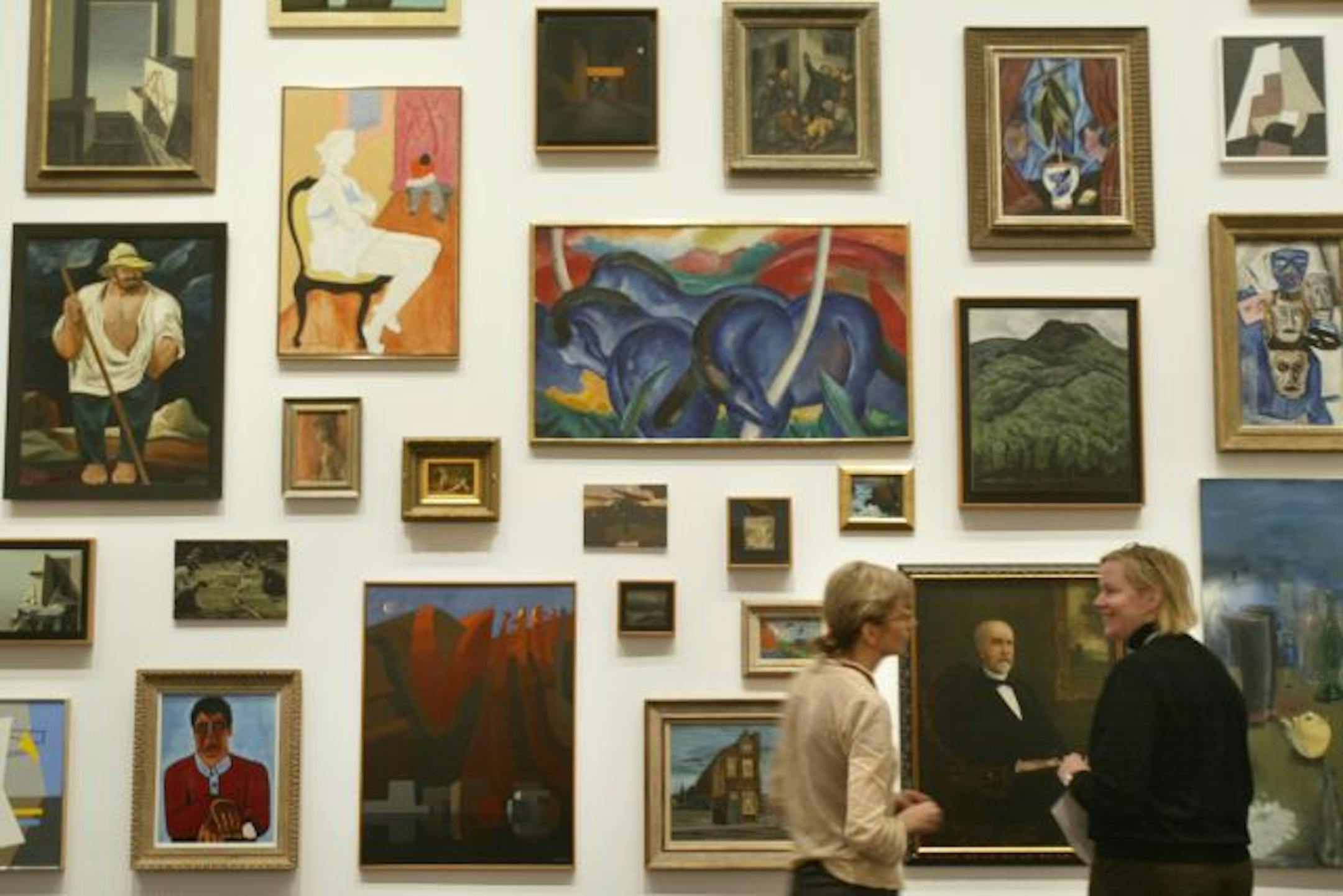
Walker Art Center founder T.B. Walker was an eclectic type whose art purchases ranged from bucolic French landscapes to religious themes and Old Masters. Eclecticism still reigns at his namesake museum, but virtually all of his art has been sold off or given to other institutions to make way for more contemporary work.
Still, a virtually life-size portrait of Walker (1840-1928) looks oddly at ease among a rollicking selection of paintings from the museum's collection, newly hung in an audaciously modern yet staunchly traditional show, "Benches & Binoculars," opening Saturday and running through Aug. 15. A second show, "Event Horizon," up through the summer of 2012, highlights film, video, photography and performances.
The exhibits are the first redo of the collection since the center expanded in 2005.
"The idea was to bring together all these different histories and ideas, stack them up and see how they look in the present tense," said chief curator Darsie Alexander, who came to the Walker a year ago from the Baltimore Museum of Art. She organized the shows with curator Elizabeth Carpenter. Many of the paintings have not been shown for more than 20 years; some recent acquisitions are appearing for the first time, and several old favorites have been dusted off and repositioned, notably Franz Marc's "The Large Blue Horses" and Edward Hopper's "Office at Night."
"Benches" gets its modern bona fides by deconstructing the collection's history and refusing to offer any narrative interpretation of how or why the 96 paintings relate to one another. Simultaneously it stakes a claim on tradition by hanging pictures floor-to-ceiling in a disorganized jumble, much the way Walker himself might have encountered new art while strolling through the "salons" held annually in 19th-century Paris. Archival photos of Walker's home and original galleries show pictures similarly stacked on his walls.
All of the "Benches" paintings have been acquired since 1940, although some were done earlier, including Carl Boeckman's sympathetic 1915 portrait of Walker that centers the north wall.
With 22-foot-tall walls, the double-height gallery is the Walker's largest, and the curators have made dramatic use of its airy space. Purple carpet covers both the floor and a half-dozen benches and stools that were designed and built by the museum's crew. Binoculars and wall maps are available.
On the north wall are 68 mostly figurative paintings dating from 1911 to 2005; on the south are 28 primarily abstract and geometric works done between 1916 and 2005. The almost identical dates undercut the commonplace notion that 20th-century art history was a long, steady march from representation to abstraction. Nope. Try as you might to label decades by shifts in style, subject, concept or color, all such narratives begin to fall apart under scrutiny. Or so it appears.


