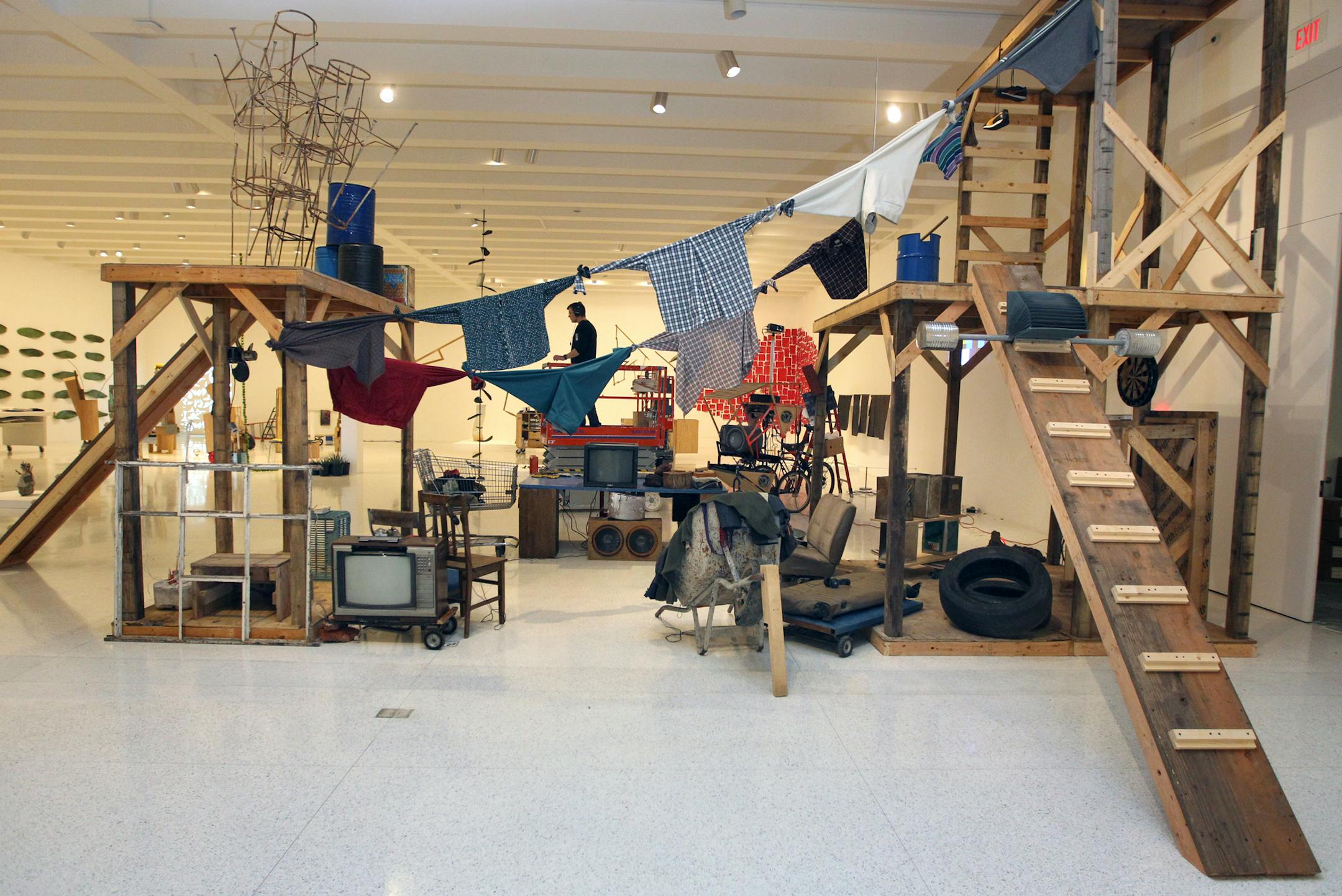
At first glance, the sprawling installation by Mexican artist Abraham Cruzvillegas at Walker Art Center suggests a haphazard construction site or maybe a neighborhood recovering from a tornado or hurricane.
Strange objects cluster at one side as if rescued from a dumpster, which perhaps they were — a log bristling with knives, a tube precariously balanced on a red ball, spiky plants atop wooden crates, fresh limes strung up to dry, pale-blue stools, a chunk of concrete sporting numbers and a crest of feathers.
A ramshackle structure occupies the room's center. Long boards bolted together sketch wall-less rooms, sleeping platforms, cupboards, perhaps a courtyard and a mazelike entrance or exit. A bundle of worn snow-fencing lies on the floor. In an adjacent "resource room," crates are pulled up to an improvised table on which books (about poetry, house building, French history) are anchored by stones, as if to keep them from blowing away. Maps of Mexico City are tacked to the wall. A peddler's jury-rigged tricycle stands nearby, its bright blue frame tricked out with mirrors and a sound system.
In video interviews, a man and woman — the artist's parents, as it turns out — explain where residents of such ad hoc neighborhoods came from (a distant village) and how they built their homes (by hand) and raised their families (hauling dishwater and bath water in buckets).
"It is not a house, it's a sculpture made of wood," Cruzvillegas insisted recently as the Walker's crew carefully finished installing the show. True, but like all of his work, it is a sculpture subtly imbued with ideas about art, family and society, spiked with allusions to Mexico's politics and economy.
Though well established in international art circles, especially in Europe, Cruzvillegas (pronounced crooz-vee-AY-goss) is pretty much unknown in the United States, an oversight that the Walker's mid-career retrospective is intended to correct. Following its Minneapolis premiere, which ends Sept. 22, the show will travel next year to Munich, Germany, and then return to his homeland for presentations in Mexico City and Puebla.
Cruzvillegas, 45, first gained attention at the Venice Biennale and then capitalized on his 2003 triumph there with residencies in Saché and Paris, France; Perugia, Italy; Glasgow, Scotland, and Berlin. The Walker's show samples pieces made during those residencies and includes loans from private collections.
A graduate of Mexico's National University, "of which I am quite proud," he criticized what he sees as the "failure of modernity" in his homeland. Peasants began moving to Mexico City and its environs in the mid-20th century, he said, lured by the idea that urban life would bring jobs, cars, homes, education and wealth. But that consumer paradise never materialized and the country's wealth remained concentrated in the hands of a few, he said.