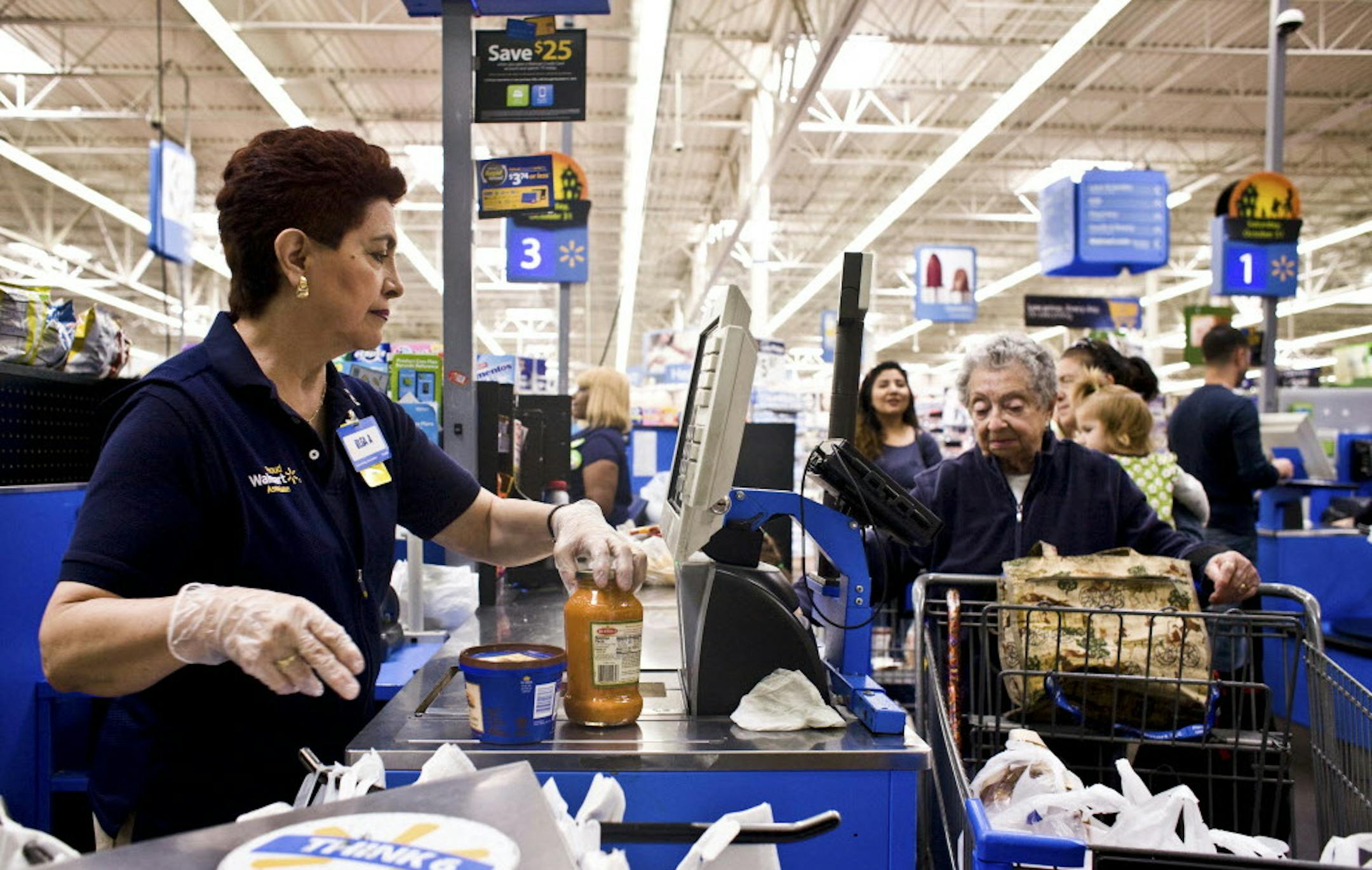
No firm in the world matches the economic imprint of Wal-Mart. The retailer, based in Arkansas and known across America for its vast "supercenters" and low prices, is the world's largest company by revenue.
Its 2.2 million worldwide workforce is about the same size as China's army, excluding reservists. Sam Walton built his empire with a relentless focus on costs: "Control your expenses better than your competition. This is where you can always find the competitive advantage," he said.
Yet change is afoot. In April 2015, Wal-Mart abruptly raised the wages of its lowest-paid staff: All now earn at least $9 an hour. Now, that is rising to $10 an hour for trained-up workers — fully one-third higher than the U.S. minimum wage.
The change is curious, because in the past Wal-Mart has paid notoriously little. In 2014 the average hourly wage of an American cashier was $9.93. According to data from Glassdoor, a jobs website, Wal-Mart's cashiers then made $8.62. Retail salespeople made $12.38 nationwide; at Wal-Mart, only $8.53.
Wal-Mart wages were low, but not pitifully so; for both cashiers and salespeople, average pay at Wal-Mart was close to the 25th percentile nationwide. What has made Wal-Mart look mean is the firm's enormous size. It employs 1.4 million of America's 16 million retail workers. Almost 4.5 million others toil in small shops with fewer than 100 employees. Wages there are expected to be low. But, typically, big firms pay more. One study from 2014 found that high-school graduates earn 15 percent more at retailers with more than 1,000 workers, compared with those who have fewer than 10 staff. Not so at Wal-Mart, which paid corner store wages while making mega-chain profits.
This — combined with a fierce resistance to unions — made the firm a target for campaigners. One common accusation against Wal-Mart — whose shareholders made a 17 percent return in the year to January 2015 — is that its low wages mean it benefits from hidden government subsidies. Many low-wage workers rely on government programs to top up their low wages, and on Medicaid for health insurance. Without this support — the argument goes — firms relying on cheap labor would collapse. In May 2013, congressional Democrats produced a report which furiously alleged that a typical Wal-Mart supercenter in Wisconsin, employing 300, costs the taxpayer $900,000 a year in welfare payments to its staff.
That was hyperbole; it assumes some other employer would be willing to hire Wal-Mart's workers at higher wages. Looks matter, though, and the benefit of today's pay rises is partly cosmetic. Other factors are in play, too.
"In some ways it demonstrated leadership, in other ways it [was] a market reaction," Doug McMillon, Wal-Mart's boss, told investors in October 2015. Recently, wage growth has been higher for junior retail staff than for other workers, suggesting that competition for staff may be heating up. Wal-Mart's first pay rise, to $9 an hour, was emulated by Target and TJX, which owns the retailers T.J. Maxx, Marshalls and HomeGoods.