

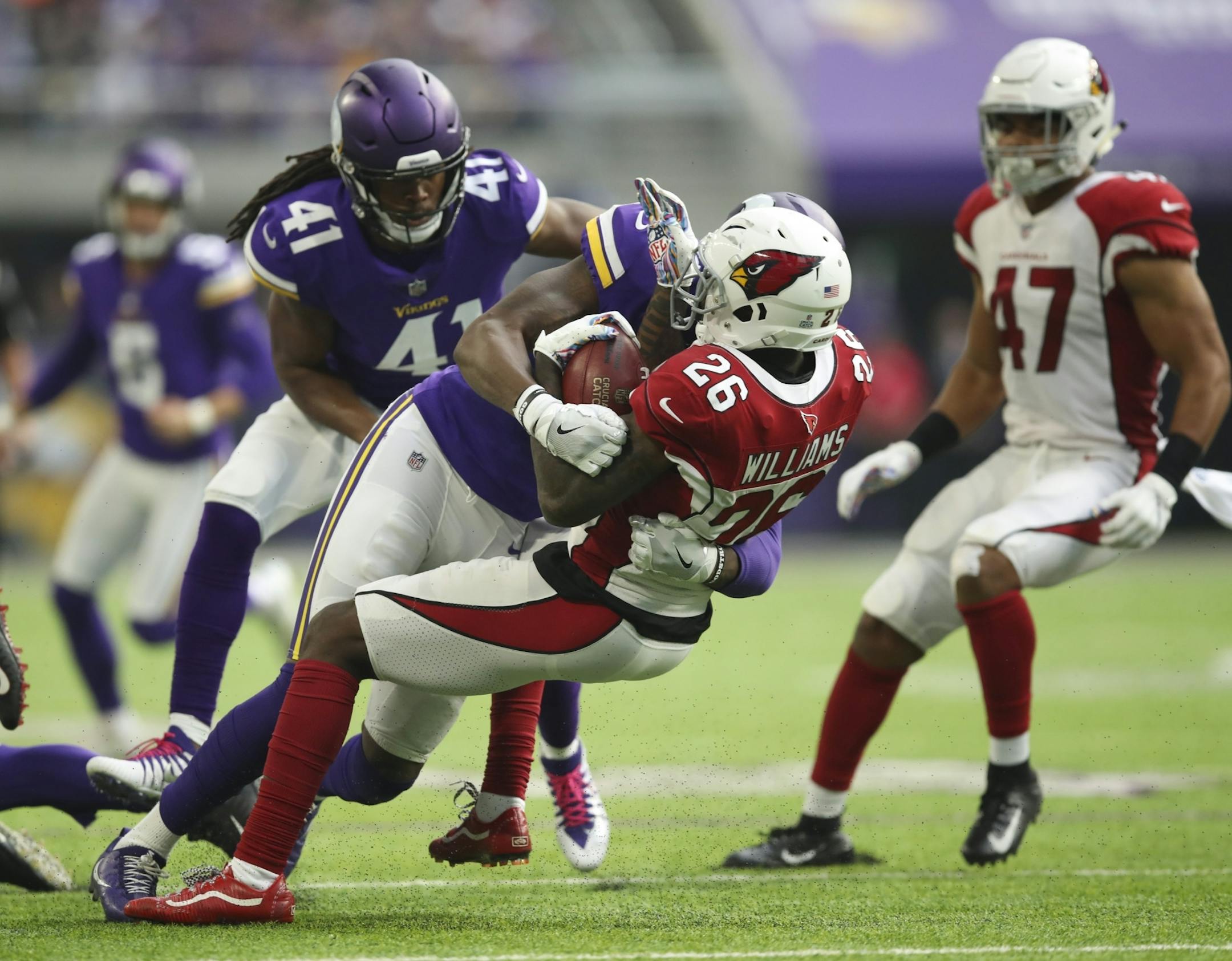
The third game of George Iloka's NFL career came on Sept. 23, 2012, when the Bengals traveled to FedEx Field to take on the Redskins and what had become the league's most talked-about offense, with Robert Griffin III running the zone-read scheme that took the league by storm that season.
Griffin ran for 74 yards and a touchdown that day but was sacked five times and lost one of his three fumbles as the Bengals — with a defense helmed by coordinator Mike Zimmer — prevailed 38-31.
Iloka's seven years in the league — and especially the 2½ he's spent with Zimmer — likely inform a bit of his nonchalance when presented with the league's latest set of avant-garde offensive ideas, which will be personified by the Chicago Bears on Sunday night.
"Ten years, 15 years ago, the wildcat was popular when Miami ran it," Iloka said. "Zone reads, [run-pass options], yada yada yada. Whatever the fad is. As an offense, you can only work on so much. So when things work in the league, a lot of teams copy it. Defenses find ways to stop it, and they move to something else."
Be that as it may, the moment is now for the offense popularized by the Kansas City Chiefs and the disciples of coach Andy Reid, including Bears coach Matt Nagy and Eagles coach Doug Pederson, who incorporated some of the Chiefs' concepts in Philadelphia and passed them along to Vikings offensive coordinator John DeFilippo. When the Vikings play the Bears on Sunday night, they'll have to be ready for a voluminous playbook that will move players all over the field, take advantage of quarterback Mitchell Trubisky's mobility and seek to confuse defenders with motion and misdirection.
Then, in what's being billed as the game of the year on Monday night, Reid's Chiefs will take on the Rams, coached by Sean McVay, who cut his teeth in the Redskins offense when Griffin was there before working with Kirk Cousins. The NFL's newest offensive concepts might not really be all that new — many of them have been popularized by teams looking for college-style offenses compatible with their young quarterbacks, and Reid's adaptation has been inspired by Texas Tech's Kliff Kingsbury — but they're the talk of the league right now because defenses have yet to find a consistent answer for them.
"I don't know if it's as much [because of young QBs] as everyone thinks it is, but there is some, there's no doubt," DeFilippo said. "What you are seeing less in the NFL is two-back football. You are seeing '12' personnel [one running back, two tight ends]. You are still seeing '11' personnel. To run the football [with] 11 personnel, you have to have an answer for that seventh guy in the box. I think that's where a lot of this started and getting creative: 'How do we just block that seventh guy if they are going to load the box on us?'
"It is a single-safety [in the] middle [of the field] league. Unless you are on third-and-long, there's very little two-high [safety defense], except some of those corners-pressed teams where the safeties are basically behind linebacker depth. This is a single-safety middle league now. You have to account for that extra player and that is kind of how it started. Some of the RPO world, some of the 'Leave a guy unblocked and you read him,' I think a lot of it has trickled up because some of the things of the guys in college are doing, and also because this league has turned into a single-safety middle league."
![Minnesota Vikings defensive back George Iloka (23) during practice at TCO Performance Center Thursday September 20, 2018 in Eagan, MN. ] JERRY HOLT ï jerry.holt@startribune.com](https://arc.stimg.co/startribunemedia/F46EZXUMH7P65E7BXIISZ6DF3Q.jpg?&w=1080)


