

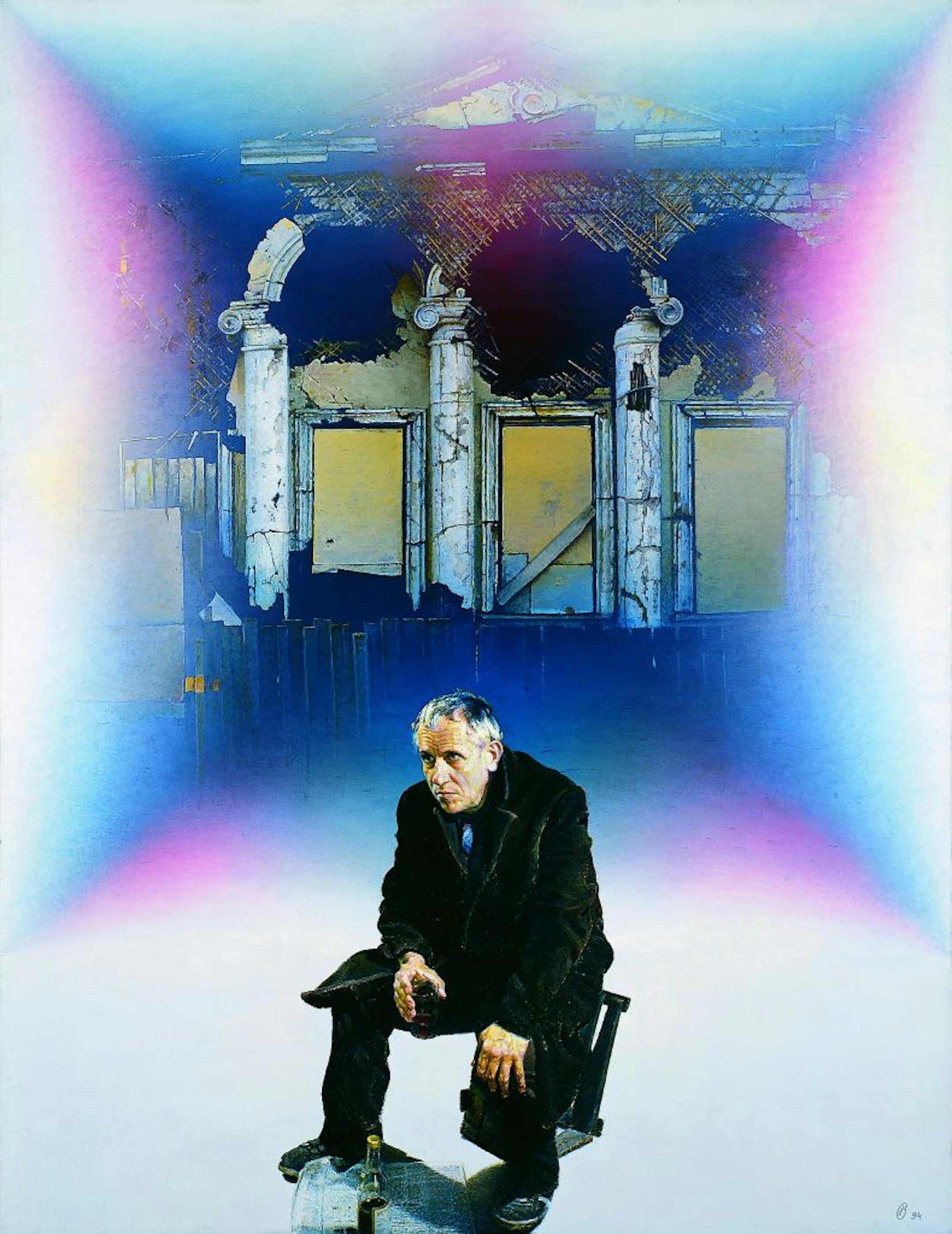
By the time the Soviet Union collapsed in political and economic bankruptcy in 1991, dissident artist Oleg Vassiliev had already established himself as an influential figure in the West. Despite -- or perhaps because of -- the scorn Soviet officials had heaped on his work, the international art world welcomed him, and starting in the 1980s his paintings and graphic designs filtered out to shows at galleries and museums throughout Europe and the United States.
His work was included in a 1999 show of Soviet-era pop art at the University of Minnesota's Weisman Art Museum. And on Saturday the Museum of Russian Art in Minneapolis will open an exhibit of more than 20 of his paintings to accompany a suite of 30 Vassiliev etchings that debuted there in August. Inspired by an Anton Chekhov story, the etchings were executed in Paris in 1991 and have never been shown together before.
During the Soviet era, artists were expected to be propagandists for government policies and to work in a realistic style. Those who conformed were rewarded with state support, shows, travel opportunities and prestigious posts as "official artists." The "unofficials" who didn't bend to the system had few if any career options and were often hounded by political authorities. Still, like Vassiliev they gained respect in other circles -- including the international avant garde -- for their principled resistance.
"You had to have the pluck to do it," said Masha Zavialova, the museum's Russian-born curator. "There were a very limited number of them, only two or three dozen" in the whole Soviet Union."
An introspective rebel
Despite his renown in the art world, Vassiliev is hardly a household name in Minnesota, where he now resides. Born in Moscow in 1931, he graduated from the prestigious Surikov Art Institute in Moscow in 1958 and worked for the next three decades as a book designer and illustrator, a below-the-radar profession that allowed him time to pursue his own art in private. With his lifelong friend Eric Bulatov, another dissident painter, he turned out beautifully designed children's books enlivened with sophisticated silhouettes, whimsical animal figures and charming folk characters, samples of which are included in the show.
"He and his friend would do a half-year of children's books and then go camping in the wilderness for six or seven weeks to purify themselves and get it out of their minds," said Zavialova.
While Vassiliev admired colleagues who defied authorities by showing art that didn't conform to the official Socialist-Realist style, he didn't have the stomach for confrontation himself. "The path to socio-political struggle ... was impossible for me," he said in a 1997 biographical essay. "What we created for ourselves in the studio, we tried not to show to the officials. Our only viewers were friends and a narrow circle of acquaintances."


