

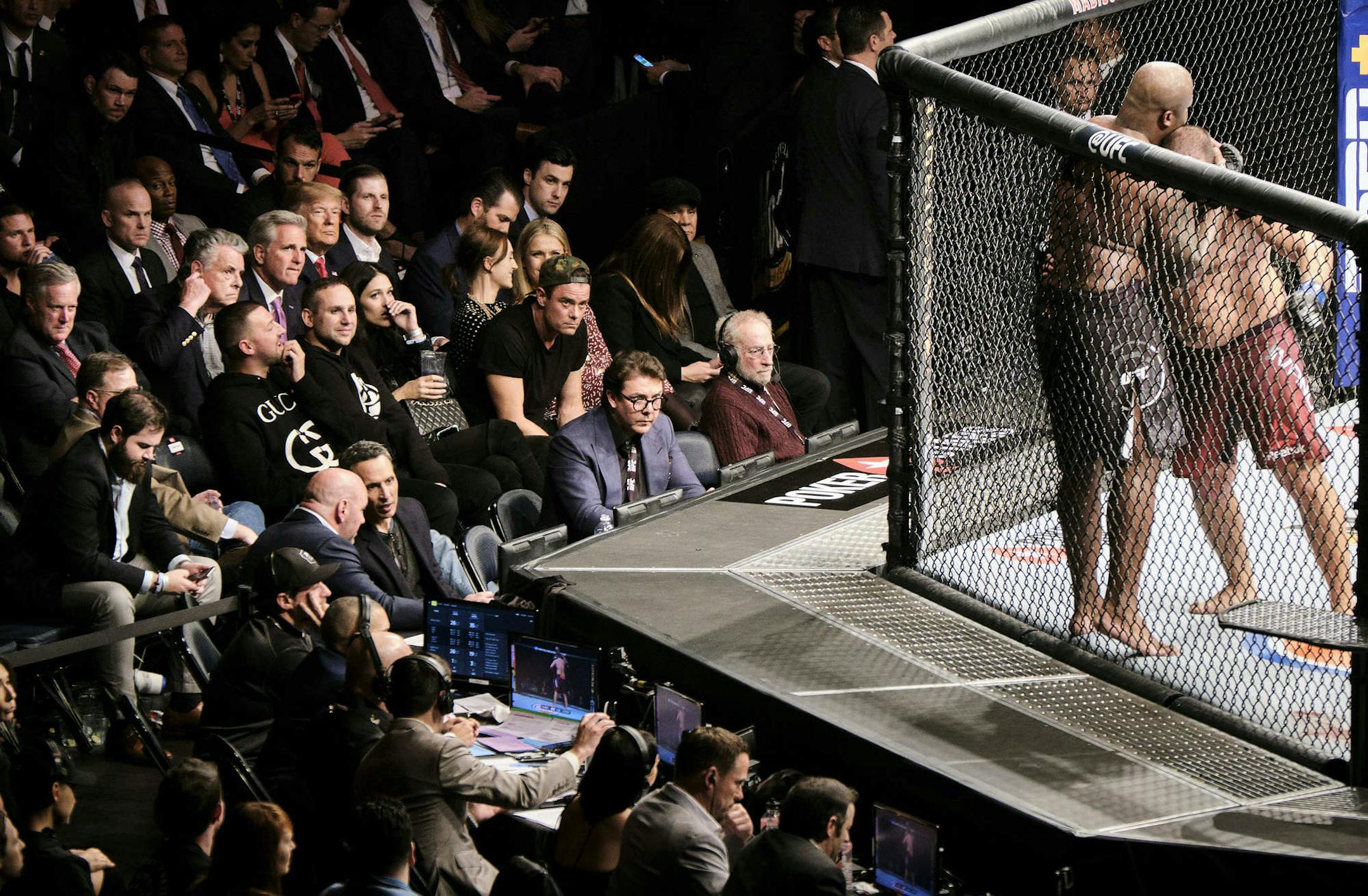
Even before President Donald Trump arrived Saturday at New York's Madison Square Garden for the Ultimate Fighting Championship (UFC), his presence was everywhere. For blocks around the arena, police gathered in large groups, and several streets along Eighth Avenue were blocked. People entering the event walked past protesters holding anti-Trump signs and the odd fan in a MAGA hat, sights rarely seen at mixed martial arts (MMA) events. Once inside, everyone was subjected to close screenings by Secret Service agents.
All night, there was a sense of anticipation and anxiety that went beyond the normal levels for fight night. The crowd was distracted during the early matches. When would he appear, and what would we do when he did?
Around 10 o'clock, a few minutes before the main card was set to begin, there was a stir on the main floor of the arena, and everyone leapt to their feet and looked down to where a large group of men in dark blue suits had appeared. And there he was among them, the president of the United States, standing beside a cage, waving.
The booing began immediately. The music on the loudspeakers was turned up, either to herald Trump's arrival or to stifle the crowd's displeasure in reaction to it, but the sound of those boos was overwhelming. A few Trump fans scattered throughout the room cheered, but they were drowned out. Three rows down, a young couple held up a sign that said "Impeach and Remove." There was no introduction as there had been at the World Series last week, no sense of ceremony or occasion, no video of the president and his sons on the Jumbotron, no "lock him up" chants — but for a moment, the environment, already full of alcohol and flush with three hours of fights and charged for more, felt volatile.
It was no surprise that a New York crowd would greet Trump with hostility, but there was no guarantee an MMA crowd would. After all, Trump has a long history with the sport. One could even argue that he'd saved it. That was back in February 2001, when the UFC was at death's door. Years of attacks by politicians and concerned parents had relegated the company and the sport to the darkest corners of the cultural landscape. Zuffa, a company run by Las Vegas casino owners Frank and Lorenzo Fertitta, had purchased the UFC for $2 million one month earlier, and it wasn't clear they'd ever see that money again. But Trump, who'd played a huge role in turning Atlantic City into a boxing mecca a decade earlier, saw something in MMA and the new owners of the UFC. He opened the doors of his Taj Mahal casino for the first event of the Zuffa era, giving their struggling promotion and its product some much-needed credibility.
Nearly 20 years later, UFC president Dana White returned the favor, singing Trump's praises at the Republican convention in 2016.
Observers outside the MMA world who had no knowledge of UFC's past relationship with Trump seemed to expect a warmer reception for the president. People who don't know the sport assume a natural affinity between Trumpism and MMA: a shared brutishness, a devotion to mindless entertainment and spectacle and cruelty, a safe space for disaffected, angry white men. In Vanity Fair, Jordan Hoffman mocked Trump for ignoring the Museum of Modern Art, the New York Philharmonic and New York City's many other cultural treasures in favor of watching "people writhe around on canvas and beat the snot out of each other." The Daily Beast suggested UFC 244 was "The Only Place in New York Where Trump Might Avoid Boos," and wondered if Trump "sensed that there is something valuable to be mined in the politically incorrect, that sweat and blood can rouse people more viscerally than reason and sentiment, that there is a base to be found in baseness." Why, critics asked, would MMA fans boo the man who speaks to their hearts with every tweet?
The simple answer is that common conceptions about MMA as a natural home for brutes, bullies, xenophobes, racists, sadists, misogynists, destroyers of common decency and poisoners of young minds are wrong.


