

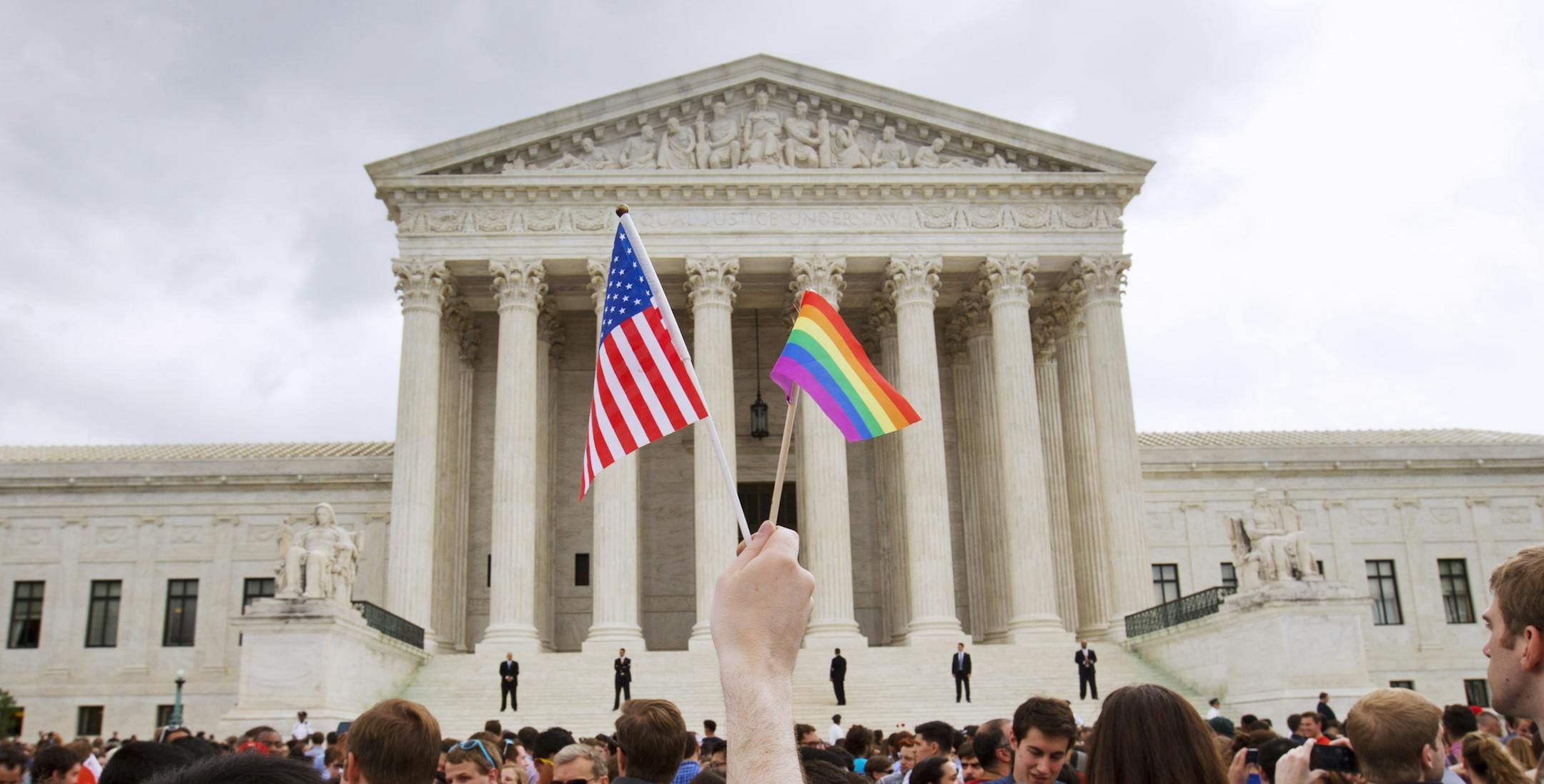
On Oct. 8 the U.S. Supreme Court will hear oral arguments in a case that will decide whether lesbian, gay and transgender workers can be fired for their sexual orientation or gender identity. Chase Strangio, a staff attorney with the American Civil Liberties Union's LGBT & HIV Project and a nationally recognized expert on transgender rights, has described it as "the most important case directly addressing LGBTQ people ever to reach the United States Supreme Court."
The oral arguments will involve three separate cases. The first, Zarda v. Altitude Express, involves a sky-diving instructor fired after disclosing he was gay. Similarly, in Bostock v. Clayton County, a beloved county social worker with favorable performance reviews was fired soon after joining a gay recreational softball league. The third case, Harris Funeral Homes v. EEOC, involves a funeral home worker who was fired after refusing to hide her transgender identity.
Central to all three is Title VII of the Civil Rights Act of 1964, which prohibits employment discrimination based on race, color, religion, sex and national origin. Title VII establishes that it is illegal for employers to treat employees differently based on their sex. In 1999 the Supreme Court ruled, in the case of Price Waterhouse vs. Hopkins, that Title VII applies to gender stereotyping as well.
The plaintiff in Price Waterhouse, Ann Hopkins, was denied partnership due to her bosses' perspective that she was inadequately feminine. She was told that if she wanted to make partner she would need to wear makeup, walk and talk like a woman and style her hair (i.e., conform to heteronormative stereotypes of femininity).
Hopkins' victory at the Supreme Court made it constitutionally impermissible for employers to treat employees differently because they do not perform their gender roles in ways prescribed by the employer. Hopkins was awarded nearly $400,000 and returned to Price Waterhouse, eventually leading one of the most diverse (as well as profitable) work teams in company history.
Dozens of federal district courts and state courts — including five federal appeals courts — have used the ruling in Price Waterhouse to protect transgender people against discrimination under Title VII. This makes sense. As the 11th U.S. Circuit Court of Appeals clearly explains, discrimination against transgender workers is sex discrimination because "a person is defined as transgender precisely because of the perception that his or her behavior transgresses gender stereotypes."
The Trump administration disagrees. The Department of Justice (DOJ) filed its brief in the Harris Funeral Home case Aug. 16. It justifies an employer's right to fire an employee for being transgender by arguing that "proving discrimination because of sex requires showing disadvantageous treatment of members of one sex relative to similarly situated members of the other."
This is a radical argument. Not only does the DOJ argue that transgender workers should have no protection from discrimination under Title VII, but it is asking the Supreme Court to overrule Price Waterhouse. It is essentially asking the court to overrule decades of precedent protecting employees from gender stereotyping in the workplace. It wants the court to create a world where employers wouldn't be held accountable for sex discrimination based on sex stereotypes so long as they simply require both men and women to adhere to traditional sex stereotypes.


