

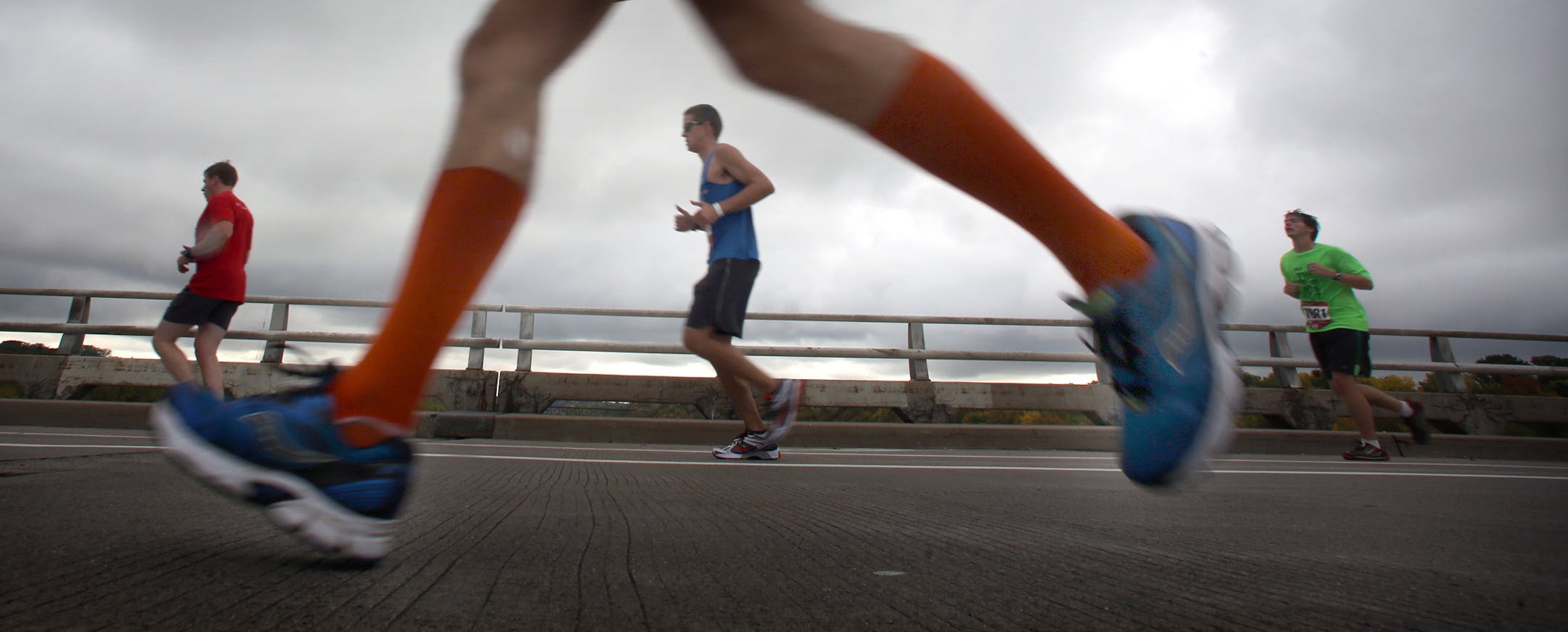
The Twin Cities Marathon is dubbed "the most beautiful urban marathon" in the country, but there are a lot of beautiful stretches in the Twin Cities and endless configurations of 26.2 miles. How did that assemblage of streets become The Twin Cities Marathon?
"I roughed out a map with a piece of string and a Rand McNally map that covered all my favorite running routes," said Jack Moran, who in 1981 was president of the Minnesota Distance Running Association (MDRA) and designer of the first Twin Cities Marathon. "Then, my wife and I got into a car with [state Rep.] Phyllis Kahn — we thought it would be good to get a politician involved — and drove it, and it did come out to be 26 miles."
The MDRA had established the Land of Lakes Marathon in 1963, and changed the location and the name to City of Lakes Marathon in 1976. The running boom took hold to such a degree that in 1981, the figure-eight City of Lakes course could not properly accommodate all the runners. Also in 1981, one week after City of Lakes, Garry Bjorklund Sports held the first and only St. Paul Marathon. It drew another 2,000 runners.
Both MDRA and Bjorklund's group realized a single race encompassing both cities would better serve the strong running community, so they joined forces for the Twin Cities Marathon's debut in 1982.
Though the logistics of a point-to-point marathon — two staging areas rather than one; shuttling runners and their spare clothes between start and finish — are far more onerous than a loop course, Moran said the board members thought it was worth the trouble to start in downtown Minneapolis and finish in downtown St. Paul. Here was an opportunity for a headlining event through the heart of the metro area. Minneapolis being a larger city, they decided running it the opposite way would create too many traffic problems.
"The park board in St. Paul was adamant they wanted as much mileage as Minneapolis. You know that rivalry," Moran laughed. So, St. Paul miles were added by detouring from Summit Avenue at Fairview Avenue down to Edgcumbe Road and back to Summit, at Lexington Avenue. As marathon courses go, this one was pretty hilly and, thus, slow. No one wants a marathon with extra challenge.
"Garry Bjorklund said all we had to do was get some fast people to run the race," said Moran. "If they posted fast times nobody would worry about the hills."
The year 1982 was the same year the Twin Cities hosted Scandinavia Today, a celebration of Scandinavian heritage. Organizers thought it would benefit from an athletic component. Northwest Airlines threw in some airfares and, bing bang, Denmark's Allan Zachariasen won the inaugural race in a speedy 2 hours, 11 minutes, 49 seconds. Hill issue resolved.

