

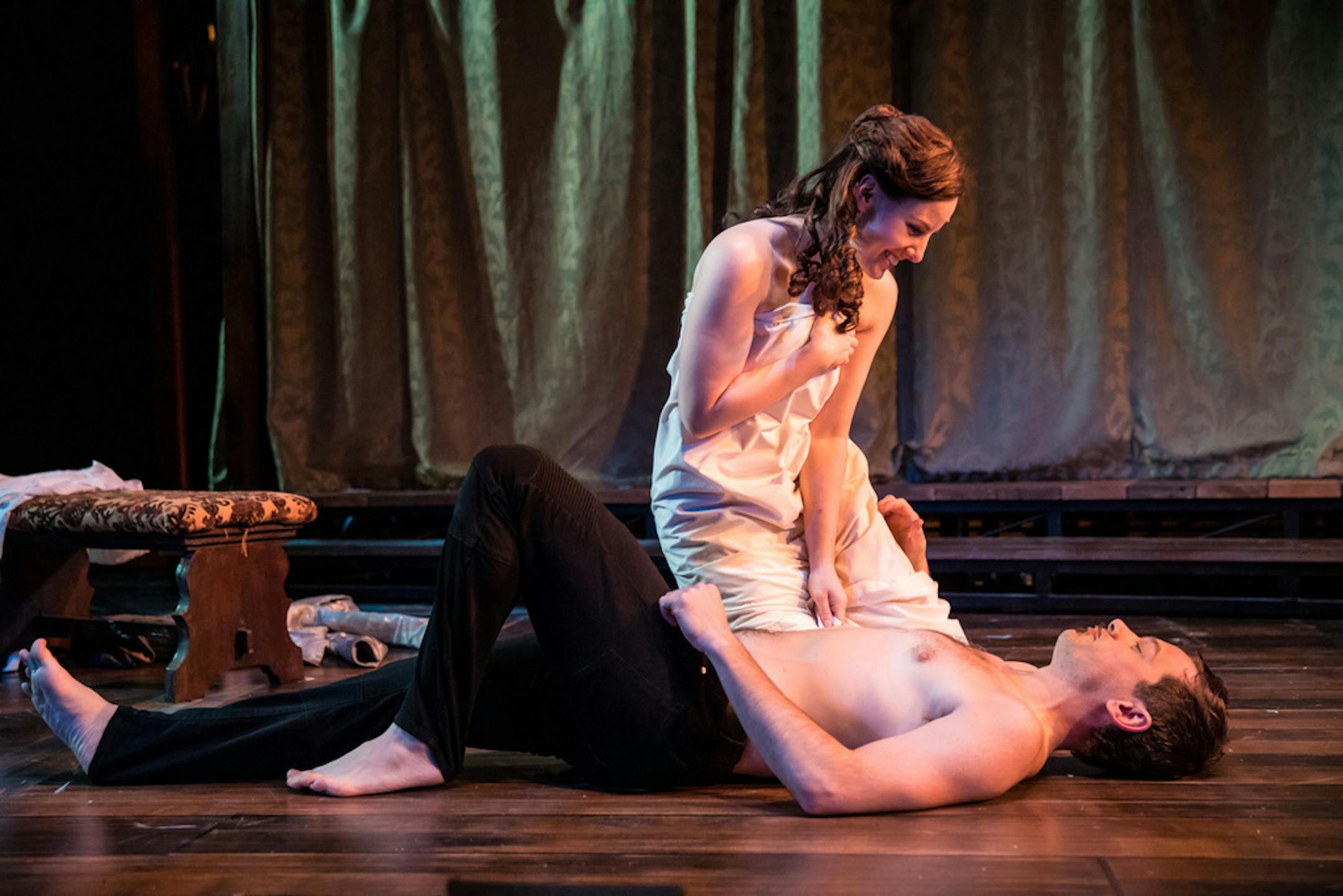
Love scenes on stage are about to change forever.
It's been decades since theatrical productions first turned to fight choreographers to safely stage battles and other scenes involving violence. Now a rapidly spreading movement insists that intimacy — everything from a hand caressing a face to a simulated sex scene — should be choreographed just as carefully. And never without upfront discussions about consent and physical boundaries.
"You would never leave actors alone in the rehearsal room to stage a slap," said Lauren Keating, intimacy consultant for the Guthrie Theater's "Frankenstein — Playing With Fire" last fall and next month's "As You Like It." "The same thing is true of a kiss."
In the Twin Cities, there's a resident fight and intimacy director at Dark & Stormy Productions, whose recent "Blackbird" depicted the physically charged meeting of a woman and the man who abused her as a child. An upcoming production of "Hair" has volunteers on hand to ensure cast safety and comfort through rehearsals and the provocative musical's two-week run. The Guthrie's "Frankenstein" didn't include any sex scenes, but there were romantic moments involving physical contact, staged with the same attention to detail as a swordfight. The movement to hire intimacy experts is even sweeping the world of TV and film, with HBO now requiring intimacy consultants on all projects.
Keating and others on the front lines say the results are healthier for performers. And they're better for audiences, too.
"When people feel safe, they take more risks," said Keating, also a director and associate producer at the Guthrie. "You know exactly what the boundaries are for the actors, and they know their boundaries with each other. You know you can go to a deeper place because you have had that conversation."
Another early adopter is Doug Scholz-Carlson, artistic director of Winona's Great River Shakespeare Festival. He's working toward becoming a certified intimacy director.
"The training has completely transformed the way we work," said Scholz-Carlson, who choreographed an assault for Minnesota Opera's "Dead Man Walking" last year. "The rape scene we created was much more brutal than what we could have created if we hadn't used these techniques. Everyone has a tendency to be careful around this stuff, but this gave us a way to set boundaries, know what they were, and then, once we had a very clear box, be free within that box to create something really powerful."


