

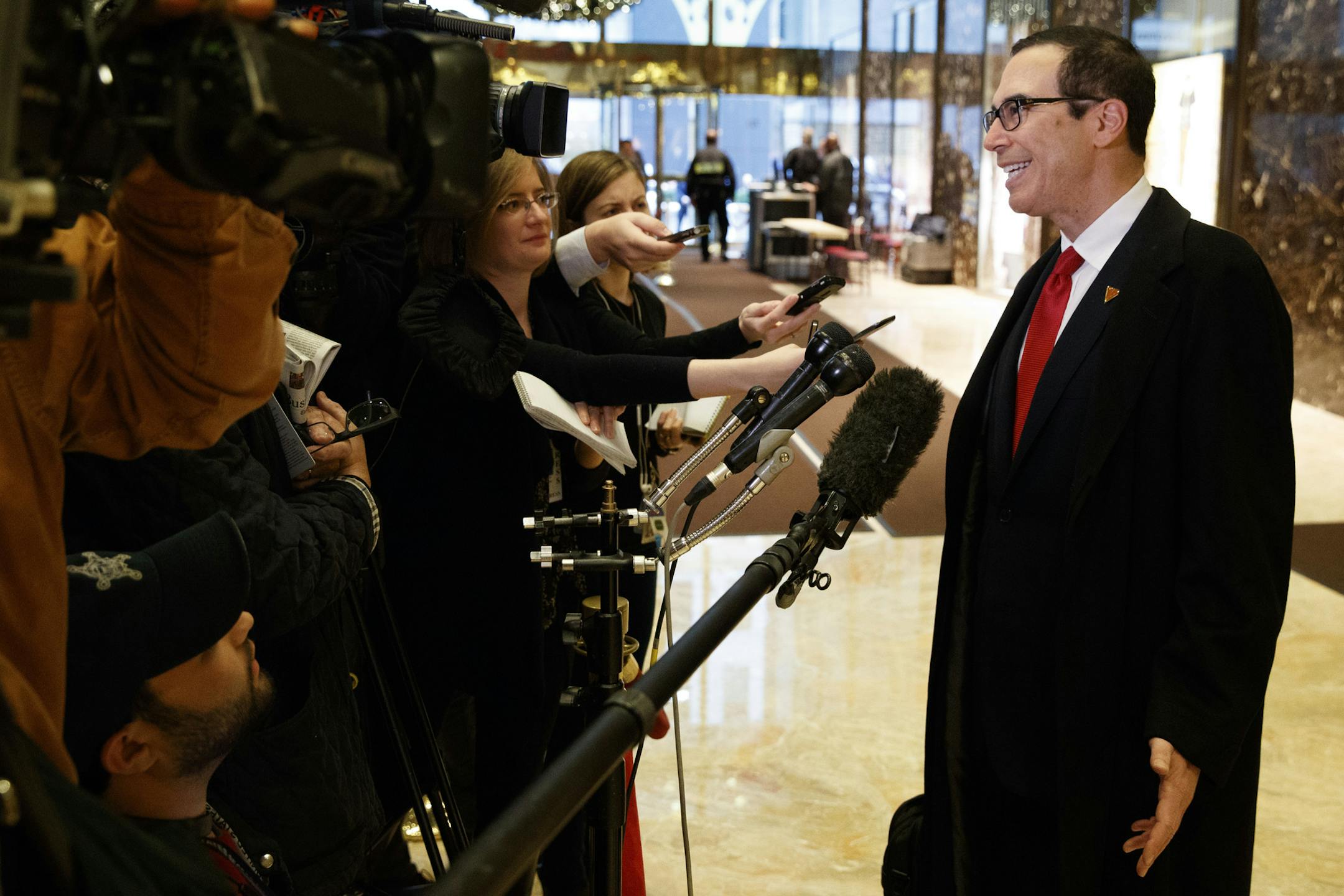
WASHINGTON – Donald Trump's nominee for Treasury secretary said Wednesday that the president-elect's tax plan won't ultimately cut taxes for "the upper class," which would be a major shift from the tax plan he proposed during the campaign.
"Any reductions we have in upper-income taxes will be offset by less deductions so that there will be no absolute tax cut for the upper class," Steven Mnuchin, who served as the Trump campaign's finance chairman, told CNBC.
That departs from Trump's published tax plan on his website, which said as of Wednesday he would "reduce taxes across-the-board," but especially for working and middle-income Americans. Independent economists' studies of Trump's plan during the campaign found that it would benefit high-income taxpayers more than others.
Mnuchin told CNBC that the upper-income gains under Trump's tax plan would be "offset by less deductions that pay for it," but provided little specificity other than to say he'd limit tax breaks in areas such as mortgage interest, one of the most expensive and politically popular tax expenditures in the federal code. He indicated that charitable giving, another expensive tax break, would remain.
"We'll still let you do charities but there'll be other deductions that will be absolutely limited," Mnuchin said. "We'll cap mortgage interest but allow some deductibility."
Trump's transition team didn't immediately respond to a request for more details on how the president-elect would offset the upper-income cuts.
Chuck Marr, the director of federal tax policy at the left-leaning Center on Budget and Policy Priorities, said Mnuchin's remarks were "completely at odds with the tax plan that Trump announced during the campaign." In a blog post, he wrote: "To be sure, the plan that Trump announced would limit itemized deductions for high-income taxpayers (to $100,000 for individuals, $200,000 for joint filers). The value of the tax cuts that would disproportionately benefit the richest people, however, far outweighs the deduction limit."
During his presidential run, Trump proposed a massive tax cut that, according to an analysis by the nonpartisan Tax Policy Center, would cost $6.2 trillion over 10 years and provide the largest after-tax gains to the top 0.1 percent of earners — a 14.2 percent cut. The conservative Tax Foundation also concluded that the highest earners would receive the largest benefit under Trump's plan.


