

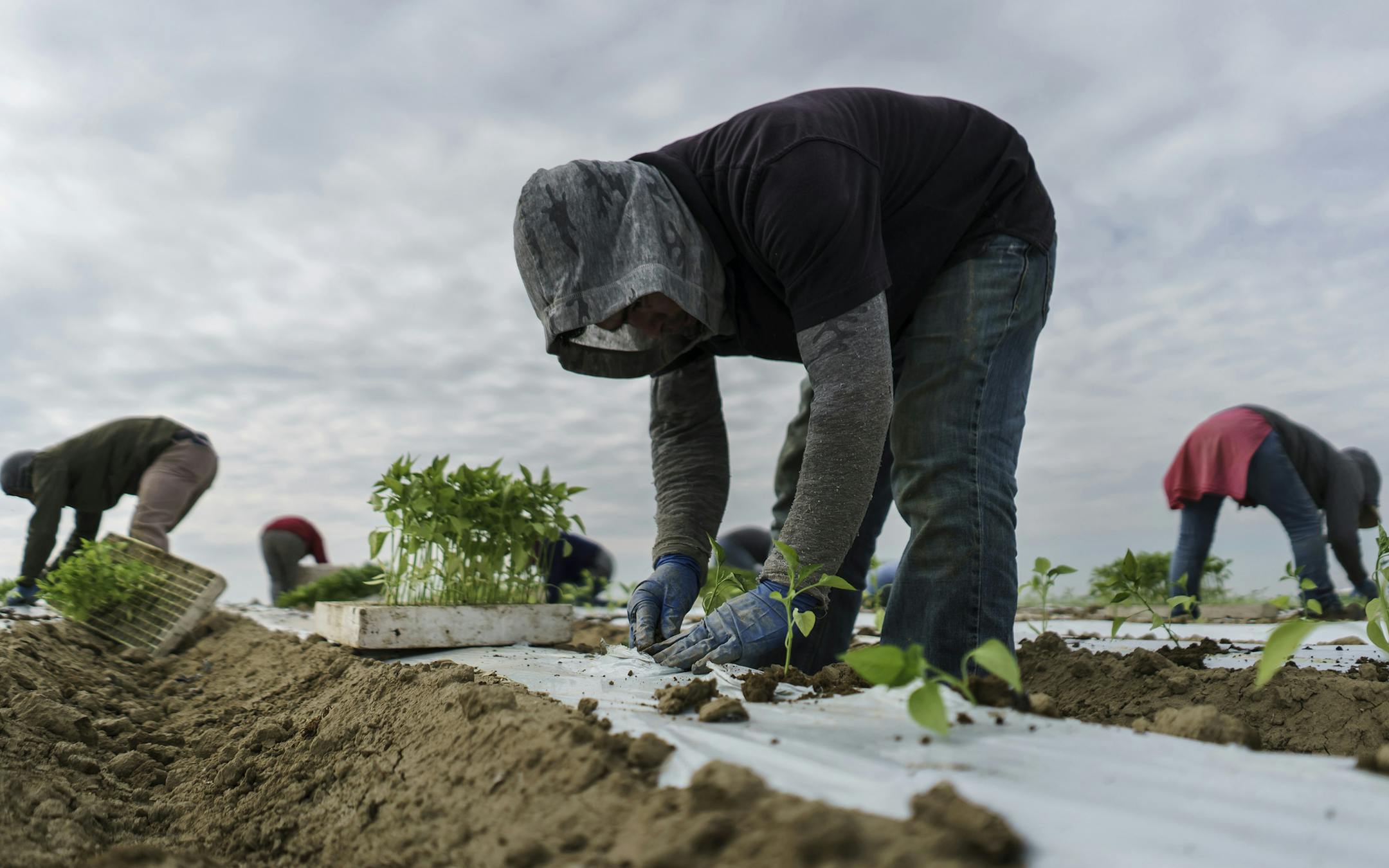
Considerable attention has been paid to the harm American agriculture could suffer from a trade war with China. Little has been said of another threat, at least as great — a threat to the capacity of America's farmers and agribusinesses to hire the workers they need to maintain America's world-class agriculture.
The primary economic effects of the tariff war with China fall on the demand side: Tariffs imposed by China on U.S. exports of soybeans, pork, dairy products, nuts, fruits and vegetables will restrict American farmers' access to one of the world's burgeoning middle-class markets. China is the chief export destination for American soybeans, and soybeans are our top agricultural export worldwide, worth $25.6 billion in 2017, compared with less than half that for No. 2, corn.
In the face of U.S. tariffs, China will seek other suppliers, not just of soybeans, but of all of our agricultural products, including dairy, which were beginning to establish an export footing. In response to U.S. tariffs on aluminum and steel, Mexico also responded in early 2018 with retaliatory tariffs on U.S. dairy products. In a June 26 letter to the White House, U.S. Chamber of Commerce Vice President John G. Murphy described the effect as a "dairy disaster."
Whether President Donald Trump has any true understanding of his rural agricultural base is unclear; he has spent almost none of his life anywhere near it.
The Wall Street Journal's Heather Haddon noted in a July 5 article that Mexico was the No. 1 destination for U.S. cheese exports, accounting for 28 percent of the total in 2017. Over the last decade, the value and volume of cheese exports to Mexico tripled. Today, as a result of the gluts in U.S. domestic production seeking a vent for export, there is more cheese in cold storage than at any time since the U.S. Department of Agriculture began keeping track in 1917. Meanwhile, the result of opportunistic European Union negotiations with Mexico, responding to Trump's protectionist stance, is that European cheese (which confronts similar problems of oversupply) will enter the Mexican market duty-free.
China, for its part, has clearly targeted its tariff retaliation to those congressional districts that most enthusiastically endorsed the trade war rhetoric of the Trump campaign. As reported by Greg Sargent of the Washington Post on July 9, a Brookings Institution analysis of China's retaliation strategy noted that more than two-thirds of the congressional districts affected by China's countermeasures supported Trump in the 2016 presidential election.
While China's actions may seem a rational reaction to hit Trump where is seemingly hurts politically, the Chinese may not understand from a cultural perspective just how reactionary, nonsensical and chaotic the Trump strategy actually is. Because Trump's "strategy" is based on viscera rather than rational calculation, the carefully calibrated Chinese response may have little effect except to encourage further countermeasures.
Indeed, on July 11, Trump announced his intention to increase tariffs on China by another $200 billion, targeted especially to consumer goods, and on Friday he said in a television interview that he's prepared to put tariffs on every import from China.


