

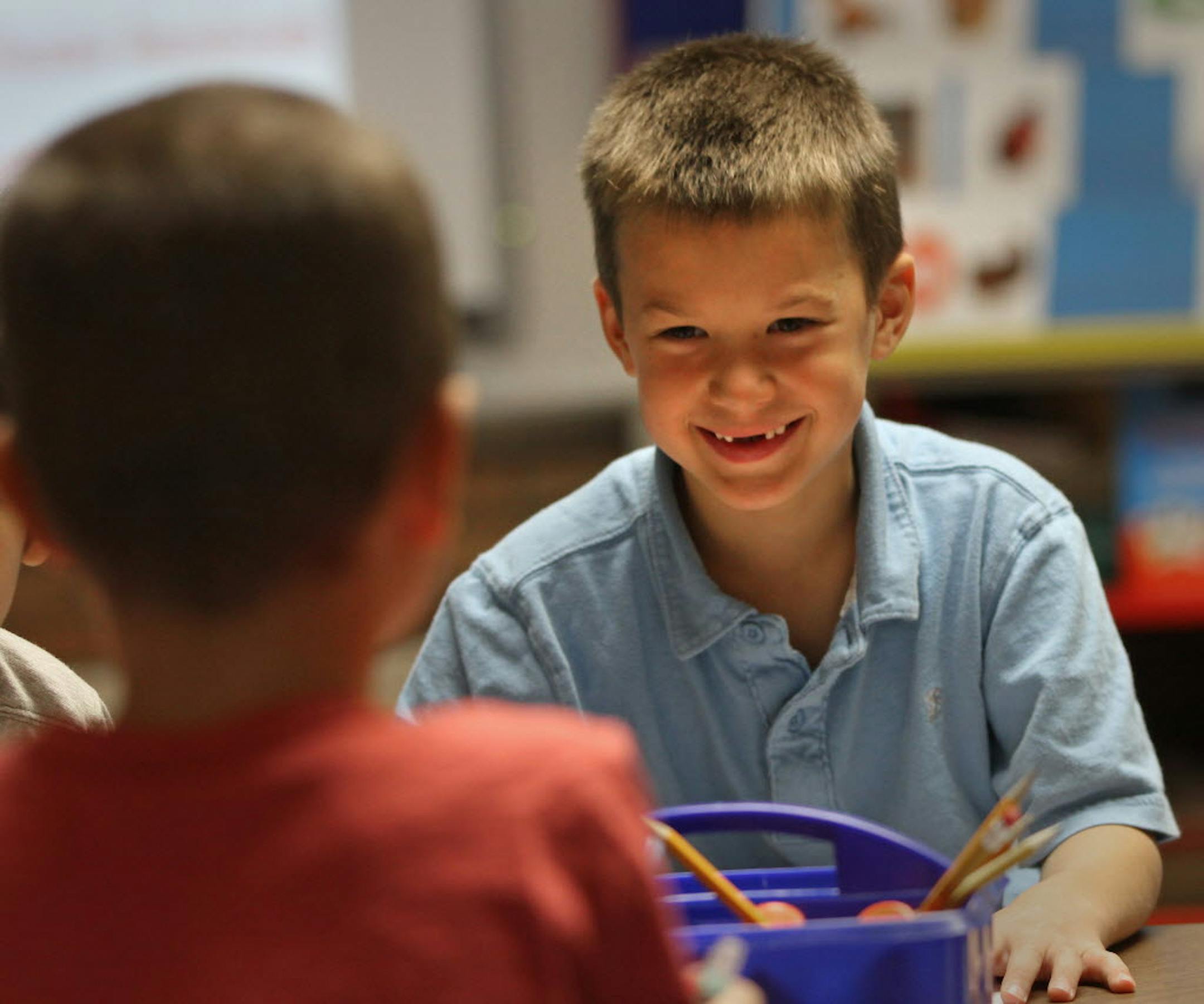
Robby Hoch is energetic, curious and outgoing, much like the other kindergartners at Creek Valley Elementary in Edina. Except for one thing: He’s a year older than most of his classmates. In his mom’s eyes, that’s a good thing.
“We wanted to give him that extra year to mature socially, and to set him up to succeed later in life,” Katy Hoch said of her choice to start her son in school at age 6 instead of 5, because of his late August birthday. “He probably could’ve handled starting at age 5, but when he turns 12, 14, 18 -- and even in college -- it’s going to be an advantage for him to be a year more mature.”
The practice, sometimes called “academic redshirting,” is a term borrowed from college sports where athletes are benched for a year to give them time to develop their skills. In the early 1990s, about 9 percent of U.S. kindergartners were purposefully held back each year, according to the National Center for Education Statistics. Today, the percentage is nearly twice that.
At Grey Cloud Elementary School in Cottage Grove, about 5 percent of the students who are 5 by Sept. 1 choose not to attend. Statewide, the number is closer to 12 percent, putting Minnesota just under the national average.
With schools’ increasing emphasis on academic achievement and society’s growing concern for kids’ emotional needs, more parents like Hoch are considering holding their children back a year until they’re more physically, academically and emotionally ready. But early educators fear too many are adopting that philosophy and for the wrong reasons.
“Parents carry a lot of anxiety about this decision, especially if their child is born in June, July or August,” said Laura Loshek, a former kindergarten teacher and now principal at Grey Cloud Elementary. “If the child ends up struggling, parents feel guilty about sending them. They always wonder if they did the right thing.”
Conflicting research
At Breck, a private school in Golden Valley, roughly 23 percent of kindergartners will turn 6 by the end of October.


