

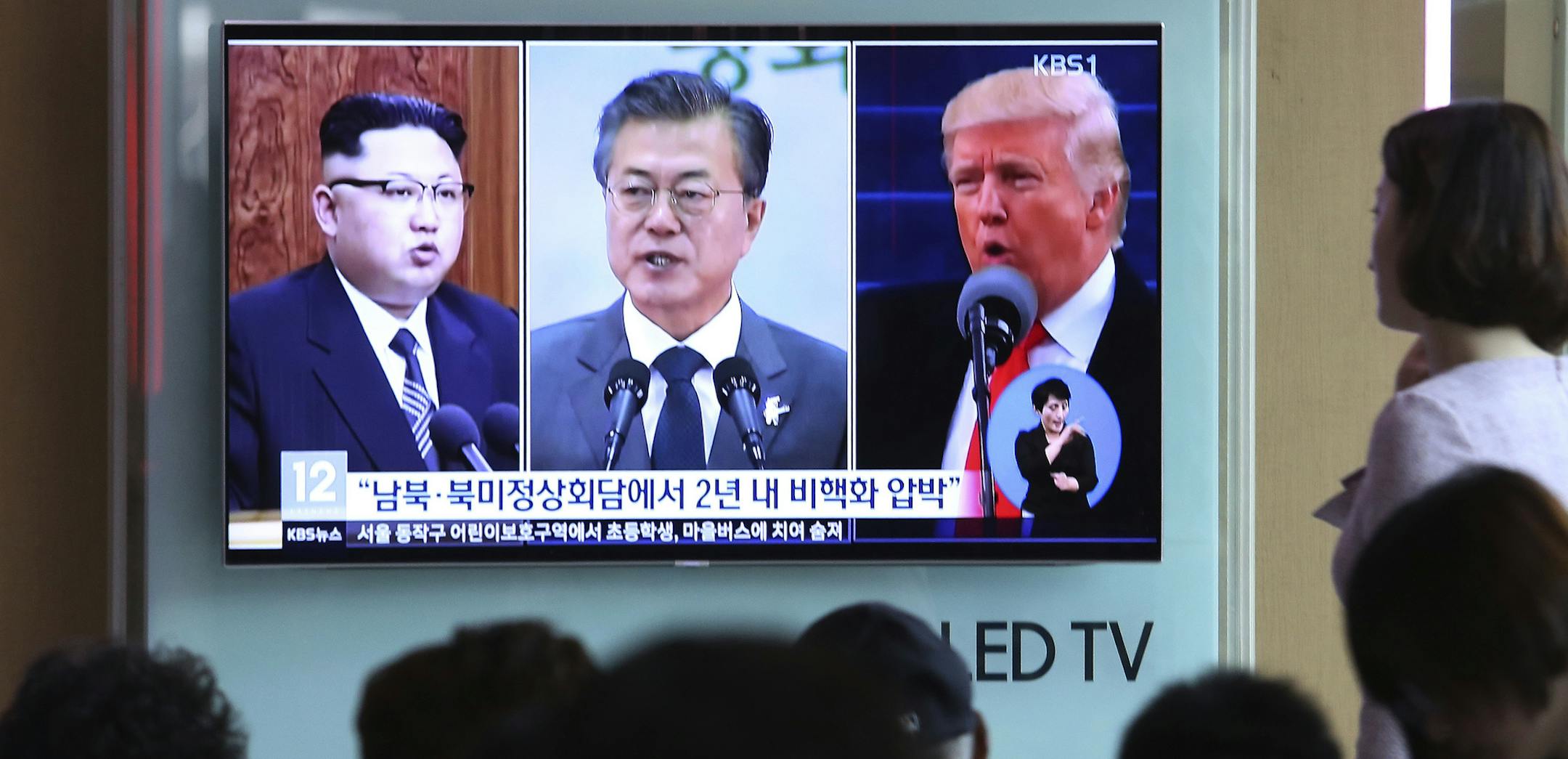
North Korean leader Kim Jong Un's recent pronouncement that his nation need no longer test nuclear weapons or long-range missiles and that North Korea would close a nuclear test site was, as President Donald Trump tweeted, "very good news for North Korea and the World."
But it may not, at least yet, reflect the "big progress" promised in the rest of Trump's tweet.
That's because there's no immediate indication that North Korea has any intent to abide by the administration's objective of denuclearization — which means "they get rid of their nukes. Very simple," Trump said on Tuesday.
Of course it's not that simple, and in fact Kim may be trying to pre-empt the president and cement his nation's status as a nuclear power before he eventually meets with Trump in late May or early June and before an equally consequential summit with South Korean President Moon Jae-in set to start Friday.
And even if an accord can be reached, verification has proved problematic for past deals, allowing the North to cheat into weapons development.
"The North Korean regime has a long history of doing some dramatic pronouncements; they also have a long history of not fulfilling them," Sherry Gray, director of international programs at the Humphrey School of Public Affairs, told an editorial writer. "So whether this is a bargaining tool or whether they actually mean it is hard to say."
The opaque nature of Kim's intent may be more clear after the inter-Korean summit. Several issues could be on the table, including the fundamental question of finally ending the Korean War with a peace treaty to replace the existing armistice.
Moon had previously been in favor of greater engagement with North Korea. But Kim made that diplomatically and politically impossible until recently by conducting multiple missile and nuclear weapons tests and by deploying bellicose rhetoric that rattled not just Seoul but Tokyo, Washington and even Pyongyang's patrons in Beijing.


