

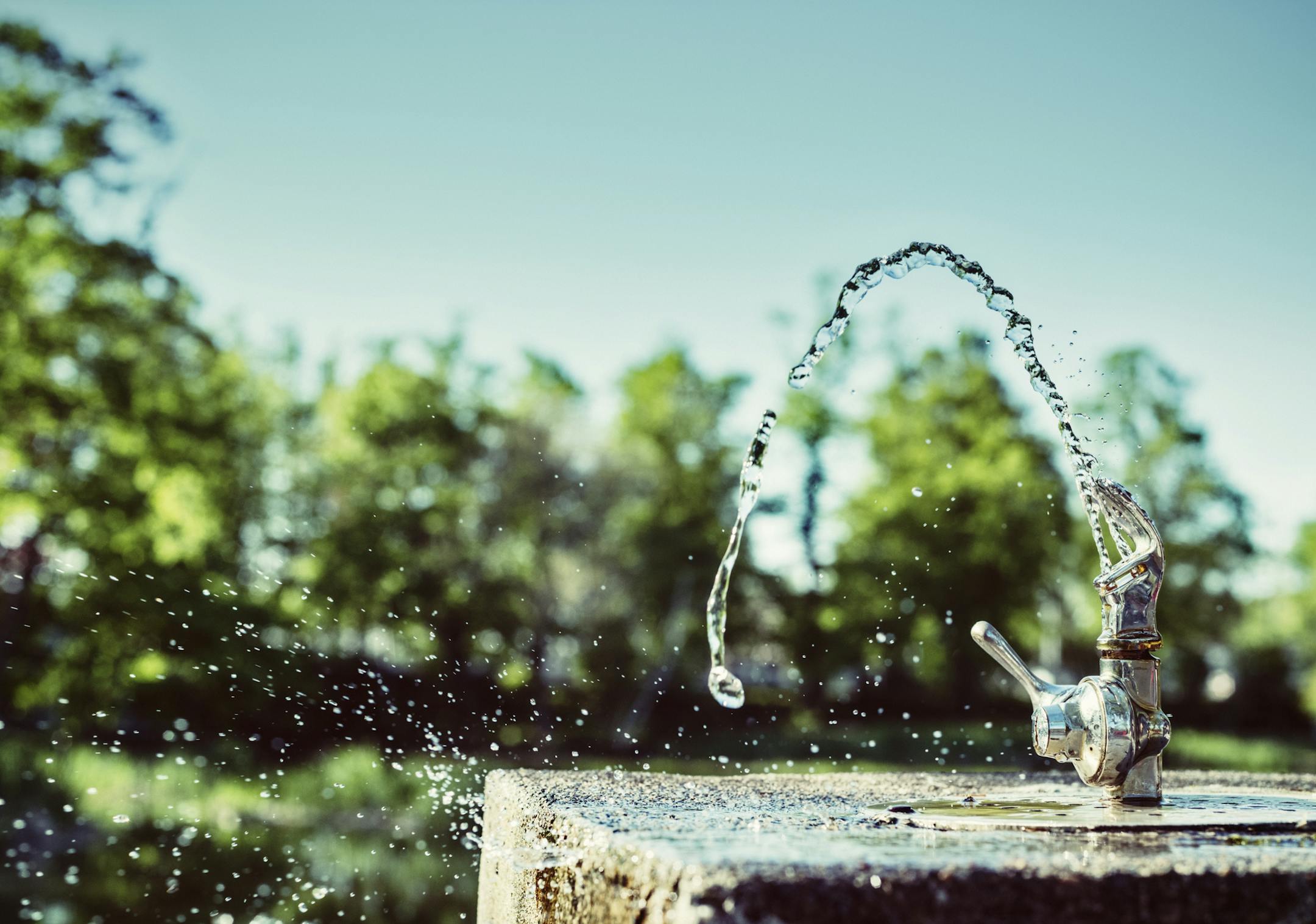
One sultry day in 2012, a handful of New Yorkers laid out a rich red carpet in Union Square Park. As a jazz band grooved in the background, vested and begloved hosts led guests to the star attraction: a drinking fountain. The event, called "Respect the Fountain," was staged by a group with an unlikely mission — to make water fountains cool again.
Fountains were once a revered feature of urban life, a celebration of the tremendous technological and political capital it takes to provide clean drinking water to a community. Today, they're in crisis. Though no one tracks the number of public fountains nationally, researchers say they're fading from America's parks, schools and stadiums.
"Water fountains have been disappearing from public spaces throughout the country over the last few decades," lamented Nancy Stoner, an administrator in the Environmental Protection Agency's water office. Water scholar Peter Gleickwrites that they've become "an anachronism, or even a liability." Jim Salzman, author of "Drinking Water: A History," says they're "going the way of pay phones."
Even the International Plumbing Code, followed by builders in most American cities, has signaled that the fountain is out of style. In the 2015 edition of the manual, which lays out recommendations on matters such as the number of bathrooms an office should have and how pipes should work, authors slashed the number of required fountains for each building by half.
This loss isn't a result of some major technological disruption. While U.S. consumption of bottled water quadrupled between 1993 and 2012 (reaching 9.67 billion gallons annually), that's more a symptom than a cause. What's changed in the past two decades is our attitude toward public space, government and water itself. "Most people over the age of 40 have really positive stories of drinking fountains as kids," says Scott Francisco, who helped organize the Union Square event with Pilot Projects, an urban design company. The sense today, though, is that "they're dangerous, they're not maintained and they're dirty."
In short, we don't trust public fountains anymore. And it's making us poorer, less healthy and less green.
The modern era's first free public water fountain was unveiled in London in 1859. Thousands gathered to watch officials turn on the tap. At its peak, about 7,000 people used the fountain each day. At that time, the rich were buying water brought in from the country. The poor were drinking water bottled from the sewage-infested Thames. Water-borne diseases such as cholera and typhoid were rampant.
The fountain changed all that by making clean water accessible for free. By 1879, London had 800 fountains. American cities followed suit. In 1859, New York debuted a fountain at City Hall Park. Detroit, Philadelphia and San Francisco soon built their own. By 1920, most municipalities were providing free, chlorinated water. The public health benefits were obvious. Half of the decline in urban deaths between 1900 and 1940 can be attributed to improvements in water quality, according to the National Bureau of Economic Research.


