

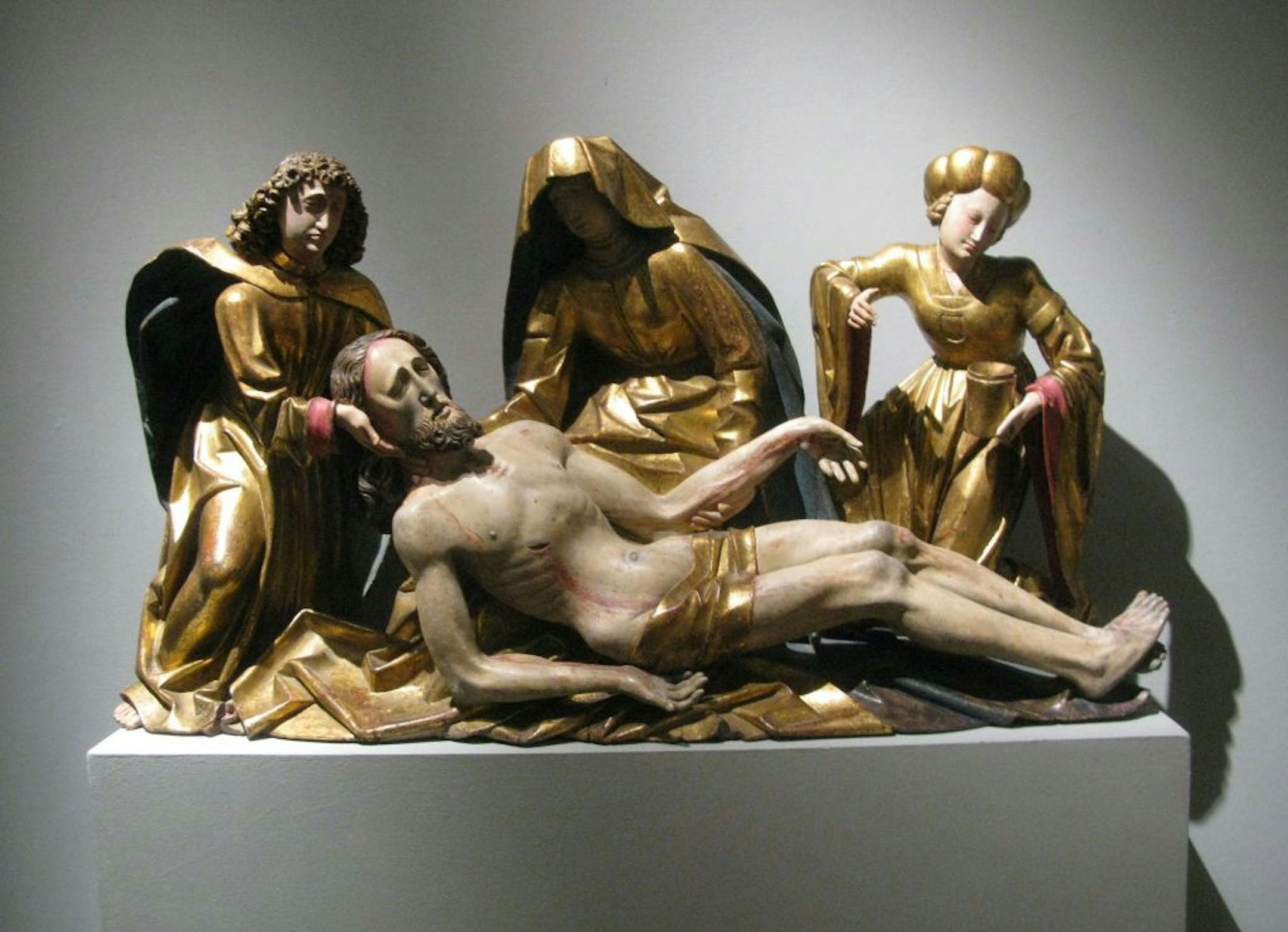
Hovering over the wounded body of their god-in-human-form, three medieval figures give silent testimony to their grief in a sculpture acquired last week by the Minneapolis Institute of Arts. Known as "The Lamentation of Christ," the 4-foot-wide sculpture was carved from pine and painted about 1490 by an Austrian artist, Hans Schnatterpeck.
Brows furrowed in sympathetic pain and sorrow, John the Evangelist, Mary the mother, and Mary Magdalene gaze at Jesus' gaunt and graying face, hold his head, reach out to cradle him. Their taut faces and pinched lips suggest the stoic reserve of those who have often known death but are not reconciled to its inevitability.
Hence the tears. Sinking gracefully into a half-crouch at Jesus' feet, Mary Magdalene has the delicate poise of a ballerina who is simultaneously reaching down and pulling away, her ambivalence driven by the tremulous sorrow that shimmers in her reddened eyes and falls in a single tear. Half hooded by a flowing cape, the eyes of Mary the mother are red-rimmed too, as are those of the disciple who gently supports Jesus' head.
Finding a visual language for grief
Now known only to connoisseurs, Schnatterpeck (1472-1510) was a master carver from the Tyrolean mountains, where artisans of the era had achieved a rare delicacy and expressiveness in an otherwise pedestrian medium.
"Finding a new [visual] language for the expression of grief was one of the great accomplishments of these northern European artists," said Eike Schmidt, the museum's sculpture curator, who spied the piece at an international art fair in the Netherlands this spring and persuaded the institution's trustees to purchase it for an undisclosed sum.
Emotions were very stylized in most European sculpture before about 1500, Schmidt said. Figures would be depicted making rhetorical gestures that signified emotional states -- hands clasped before the chest or fingers touching a cheek would mean sorrow even while the faces retained a masklike calm. Schnatterpeck's more famous contemporaries, including marble-worker Michelangelo in Italy and wood carver Tilman Riemenschneider in Germany, introduced an expressive new naturalism in gesture, posture and poses. In "Lamentation," Schnatterpeck also nicely deployed the painted tear, a device invented earlier in the century by the Flemish artist Rogier van der Weyden.
Following Tyrolean fashion of the time, Schnatterpeck painted and gilded the "Lamentation" figures. The pale flesh and stained eyes of the living contrast with Christ's pallor and bloody wounds. His brutalization is further dramatized by a swollen lump of flesh above the nail hole in his foot, a grisly reminder of how his body would have slumped on the cross. That unflinching and somewhat ghoulish naturalism, coupled with the figures' agitated drapery, heightens the psychological and spiritual impact of the piece.


