
Tesla's shift to online sales could lead to the end of your friendly local car dealer

Some dealers are spending more on service operations, where profits are higher anyway.

Chicago Tribune
March 20, 2019 at 12:14AM
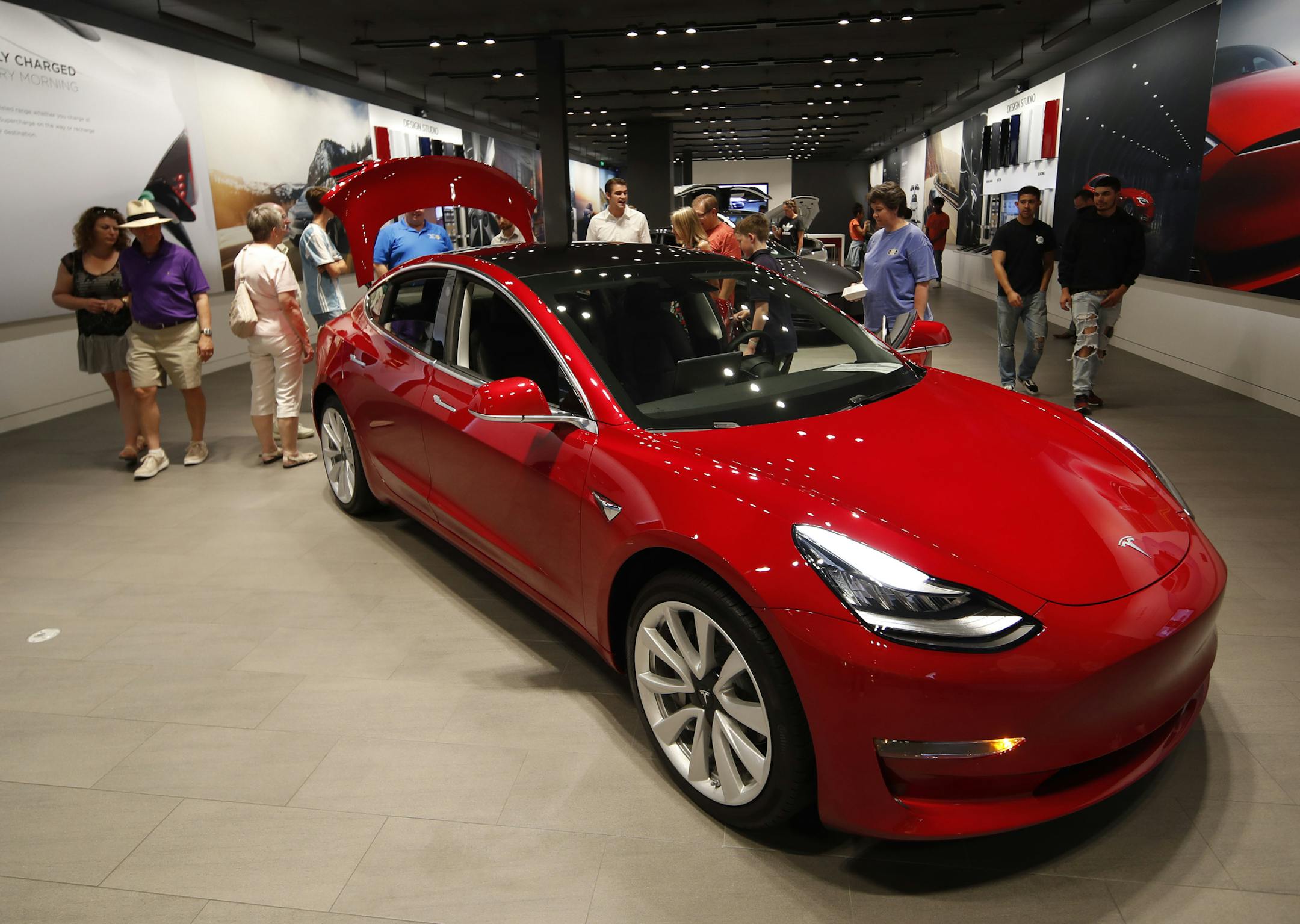
FILE- In this July 6, 2018, file photo, prospective customers confer with sales associates as a Model 3 sits on display in a Tesla showroom in the Cherry Creek Mall in Denver. Tesla is suffering one of its worst sell-offs of the year after announcing it would begin closing all of its stores in favor of selling its electric cars exclusively online. The goal is to allow Tesla to lower the price of its Model 3, the vehicle that CEO Elon Musk envisions as the company’s first mass-market vehic
Customers admired a Model 3 at a Tesla showroom in Denver in July. Tesla has closed 10 percent of its showrooms and is moving most of its sales online. (The Minnesota Star Tribune)

DOWNERS GROVE, Ill. – Packey Webb Ford, a 57-year-old car dealer with an old-school jingle, has bet more than $20 million on what it hopes will be the dealership of the future.

With car shopping migrating online and dealerships looking like the next brick-and-mortar retailer poised to fall, Packey Webb built a gleaming 54,000-square-foot facility on the 10-acre site of a former junkyard in the southwest suburb of Chicago.

Opened in late 2017, the dealership features the usual floor-to-ceiling windows with panoramic views — and a surprisingly small showroom.

The service area, however, is a different story. "You could land an airplane in here," said Webb Ford sales manager Kevin Schmieder, gesturing to the 32 bays lined up to accommodate what has become the dealership's undisputed profit center.

"If there are no dealers, you're still going to have to have these cars serviced somewhere," said John Webb, 52, a partner in the dealership started by his father, Patrick "Packey" Webb. "That's where the future is going to be."

Webb Ford has already outlasted many of Chicago's plaid-jacketed pitchmen from a bygone era, legends such as Harry Schmerler, "Your Singing Ford Dealer," and Celozzi-Ettleson, "Where You Always Save More Money."

But surviving in the digital age will take more than a good slogan.

When Tesla recently announced it was shifting all sales online and winding down its stores, the electric vehicle manufacturer sent shock waves through the auto industry, signaling perhaps the beginning of the end for your friendly local car dealer.

No more low-budget TV commercials, no more kicking the tires, no more giant inflatable tube men beckoning from lots with unbeatable deals. Touting cost savings and consumer preference, Tesla closed 10 percent of its 100-plus stores before putting the brakes on additional downsizing.

Last year, four out of five buyers who ordered the Model 3 — Tesla's lowest-priced car — bought it online, without taking a test drive, the company said. "Customers are becoming increasingly comfortable making purchases online, and that is especially true for Tesla," CEO Elon Musk said in a Feb. 28 e-mail to employees.

While Tesla may be ahead of the curve, the bold move online has fueled broader industry speculation that auto dealers could soon join the growing list of traditional retailers — from booksellers to mattress stores — vanquished by a mouse click.

"Don't count on it," said Michelle Krebs, a Detroit-based analyst for Autotrader. "I don't see everybody going to online car sales tomorrow."

The entrenched interests of the nearly 17,000 new-car dealers across the U.S., whose $1 trillion in annual sales are protected by state laws and franchise deals with manufacturers, will no doubt be hard to bypass.

In Illinois, 713 new-car dealers generated $38.3 billion in sales in 2017, according to the National Automobile Dealers Association.

Dealerships, whose ranks have been declining in recent years, are defending their turf against Tesla's move online, with the Illinois Automobile Dealers Association among several state trade groups considering legal action to challenge whether manufacturers can sell direct to consumers, said its president, Pete Sander.

Even before Tesla's recent announcement, car dealers have waged a pitched battle in statehouses across the nation — with some success — to prevent Tesla from bypassing franchise laws and selling directly to consumers. But with much of the car-buying process already merging onto the information superhighway, Sander acknowledged dealerships will need to adapt to survive.

"I don't think we'll ever be able to stop online sales," Sander said.

Armed with smartphone apps, more buyers research, select, price and even locate their cars online before setting foot in a showroom, reducing both sales margins on new cars and time spent at the dealership.

In 2017, franchised dealers sold a near-record 17.1 million new vehicles, but the shrinking margins accounted for only about a fourth of gross profit, said the National Automobile Dealers Association. Meanwhile, the smaller service and parts business brought in nearly half of dealership profits.

"The economics of the dealerships are becoming more and more difficult," Krebs said. "One of the reasons dealers are beefing up service is because there's not a lot of money in new-car sales."

The shift to online is taking place in the used-car market as well. Carvana, a publicly traded Phoenix-based company founded in 2012, allows customers to browse, finance and buy used vehicles using a mobile app, with next-day delivery in more than 100 markets, including Chicago. In lieu of a test drive, buyers have seven days to return the cars, a policy adopted by Tesla when it announced its online sales transformation last month.

Appearing on CNBC recently, Carvana CEO Ernie Garcia said returns happen less than 10 percent of the time, costing the company a couple of hundred dollars — far less than the fixed costs of running a dealership to give customers a test drive. "We think it's a pretty good trade," Garcia said.

Other automakers have toyed with online sales of new cars, including Ford, which launched a program last year allowing consumers to do everything but close the deal before picking up their car at a dealership.

A Ford spokesman did not respond to a request for comment on the program, but Webb said his dealership has not received a single order to date.

No matter how much of the car-shopping experience eventually moves online, Webb remains skeptical customers could ever become comfortable with a web-only purchase.

"I still think they want to drive it, smell it, kick the tires at least once before they take delivery," Webb said.

And in any case, with his eight-figure bet on the future, Webb is already adapting. "I don't see the dealerships going away. You might not need as many showrooms, but you're still going to need service centers."

about the writer

about the writer

Robert Channick

More from Business

See More
Ten skids of loose peanut butter crackers wait to go to the land fill Saturday Feb. 7, 2009 as Gleaners Food Bank destroys products containing peanut butter as part of the nation wide recall of foods containing Salmonella tainted products from Peanut Corp. of America . (AP Photo/The Indianapolis Star,Michelle Pemberton)
The Minnesota Star Tribune

Gold Star Distribution, which supplies several Halal markets in the Twin Cities, is voluntarily recalling a list of food and merchandise products stretching 44 pages and including products from candy to medicine.

card image
card image