

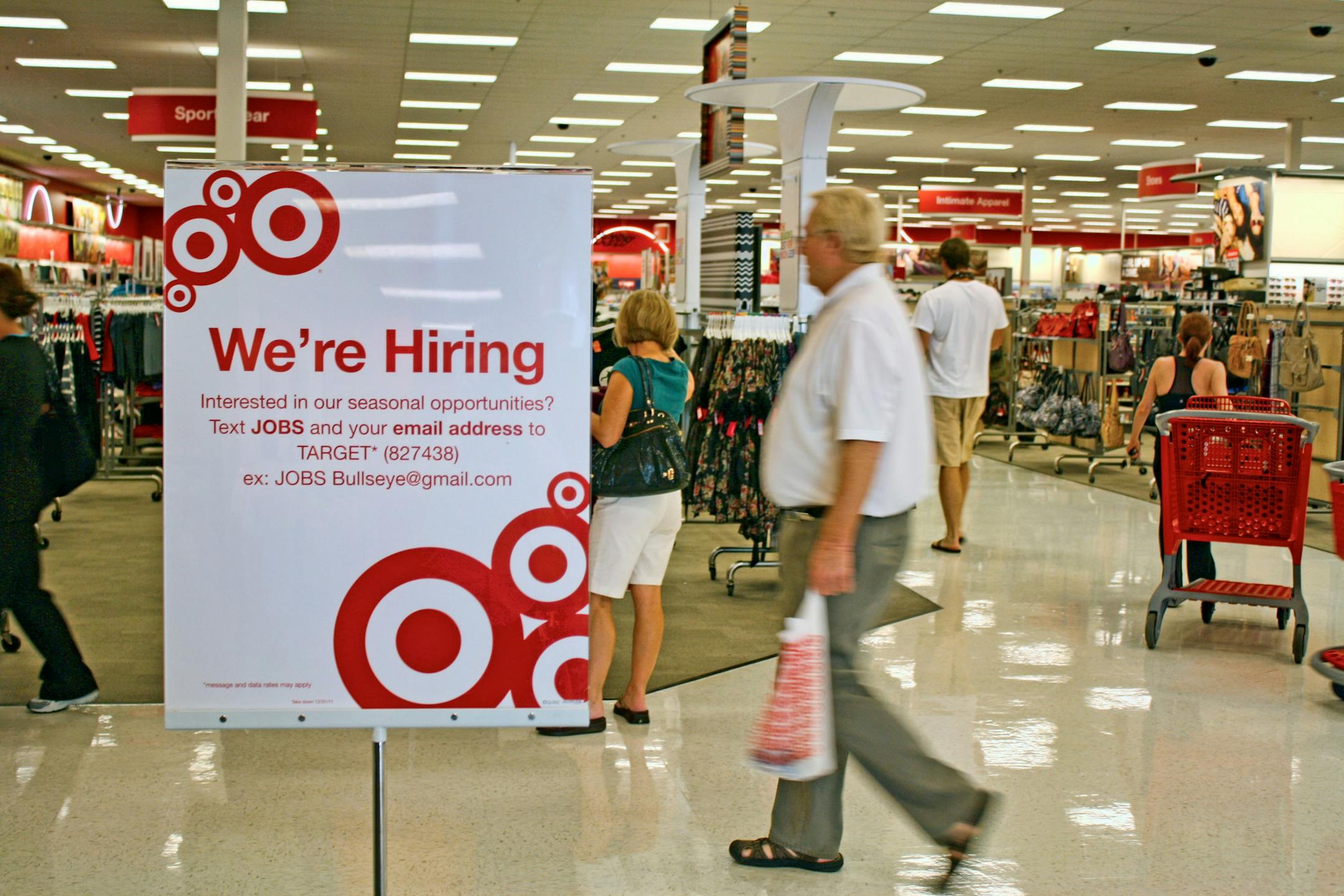
Target Corp. carefully planned its early Monday announcement about a new $11 per hour minimum wage to get attention. The plan worked.
Some of the many headlines put the news of Target's plan to go to $15 per hour by the end of 2020 squarely in the context of political pressure from a five-year-old "Fight for 15" campaign demanding a federal $15 per hour minimum wage. Sophisticated reports reflected the reality: Target is boosting minimum wages in a "battle for store workers" and "to counter Walmart."
Even Target's stated goal of paying the $15 per hour that advocates have demanded as a minimum for everybody should be seen only as an aggressive flanking maneuver in that battle for workers.
For a sense of the competitive heat for workers locally, just talk to a few local employers. They can't imagine how Target gets attention for starting people at $11 per hour. It's far too late in a tight labor market for just $11 an hour to be news.
Target has stores all over and not just Minnesota, of course, but here in the Twin Cities $11 per hour hasn't been enough for a while, even for jobs that don't seem to require much by way of formal training or experience.
No-experience-necessary jobs doing light assembly or packaging in distribution centers in the greater Minneapolis-St. Paul area seem to start at no less than $12 per hour. Based on a quick scan of local job boards, there's an entry-level packaging job in Rosemount beginning at $13 per hour. There's a warehouse job in Chanhassen starting at $14 an hour, so long as candidates can learn to operate a pallet jack.
Nobody in business at this point can be surprised by a tight labor market, not with a U.S. job market expansion that has been setting records for its long duration. The 500 companies in the S&P 500 now employ about 25 percent more people in the United States than the S&P 500 did in early 2009, and smaller companies have grown their U.S. payrolls even more. Meanwhile, the U.S. Department of Labor reported this summer that there have never been more job openings.
American workers seem to know that, too. In its latest update on the American workplace, the research organization Gallup found that more than half of American workers are now looking for a new job or closely watching for openings.


