

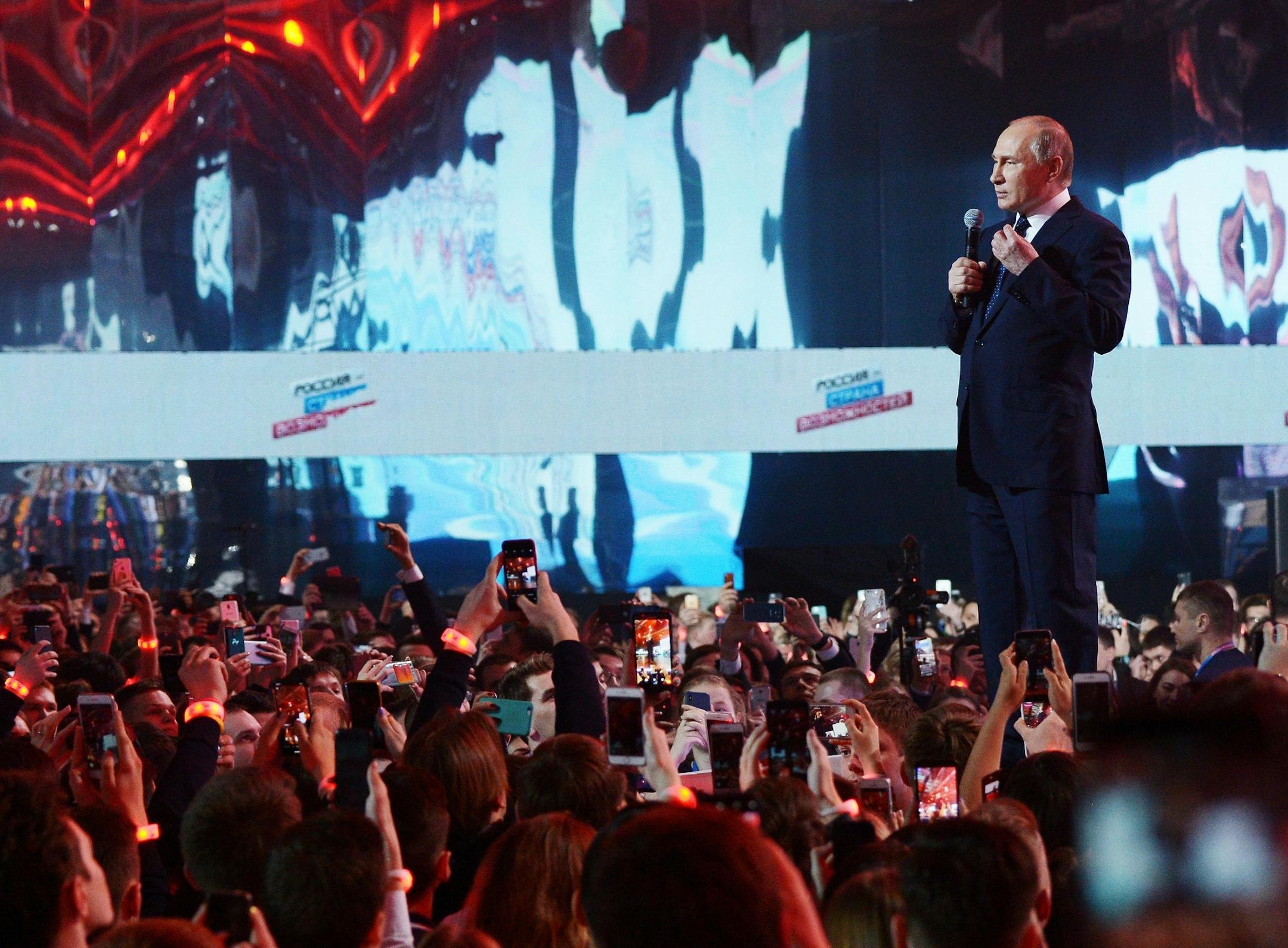
With days to go before Russia's presidential election, Vladimir Putin has barely campaigned for a victory that's all but assured.
Even in Crimea, the peninsula he seized to the joy of many Russians, Putin spent only a few minutes at a rally this week to thank supporters who waited hours to see him.
Amid widespread public apathy about the outcome and discontent over stagnating living standards, the Kremlin's only challenge is to ensure that turnout for Sunday's vote is sufficiently high to give Putin's record fourth term a stamp of legitimacy. Regional officials are resorting to inducements ranging from free food to prize contests to lure voters to the polls as Putin extends his rule to 2024. The election is "an imitation," said Grigory Yavlinsky, one of seven candidates running against Putin. "It's like a referendum, as Putin's main goal is to stay in power forever."
Eighteen years after he was first elected president, Putin is already the Kremlin's longest-serving leader since Soviet dictator Josef Stalin. He'll face a host of challenges in his new six-year term, as spiraling confrontation with the U.K. over an alleged nerve-agent attack adds to tensions with the U.S. and Europe over conflicts in Ukraine and Syria. Russia's economic recovery is sputtering after the worst recession this century. In what's likely his last term, Putin, 65, must also groom a trustworthy successor.
His motley collection of challengers includes Communist candidate Pavel Grudinin, a farm boss who's defended Stalin's bloody purges; ultranationalist Vladimir Zhirinovsky, who's been trounced in past contests; and Boris Titov, who attracted ridicule for running against Putin while serving as the Kremlin's business ombudsman.
There's also former reality-TV star Ksenia Sobchak, who's run a campaign critical of Putin while laboring under accusations from opposition leader Alexey Navalny that the Kremlin encouraged her candidacy to add sparkle to the lackluster contest. Navalny was barred from running.
"It's a very strange campaign because Putin sees the election as a harmful thing that distracts him from his real task" of running the country, said Tatiana Stanovaya, an independent political analyst. "He's not interested in what voters care about."
Struggling with a cold for much of the campaign, Putin attended few election events and, as in previous contests, dodged televised debates with his opponents. Meanwhile, state broadcasters lavished coverage on presidential visits to Russia's regions.


