

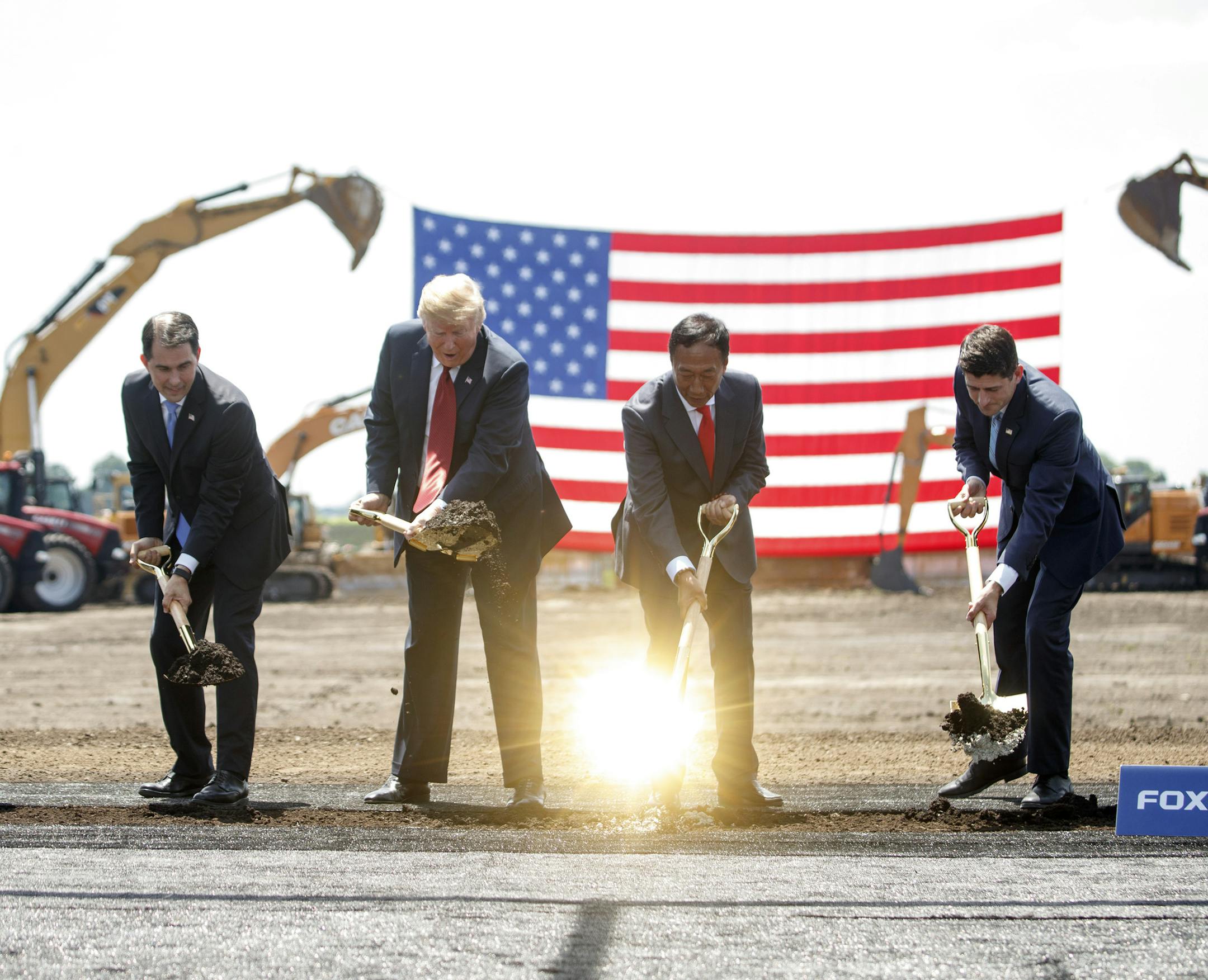
Last June, President Donald Trump, then-House Speaker Paul Ryan and then-Wisconsin Gov. Scott Walker grabbed golden shovels at the Wisconsin groundbreaking for Taiwanese electronics maker Foxconn. In retrospect, it appears that the politicians were digging a hole for themselves — and for Foxconn.
It was a familiar scene in an era when state and local governments heap as much as $80 billion a year in subsidies on companies in the name of jobs, jobs, jobs. Markets don't decide where big companies expand and hire. Politicians do. Or at least they try, as they race toward the cameras with taxpayer money in hand.
Central planning, once a slur linked to the failures of the crumbling Soviet Union and the stumbling Warsaw Pact, these days goes by the beguiling label "economic development." Fairer tax bills for all, a better education for all and displaced worker aid for all? Boring. Let's pick winners. Let's have flashy artist renderings of sprawling industrial structures that taxpayers soon will see, touch and, in some cases, smell.
"America is open for business more than it has ever been open for business," Trump crowed at the Foxconn ceremony. "I want to wish you good luck, and congratulations on this — the eighth wonder of the world."
Foxconn promised a $10 billion factory, employing 13,000 mostly blue-collar workers making TV flat panels in southwestern Wisconsin — all with the aid of about $4 billion in tax breaks over 15 years. It would be a stunning, remarkable reversal of decades of U.S. TV manufacturing moving offshore.
Yeah, good luck with that is right. But maybe the congratulations were a bit premature.
In January, Foxconn reminded everyone why no one has made televisions with American-made parts since Zenith folded up shop in 1995, becoming a South Korean-owned electronics research and development company. The eighth wonder of the world became a now-you-see-it-now-you-don't pipe dream. Or seemed so.
"In terms of TV, we have no place in the U.S.," said Louis Woo, a Foxconn executive who helped broker the subsidy-rich deal in Wisconsin. "If a certain size of display has more supply, whether from China or Japan or Taiwan, we have to change, too."


