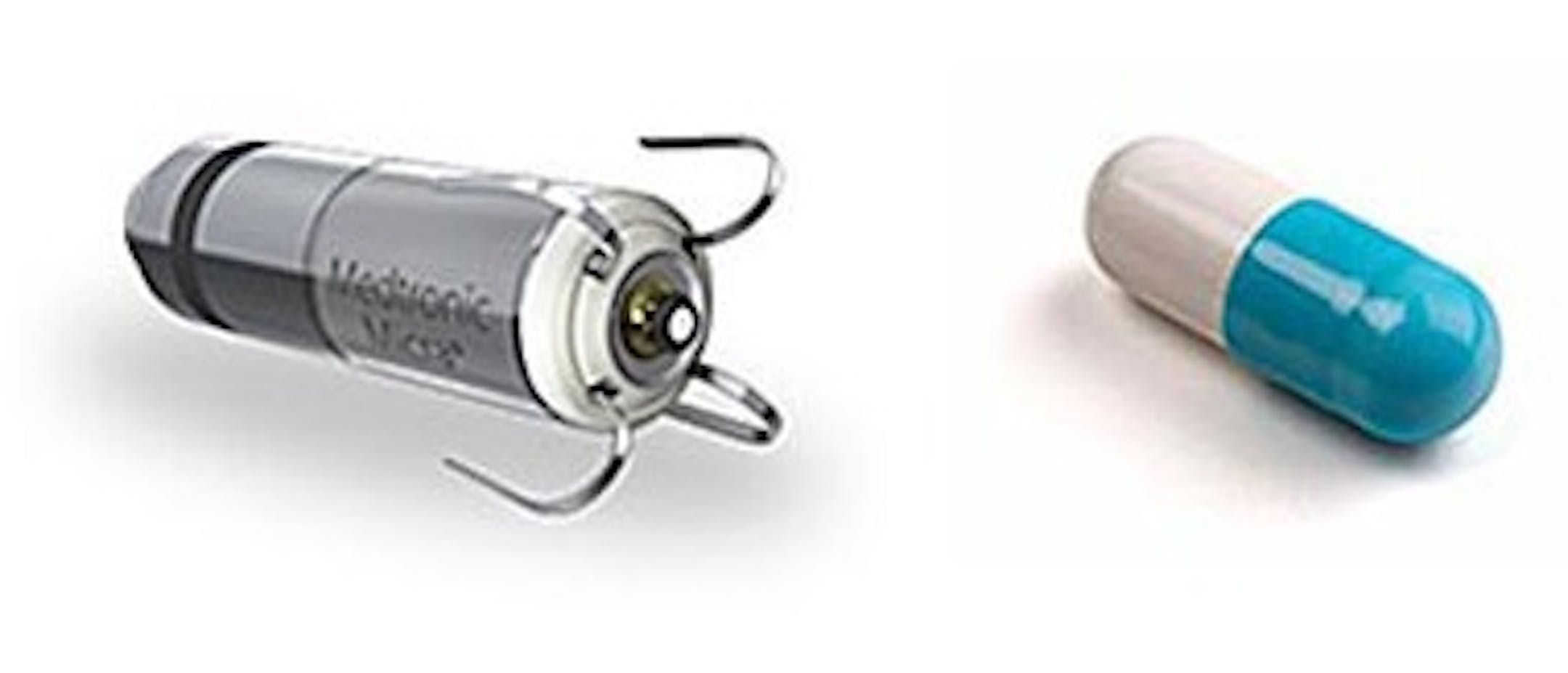
Medtronic says patients using its new battery-sized pacemaker had nearly half the rate of serious complications as people who get larger traditional devices, pointing to study results published Monday in the New England Journal of Medicine.
Minnesota-run Medtronic PLC is trying to get the U.S. Food and Drug Administration to approve its experimental Micra pacemaker, which is so small that it fits entirely in the heart's right ventricle and can be delivered through an incision in the femoral vein. Pacemakers, including a similarly small experimental one made by St. Jude Medical, monitor the heart and send tiny electric shocks if it beats too slowly.
The Medtronic-sponsored study found that 4 percent of the 725 patients who received a Micra pacemaker had serious complications that led to hospitalization and new surgery after six months. The study did not have a control group, but Medtronic estimated the serious complication rate for patients with a traditional pacemaker would have been 7.4 percent in that time.
"We wound up with about 50 percent [fewer] of the complications that traditional systems have," said Dr. Dwight Reynolds, lead author of the NEJM paper and principal investigator of the non-randomized single-arm study, called the Micra Transcatheter Pacing Study.
The Micra weighs 2 grams and is just over an inch long. It was designed by Medtronic staff mainly in Minnesota to fit a $700 million niche for small, single-chamber pacemakers that can be implanted with a catheter, avoiding the need for open surgery. The market size is expected to grow as the device companies figure out how to make the small devices effective for more complex heart-rhythm problems.
St. Jude Medical's experimental device is called the Nanostim, which has not fared as well during the testing phase, though it was approved for commercial use in Europe much earlier. Little Canada-based St. Jude got European approval in 2013; Medtronic did this year.
In September, research sponsored by St. Jude led to a paper published in the NEJM that found Nanostim patients had a 6.7 percent rate of major device-related complications at six months, compared with a 3.2 percent complication rate it estimated for traditional pacemakers, not including incidents of lead-fracture.
"These two studies demonstrate that leadless pacing is feasible and relatively safe, at least in the short term," Boston electrophysiologist Dr. Mark S. Link wrote in an editorial accompanying Monday's Micra study results in the NEJM.