

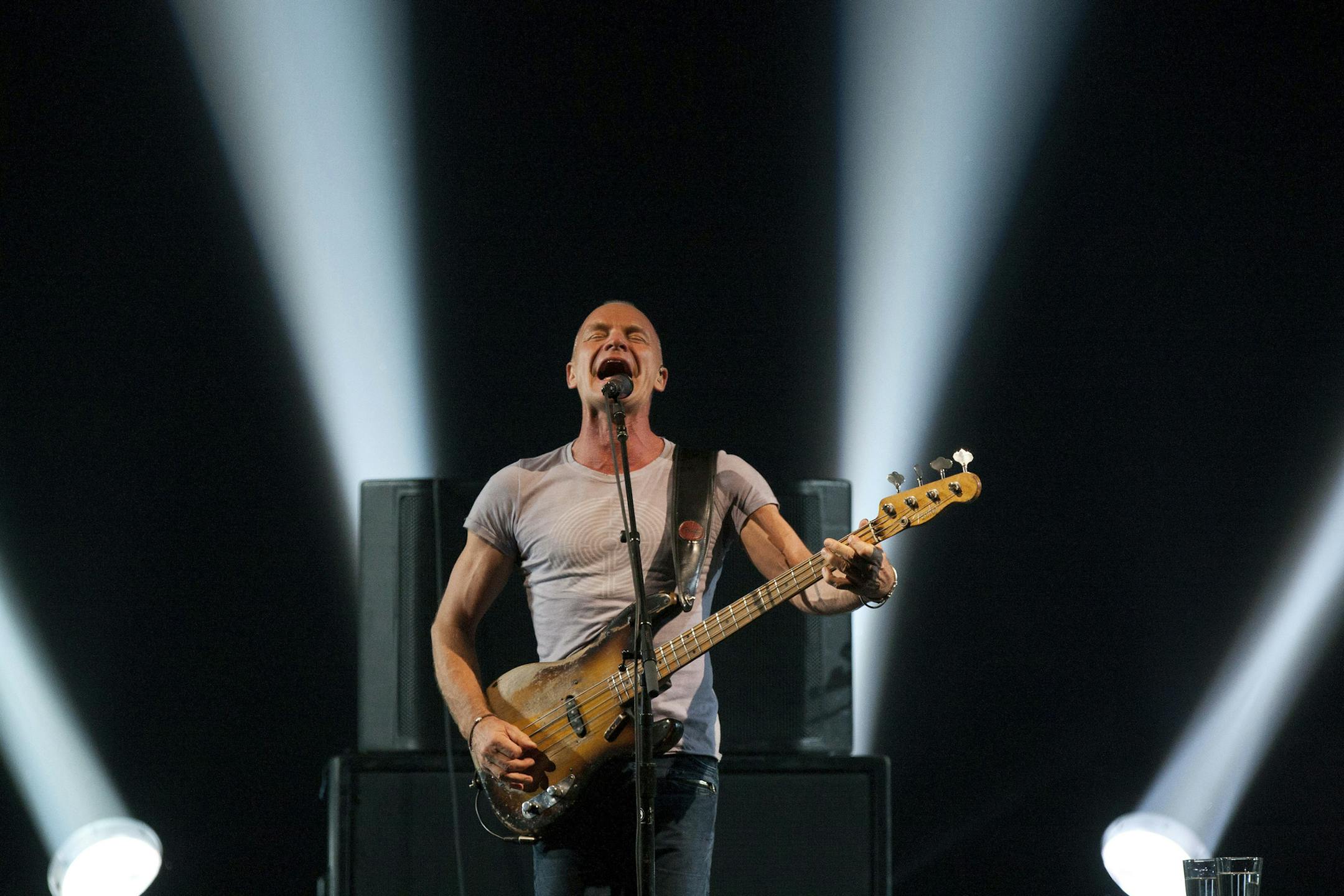
The news that Sting returned to rock last year was not greeted with the same kind of excitement as Garth Brooks returning to concerts, Kevin Garnett rejoining the Timberwolves or Vin Diesel coming back to the "Fast and Furious" franchise.
We knew Sting was a rock star, but we'd forgotten that he made rock music anymore.
For the past dozen years or so, the ever adventurous, ever ambitious artiste followed his muse and made a lute album, recorded symphonic versions of his hits, crafted a Christmas album and created and starred in a Broadway show.
Who can blame him? He's Sting, Renaissance man, practitioner of tantric sex and unofficially the most intellectual man in rock. Oh, he's also the recipient of 17 Grammys, an Emmy, the Polar Music Prize and a Kennedy Center Honor. Queen Elizabeth honored him with Commander of the Most Excellent Order of the British Empire, apparently one step below being Sir Sting or, more properly, Sir Gordon Sumner. On Sunday, he was a finalist for an Oscar for best original song for the fourth time.
Last November, Sting released "57th & 9th," his first collection of rock and pop songs since 2003. The title doesn't mean anything to anyone, even someone who lives in New York City. It's just an intersection Sting crossed daily on his way to a Manhattan recording studio.
What should "57th & 9th" mean to Sting fans?
There's some genuine rocking on "Petrol Head" and echoes of the Police on the opening track "I Can't Stop Thinking About You." "If You Can't Love Me" evokes the thoughtful jazz-rock of Sting's early solo career. There's some well-crafted balladry, including the Tom Waits-like "The Empty Chair," an ode to a journalist killed by the Islamic State in Iraq and the Levant.
Of course, there's political commentary. He's Sting, king of causes. The Middle Eastern-tinged "Inshallah" talks about the refugee crisis, and the sunny-sounding "One Fine Day" addresses the climate crisis.


