

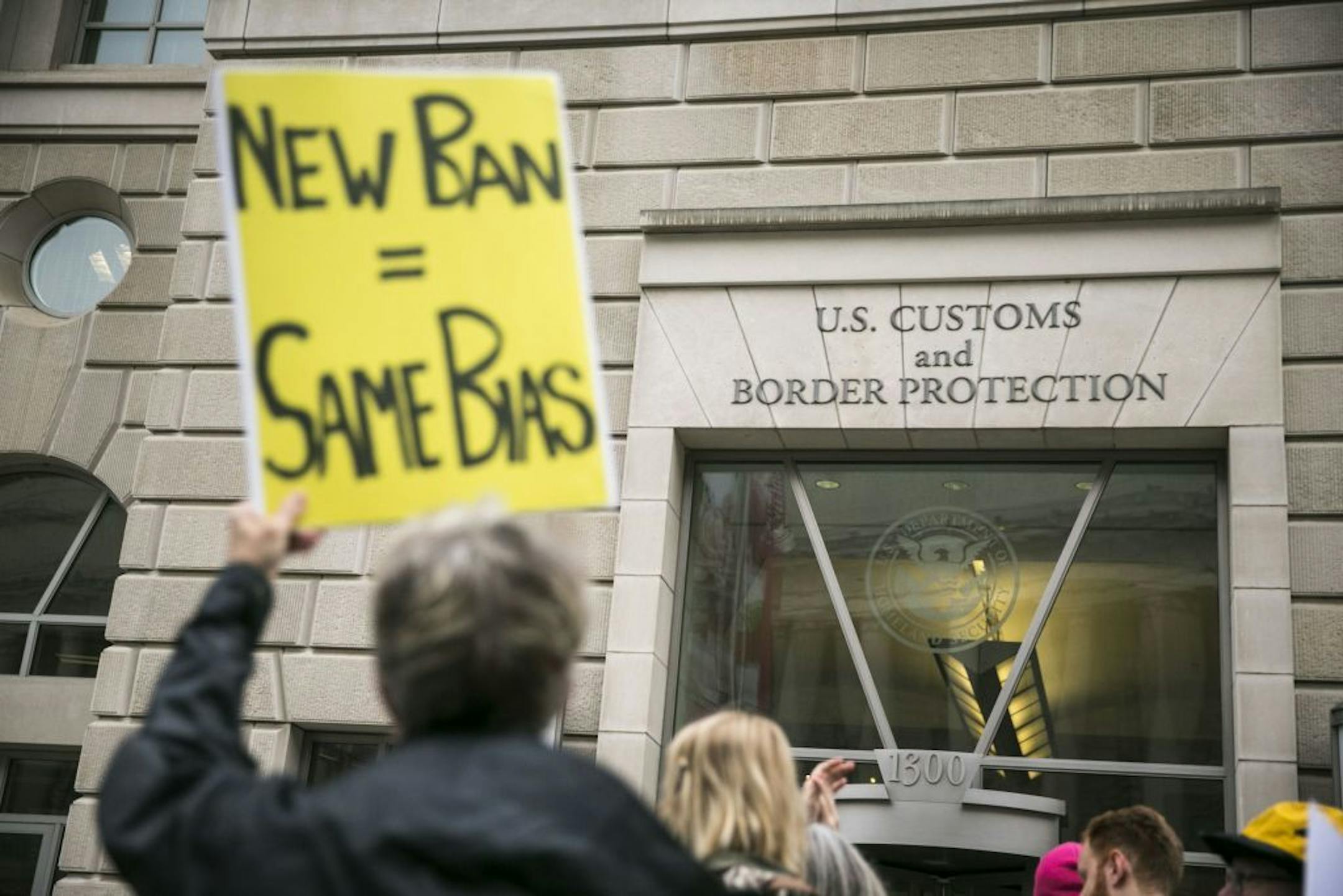
In a remarkable 10-to-3 decision, a federal appeals court on Thursday affirmed the freeze on the second iteration of President Donald Trump's executive order on immigration from six majority Muslim countries. The court said that national security "is not the true reason" for the order, despite Trump's insistence to the contrary. It's extraordinary for a federal court to tell the president directly that he's lying; I certainly can't think of any other examples in my lifetime.
The decision and the breakdown of the judges voting against the ban — which includes a Republican appointee — presages defeat for the executive order in the U.S. Supreme Court, should the Trump administration decide to seek review there. Faced with this degree of repudiation from the federal judiciary, Trump would be well advised not to go to the Supreme Court at all.
The decision for the 4th Circuit Court of Appeals was written by Chief Judge Roger Gregory, who has the distinction of having been appointed to the court first by Bill Clinton, in a recess appointment that would have expired, and then by George W. Bush — a reminder of bipartisanship in the judicial nomination process that seems almost inconceivable today.
Gregory's opinion had three basic parts, of which the middle one was the most important.
First, Gregory found that the plaintiffs in the case had standing to challenge the executive order as a violation of the First Amendment's establishment clause. He pointed out that under the "endorsement test" first offered by Justice Sandra Day O'Connor, the establishment clause is violated when the government sends a message to some people that they are insiders, favored members of the political community, or a message to others that they are outsiders, disfavored as citizens.
In O'Connor's analysis, feelings count. As the 4th Circuit put it in the passage quoted by Gregory, "feelings of marginalization and exclusion are cognizable forms of injury" under the endorsement test. Thus, Muslim plaintiffs who alleged that they experienced a sense of exclusion and harm have the constitutional right to bring a lawsuit.
Although the 4th Circuit dissenters objected plausibly that this reliance on emotional experience would allow anyone "who develops negative feelings" to bring an establishment clause case, their objection isn't really to Gregory's reasoning, but to the endorsement test itself. And that's part of constitutional doctrine.
That led Gregory to the heart of his opinion — and the condemnation of Trump as a liar. The strongest legal argument available to the Trump administration was based on a 1972 Supreme Court case called Kleindienst v. Mandel.


