
Silicon Valley firms face challenge from proposed import tariffs

It would hit tech products, which rely on parts from around the world, particularly hard.

March 14, 2017 at 11:16PM
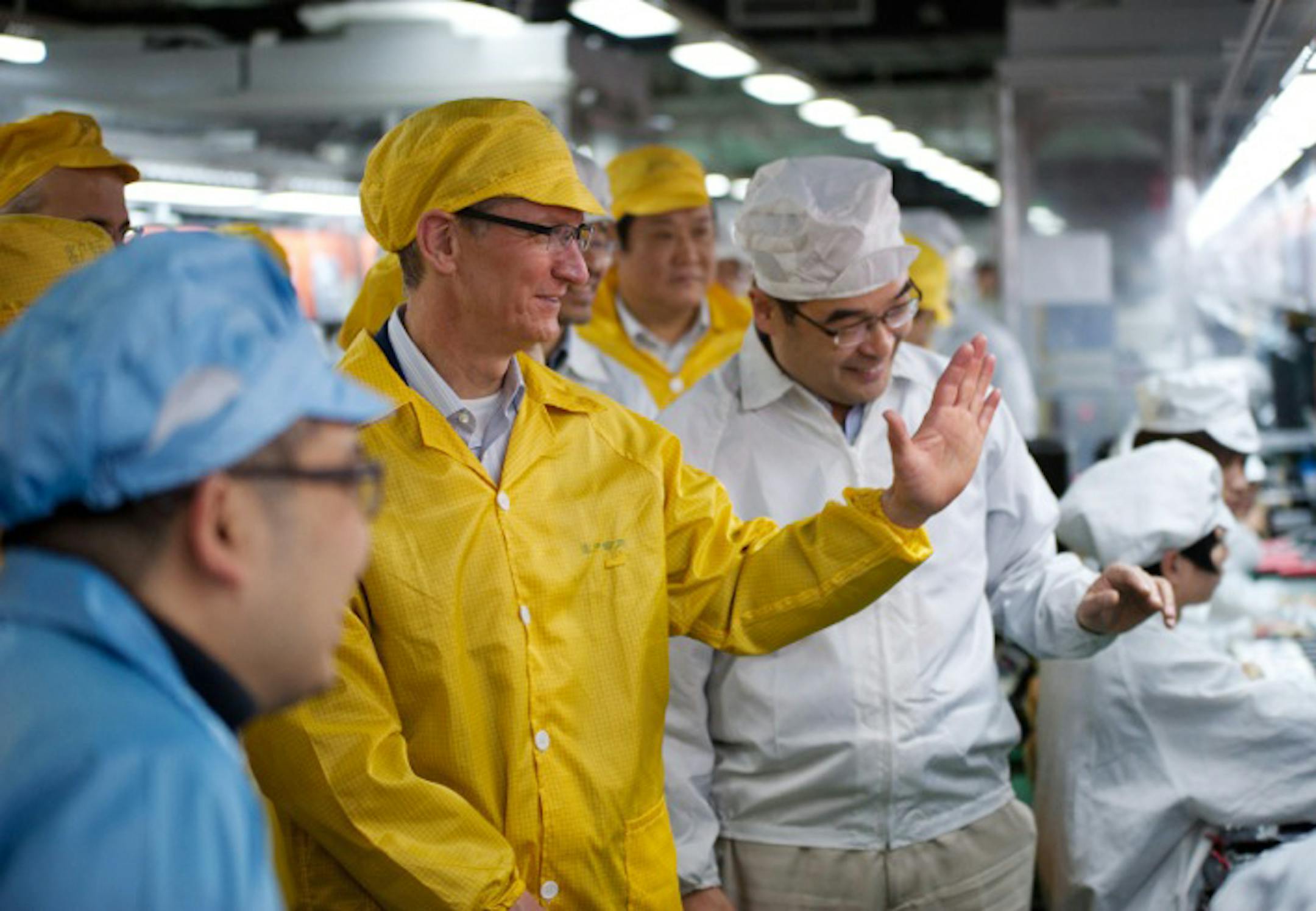
In this March 28, 2012 photo provided by Apple, Inc., Apple CEO Tim Cook, center, visits the iPhone production line at the newly-built manufacturing facility Foxconn Zhengzhou Technology Park, which employs 120,000 people. A report released Thursday, March 29, by the Washington-based Fair Labor Association says Hon Hai Precision Industry Co., the Taiwanese company that runs Apple's factories in mainland China, has committed to reducing weekly work time to the legal Chinese maximum of 49 hours. (
Apple CEO Tim Cook in 2012 visited the iPhone production line at Foxconn Zhengzhou Technology Park in Tawian, which employs 120,000 people. (The Minnesota Star Tribune)

SAN JOSE, Calif. – That shiny new iPhone may say "assembled in China" on the back, but its origins are scattered around the world: wafers from Taiwan, modem chips and batteries from South Korea, displays from Japan, components from Europe and raw materials from Africa, Asia, Europe and the U.S.

Now that complicated supply chain may put Apple — the world's most valuable company — in the bull's-eye as President Donald Trump and congressional Republicans consider sweeping import tariffs or a comprehensive border tax on incoming products, components and raw materials.

But while Apple has been singled out by Trump before, the administration's actions would affect a who's who of Silicon Valley's big-name tech companies — which could see sales, revenue and access to global talent take a hit from new fees and the trade wars that could follow.

"It's a real mess," said Marcus Noland, executive vice president at the Peterson Institute for International Economics, a Washington, D.C., think tank that supports free trade.

Only two months into the Trump administration, it's difficult to discern how an import tariff or border tax might take shape, but the president has said he wants to punish U.S. companies that make goods overseas to sell back home. Imposing new costs on imports would encourage domestic manufacturing and create jobs, Trump has argued.

While campaigning, Trump mentioned a 45 percent import tariff on goods from China and 35 percent on imports from Mexico. More recent reports suggested the Trump transition team was looking at a 10 percent fee. House Republicans, meanwhile, have proposed a 20 percent "border adjustment tax" covering all imports from all countries.

The list of firms with the most to lose from an aggressive new tariff or tax regime includes the valley's biggest names: Google, Tesla, Oracle, HP, Cisco, Intel, Seagate, Western Digital, Nvidia, Marvell Semiconductor and more.

Consumers also will inevitably see increased costs from import tariffs or a tax passed on to them, according to experts. "You and I are going to pay for it," said Georgia Tech professor John Vande Vate.

However, others believe imposing higher import costs would deliver significant benefits. Northwestern University law Prof. Steven Calabresi said the proposed 20 percent border adjustment tax would "encourage Americans to buy American products" and "promote good jobs here in the United States" while raising $1 trillion over 10 years.

"It is smart to discourage a little bit of the buying of foreign goods if you can then cut income taxes and get people back into the workplace or get them to work harder," he wrote this month in an opinion article for the Hill.

Still, tariffs or a tax would also hit countries like China that export to the U.S., potentially leading to trade wars with nations whose markets and raw materials are critical to tech companies.

"If we decide to impose tariffs or high barriers to trade on our trading partners we should expect reciprocal trade barriers, which of course is not good for our industries, it's not good for prices, and the whole thing spirals downward," said Renee Bowen, a Stanford University Graduate School of Business professor who studies international trade.

Generally, when tariffs drive prices up, sales go down, said Rob Atkinson, president of the Information Technology & Innovation Foundation, a tech-focused think tank.

The tech industry has long depended on a complex global network of suppliers, workers and materials. Apple, for example, noted in its most recent quarterly report that its manufacturing is concentrated among a small number of suppliers in Asia.

"Everything that is in our products comes from overseas," Hewlett Packard Enterprise CEO Meg Whitman told CNBC in February. "That supply chain has taken 30 years to set up. So when all those components come in and are taxed, it's not going to be good. This does not create jobs. It actually lowers the number of jobs for many, many companies."

HP makes printers and PCs in China, while Cisco, Seagate and Western Digital manufacture products there and in Thailand, said analyst Handel Jones of International Business Strategies in Los Gatos, Calif.

Google's new Pixel phones are made by HTC in Taiwan, where Nvidia and Marvell Semiconductor buy chips that power products sold in the U.S. The Home virtual-assistance device by Google is made in China, and the company relies on Taiwanese firm Quanta to supply the servers that make it a cloud-services titan. Facebook also buys servers from Quanta, according to analysis firm Moor Insights & Strategy. Intel has fabrication and assembly plants in China, and assembly facilities in Malaysia and Vietnam.

Even a software-and-services company like Oracle is vulnerable to tariff-related retaliation, because it has invested heavily in providing IT services in China, where its clients include state-owned enterprises. The Chinese government, on top of potentially responding tit for tat to tariffs or taxes, could bar state-owned companies from doing business with U.S. firms, said the Peterson Institute's Noland.

Companies that make some products in the U.S. won't escape, either. They too would be vulnerable to an all encompassing import levy, such as the proposed border adjustment tax, because they use materials or parts from other countries.

Conflict between the U.S. and China over trade could spread to other areas, potentially affecting American firms' access to Chinese talent, Noland said. "A trade war that started with products," Noland said, "could spill into things like visas and immigration issues, which would disadvantage the entire high tech sector."


In this Friday, March 9, 2012 photo, Hewlett Packard CEO and President Meg Whitman speaks at a conference on the Stanford University campus in Palo Alto, Calif. Whitman could get more than $15 million for her first year as CEO of Hewlett-Packard, according to company filings. It's a big payday even by the lofty standards of big-time CEOs. The chief executives of major public companies made a median of $9.6 million in 2011, the most recent year available, according to executive pay research firm
In this Friday, March 9, 2012 photo, Hewlett Packard CEO and President Meg Whitman speaks at a conference on the Stanford University campus in Palo Alto, Calif. (The Minnesota Star Tribune)
about the writer

about the writer

Ethan Baron, Mercury News

More from Business

See More
card image

Fourth high-profile assault of hospital workers since last fall underscores challenge of managing patients in mental health crises.

card image
This transmission electron microscope image shows SARS-CoV-2, the virus that causes COVID-19, isolated from a patient in the U.S., emerging from the surface of cells cultured in the lab. (NIAID/TNS) ORG XMIT: 1659810