

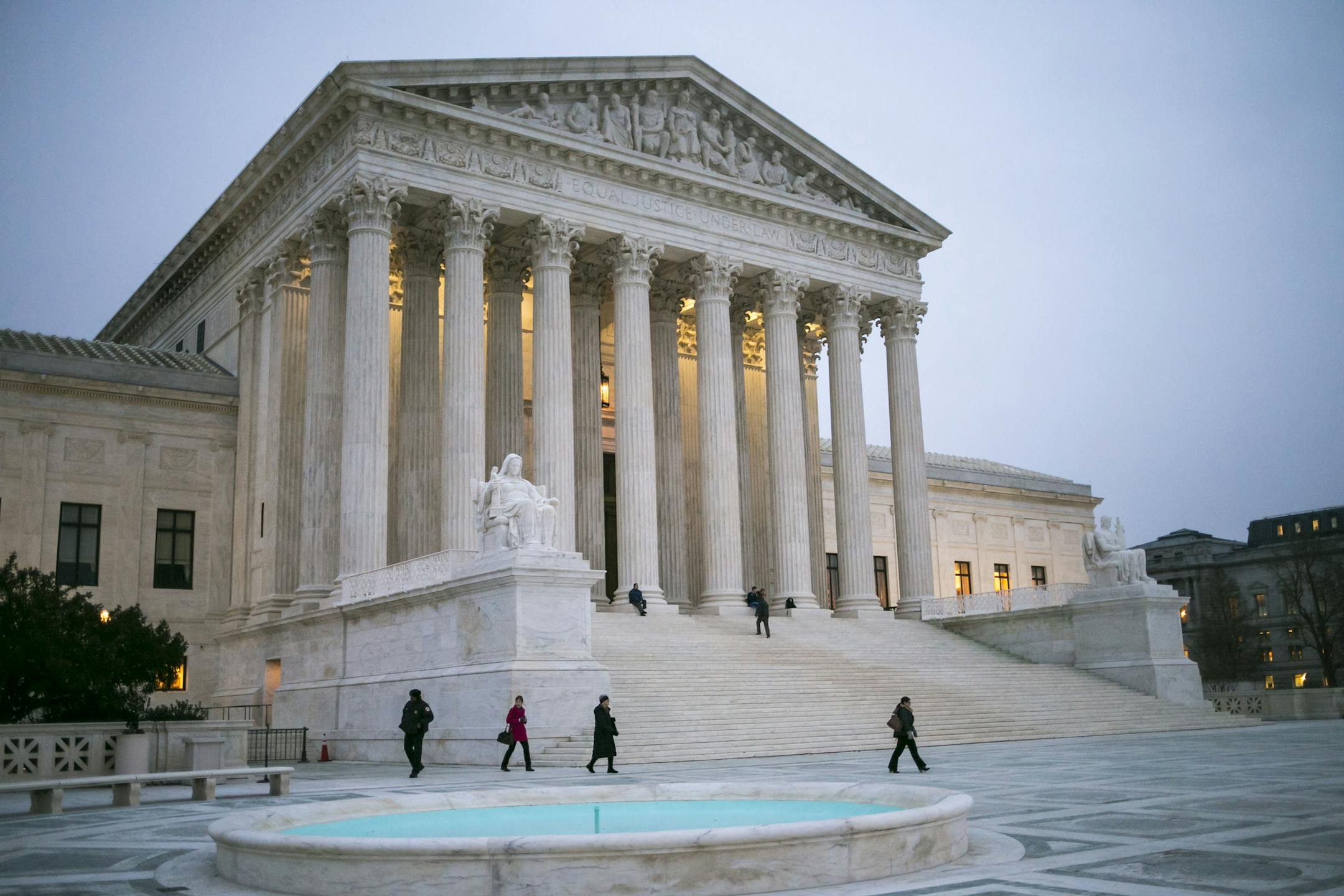
Last Tuesday, in an hourlong oral argument conducted over the telephone, three judges from the U.S. Ninth Circuit Court of Appeals listened to a Justice Department lawyer urge them to reinstate President Trump's ban on travel from seven largely Muslim nations. The lawyer, August E. Flentje, offered several reasons why they should do this, but one in particular seemed to disturb the judges. The judiciary, Flentje claimed, must defer to the executive branch when it comes to national security.
"This is a traditional national security judgment that is assigned to the political branches," Flentje declared.
"Are you arguing then," asked Judge Michelle T. Friedland, "that the president's decision in that regard is unreviewable?"
Yes, said Flentje.
This sounded eerily familiar — an echo from another legal controversy long ago. On Aug. 9, 1950, in a D.C. federal courthouse, a lawyer for the widows of three civilian engineers who died in the crash of an Air Force B-29 requested the accident report, expecting it would shed light on the cause of the disaster. An assistant U.S. attorney balked, insisting the report "cannot be furnished without seriously hampering national security" because "the aircraft in question" was "engaged in a highly secret mission" and carried "confidential equipment." In response, a skeptical U.S. District Judge William Kirkpatrick said, "I only want to know where your argument leads." The government's attorney made plain where it led: "We contend that the findings [of the executive branch] are binding … upon the Judiciary. You cannot review it or interpret it. That is what it comes down to."
Kirkpatrick was having none of that argument. In June 1950, he ordered the government to hand over the accident report and all related documents. He wanted it known that the type of executive immunity from judicial review asserted by the government "had been fully considered and held not sustainable."
In an appeal filed to the U.S. 3rd Circuit Court of Appeals in April 1951, the government did more than challenge Kirkpatrick's ruling: It challenged Kirkpatrick's very right to make a ruling. Most fundamentally, the government now questioned whether any judge could force the executive branch to hand over documents it considered privileged: "We believe that the determination of what documents should not be disclosed … is … necessarily within the discretion and distinctive knowledge of the executive branch."
At a hearing Oct. 19, 1951, that assertion received much attention from a three-judge appellate panel led by Judge Albert Maris. What bothered Maris most was the government's assertion of unilateral executive power, free from judicial review, to decide what qualified as a national security secret. In a unanimous opinion filed two months later, upholding Kirkpatrick, Maris wrote: "The government of the United States is one of checks and balances. One of the principal checks is furnished by the independent judiciary which the Constitution established. Neither the executive nor the legislative branch of the government may constitutionally encroach upon the field which the Constitution has reserved for the judiciary."


