

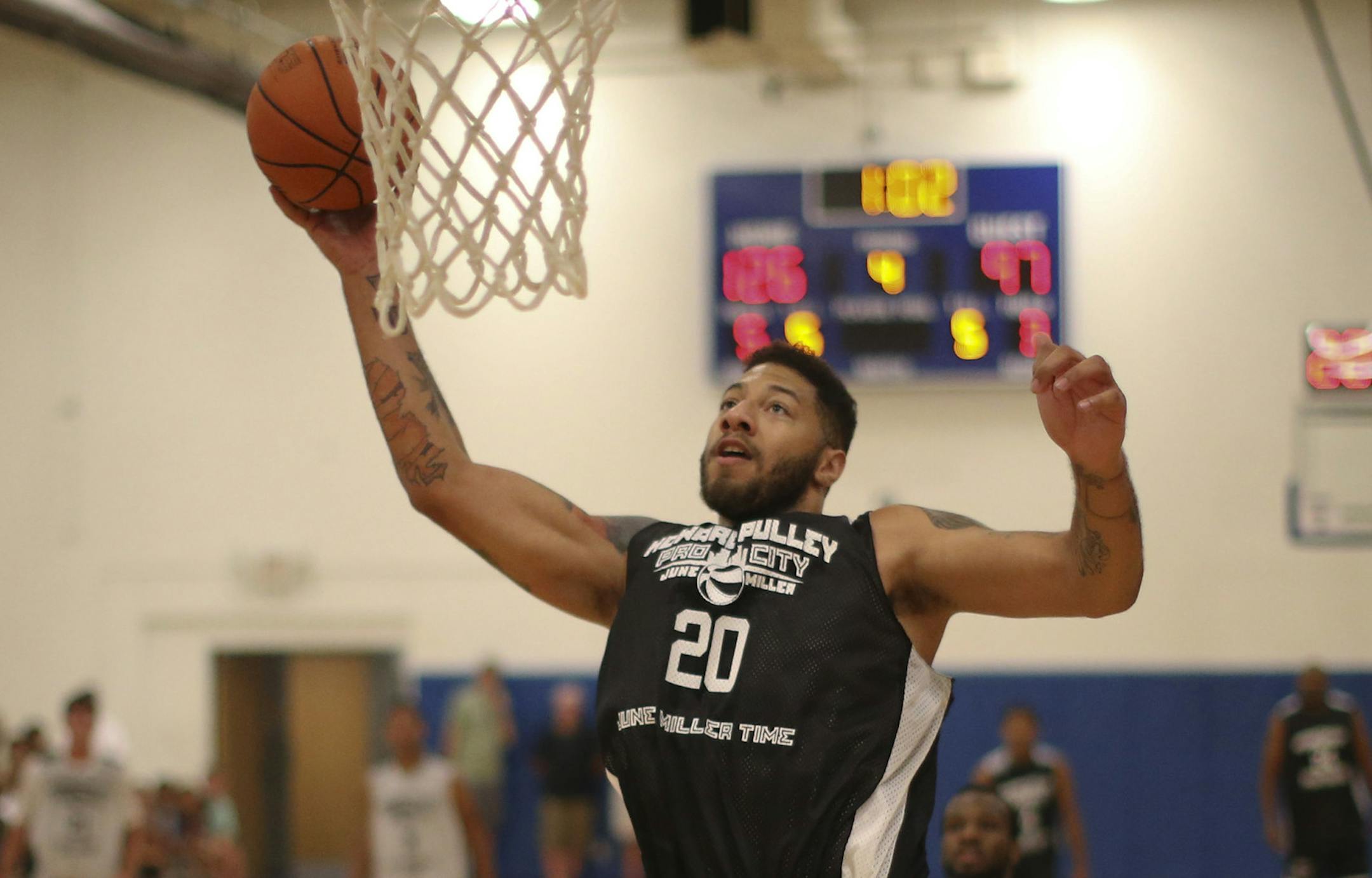
One minute remained on the game clock and his team held a comfortable lead, so Royce White thought he'd treat the crowd to a showboat move.
Alone on a fast break, White tossed the ball off the backboard and leapt to throw down a thunderous, one-handed dunk. Except his timing was a smidgen off, so he had to settle for a layup, drawing a mixture of laughs and wisecracks and a wry smile from White.
It was 10 p.m. with about 200 people in attendance at a suburban Twin Cities gym.
Facing a bunch of college players in the Howard Pulley Summer League, White was the main attraction and, at 6-8 and 260 pounds, he wasn't hard to spot. He looked like Shrek on a basketball court with his imposing presence.
He scored 24 points but could have finished with 80, if he wanted. He zipped one bounce pass from half-court through traffic to a cutting teammate for a layup. He made a deep three-pointer, played point guard and posted up whenever he felt like shooting a layup.
Amid the oohs and aahs, I kept thinking to myself, hopefully this isn't as good as it gets.
White belongs in the NBA. He's too skilled and too powerful to see his talent go to waste. But his future as a professional basketball player remains murky as he attempts to forge a career while remaining steadfast in his conviction that his mental health issues take precedence over everything.
A first-round draft pick last summer, White already has a new team after the Houston Rockets traded him to Philadelphia earlier this month in a divorce that seemed inevitable. A change of address gives the appearance of a fresh start, but the uncertainty surrounding his medical situation raises skepticism that the outcome actually will be different.
![Former Hopkins standout and current NBA player now with the Philadelphia 76ers played in a Howard Pulley Basketball League game Monday night, July 15, 2013 at High Performance Academy in Eagan. Royce White protected the ball from the defense of Jefferson Mason during June Miller Time's game against Pat Madison Magic Monday night. ] JEFF WHEELER • jeff.wheeler@startribune.com](https://arc.stimg.co/startribunemedia/2DHDF2B2LSF4HS6QV52XYBRVQU.jpg?&w=1080)
![Former Hopkins standout and current NBA player now with the Philadelphia 76ers played in a Howard Pulley Basketball League game Monday night, July 15, 2013 at High Performance Academy in Eagan. Royce White greeted Pat Gallatin with a big hug after his game Monday night. At left was Ginny Krey. Both are longtime friends of White's grandmother, Sandy Pryor, and have known White since he was a baby. A big baby they were quick to point out.] JEFF WHEELER • jeff.wheeler@startribune](https://arc.stimg.co/startribunemedia/A4Q3Z24QRV6C6RPV7GG77DRSEI.jpg?&w=1080)


