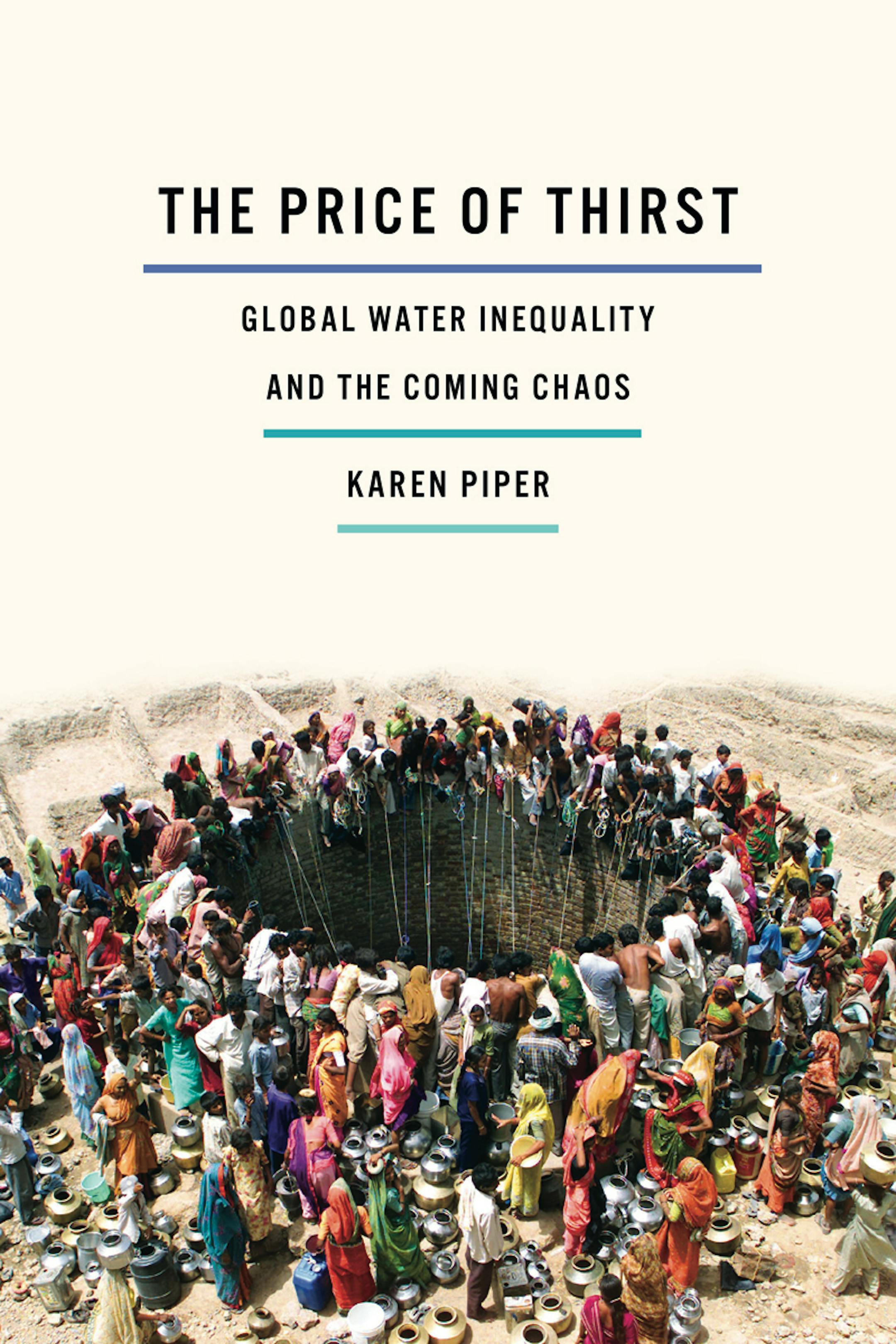
A publisher located in the Land of 10,000 Lakes might seem like an unlikely promoter of a book about a mostly unacknowledged world water crisis. Furthermore, the publisher is a university press, not generally associated with aggressive investigative reporting. And another surprise — the investigative reporter is not primarily a journalist, but rather an English professor whose academic specialty is postcolonial studies.
For decades, I have been thinking that the next civil war in the United States would be triggered not by human, racially based slavery but rather by battles over water use — for drinking, for farming, for recreation. Author Karen Piper, a University of Missouri professor, has revised my thinking. It turns out the war I project might transcend the United States, spilling over into other nations on other continents.
To conduct her research, Piper spent significant time in California, to be sure, but also Chile, South Africa, India, Egypt and Iraq. Everywhere, governments, instead of serving all their constituents, are treating water as a commodity, something to be bought and sold for profit. Trouble is, the vast number of low-income folks in every nation lack the money to purchase adequate amounts of the life source. Those nations are receiving assistance from supposedly benevolent agencies such as the International Monetary Fund and the World Bank.
At first, I thought Piper might be exaggerating, that she might have become a water-rights zealot stating a case beyond the available evidence. But no, her research is impressive and her evidence is reliable.
Piper mentions her "day to day despair about climate change," and believes the water crisis will worsen because of climate change, abetting the destruction done by greedy multinational corporations (including seemingly do-good firms selling bottled water) as well as misguided government agencies.
Piper offers individual faces and names, so readers can discern flesh-and-blood culprits. She opens the book at the World Water Forum, convened every three years. The organizers state they want to solve world water problems, but instead aggravate the problems by shutting out the downtrodden.
While at the forum — in Marseille, France, in 2012 — Piper vows that her book "will look at the history of the global water elite, as well as the precarious position they have created for global social stability. The problem is that, unlike other commodities, people cannot 'go without' water, and so what these corporations are actually producing, rather than clean water, is dangerous global social unrest."
The largest "water corporations" carry names that might not sound even a little bit familiar — Suez Environment and Veolia Water.