

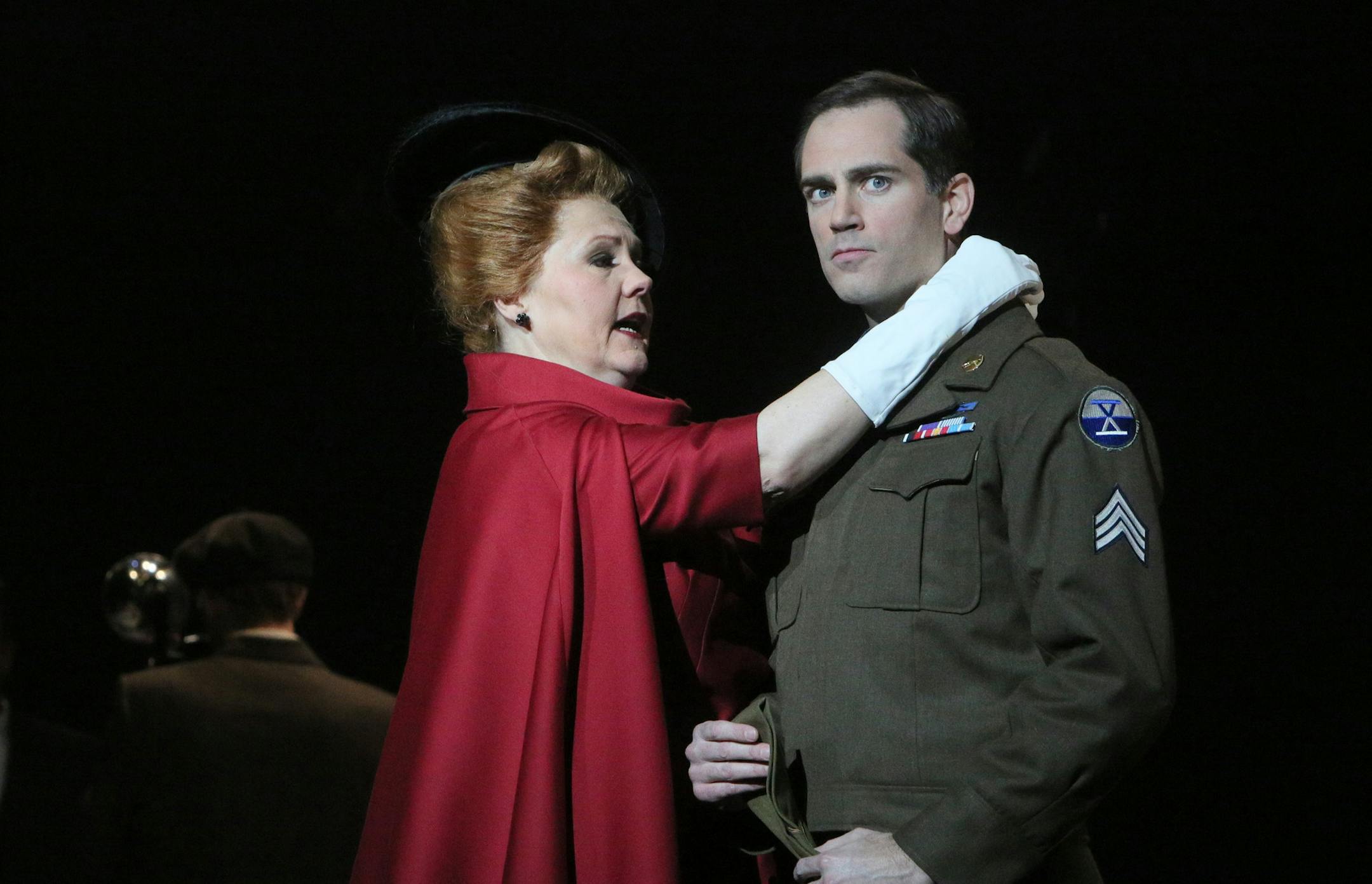
Contrary to rumor, lightning on occasion does strike twice.
Composer Kevin Puts won the Pulitzer Prize in 2012 for "Silent Night," his debut opera with librettist Mark Campbell. The Minnesota Opera commissioned and premiered the sensitive depiction of the World War I Christmas truce.
Wisely, the company asked Puts and Campbell for a follow-up — and it should be noted that this was offered before the Pulitzer was announced. The result, unveiled Saturday night at the Ordway Center, is an operatic treatment of "The Manchurian Candidate," the 1959 Cold War thriller by Richard Condon and the 1962 film.
This opera is another winner, an exciting roller-coaster ride that manages to make telling political points relevant to today, all wrapped in a superbly imaginative production directed by Kevin Newbury and conducted with flair by Michael Christie.
The story is of Raymond Shaw, a Korean War POW who is brainwashed by Communists into becoming a "perfect assassin." The force behind the plot is, in fact, Raymond's mother, Eleanor, a right-wing fanatic who is bent on a "holy crusade" to restore the country "to its original purity." Another former prisoner, Ben Marco, tries to save Raymond and crush the plot.
The opera jacks up the emotional quotient. Puts' shrewdly inventive, polyglot score illuminates dramatic turns and adds ironies. The initial scene in Korea where, as an experiment, Raymond is asked to murder two of his fellow soldiers, is sung by the chorus in the cheerful mode of the dwarves in "Snow White." Later we hear a Sousa-style march and echoes of Stravinsky, Copland and John Adams — all in Puts' own voice — along with lush, lyrical orchestral writing as Raymond recalls his budding romance with his wife-to-be, Jocie.
Puts' cleverest — and most effectively dramatic — touch is an ostinato, a repeated note that opens the opera and recurs whenever Raymond's post-hypnotic suggestions kick in, a perfect sound equivalent of brainwashing and the paranoia that pervades the story.
Campbell's smart libretto remains true to the story while compressing certain scenes, creating ensemble numbers and always pushing the action forward in fast-moving cinematic episodes.


