

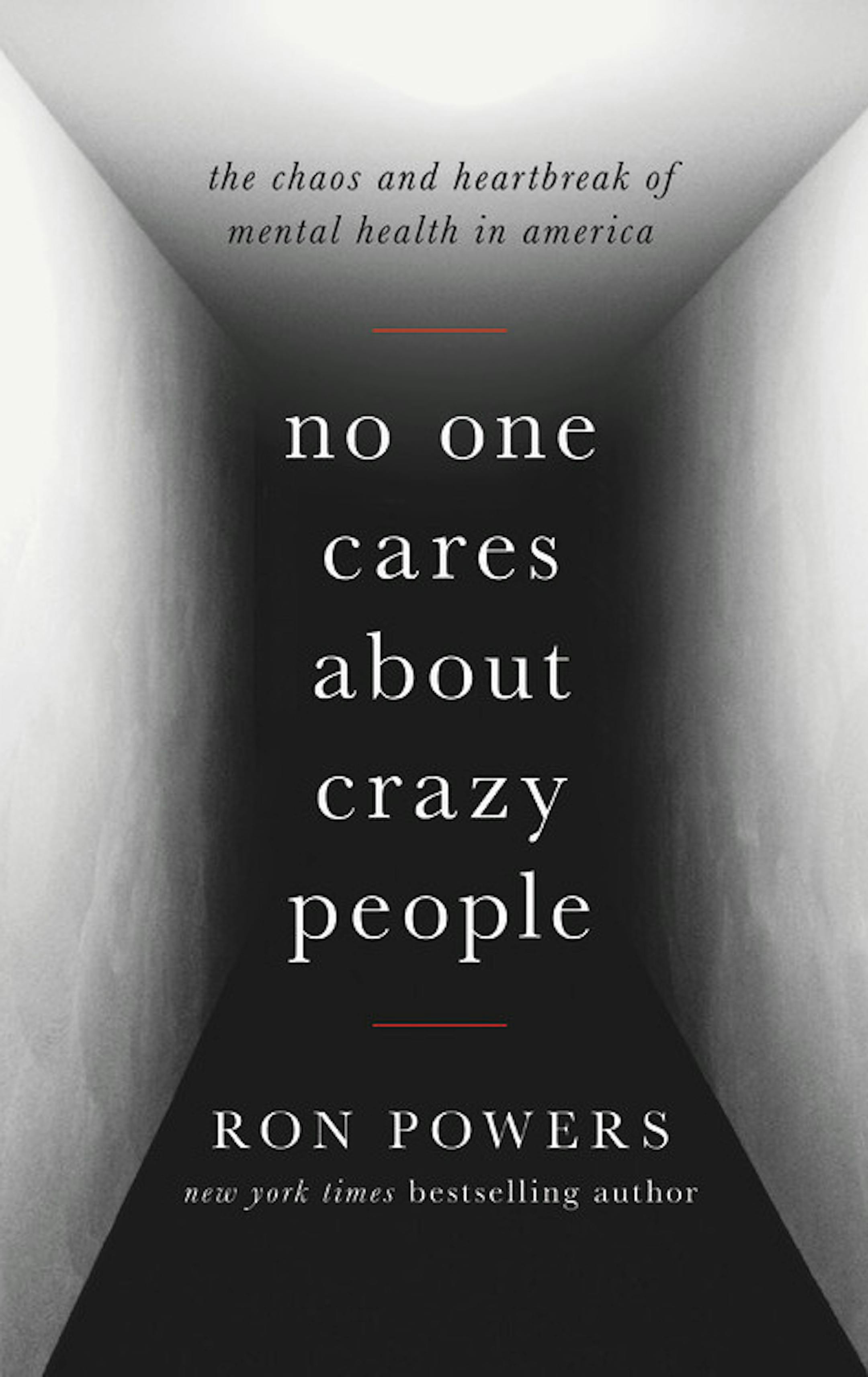
"And really, end of the day, who the hell wants to read about schizophrenia anyway? Not me." That's Ron Powers, speaking of himself while echoing the remark by onetime Wisconsin Gov. Scott Walker aide Kelly Rindfleisch that became the title of Powers' latest book: "No one cares about crazy people."
Powers cares a great deal, for reasons spelled out on his first page. Kevin, the younger of his two children, hanged himself in 2005, just before turning 21. His brother Dean, two years and eight months older, experienced a psychotic break on Christmas Day 2012; the following summer, he tried to drown himself. Schizophrenia drove both boys to the brink.
In his moving preface, Powers provides all the right reasons he avoided writing this book for 10 years after Kevin's suicide: Protecting his family's privacy. The moral blemish of exploitation, coupled with his insistence that his sons are not for sale. Fear that nobody would want to read it.
But having refrained from writing the book "as insulation against an exercise in self-indulgence," Powers eventually came to the view that this position "was itself an exercise in self-indulgence." With the blessing of his surviving son and his wife, Honoree, he decided to tell his family's story, supplemented by a history of how mental illness has been treated, from Bedlam to Obama.
Those historical portions of the book don't break new ground; good a writer as Powers is, they could be much shorter. We don't need long passages or whole chapters on the treatment of the mentally ill before the 20th century, Darwin, eugenics, the relation between art and madness, the development of the first psychotropic drugs, the horrors of modern warfare and the tension between psychology and physically grounded brain science.
But through judicially interspersed chapters involving his beloved boys, one is brought back to why Powers is so passionate — living as he does in a country where, as he points out, 90 percent of the 38,000 suicides each year are the result of mental illness. Where mental illness shortens life expectancy by 23 years. Where more than half of the prison population is mentally ill.
The chapters on Kevin and Dean are heartbreaking. Powers takes us back to their early, carefree days as kids. He shares writings from both, alongside anecdotes of the sort that might be told by any proud parent.
Cursed by hindsight, he can describe an accident during which Dean was wrongly accused of drunken driving as the event "that launched my eldest son into his rendezvous with schizophrenia." Listening to the musically gifted Kevin play a new song on his guitar, Powers recalls a "temporary, beautiful, golden thing. A presence to be experienced only once, and briefly, and then never again."


