

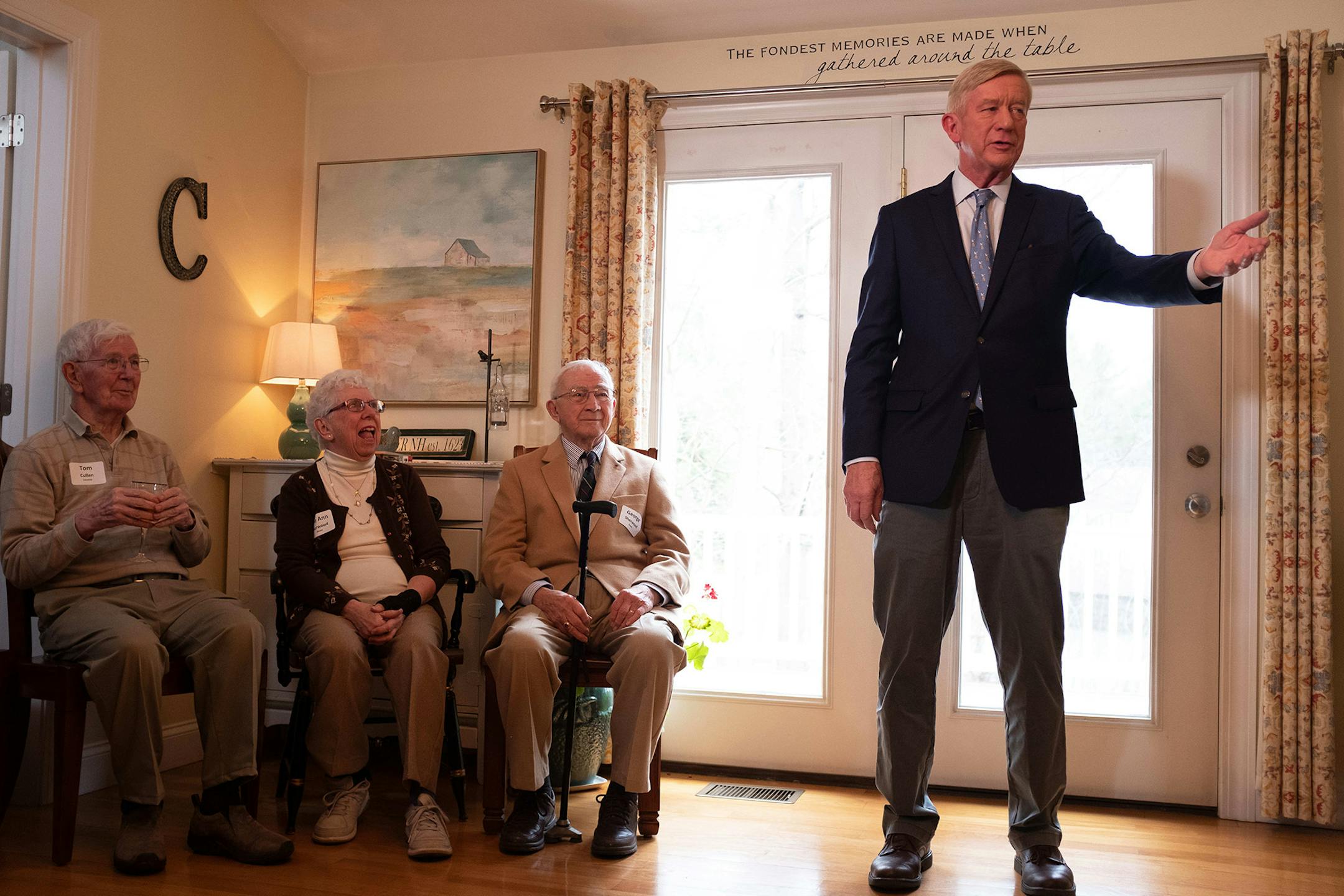
Former Massachusetts Gov. Bill Weld, who announced last week that he will challenge President Donald Trump for the 2020 Republican Party nomination, is a man out of time: an old-guard Northeastern Republican of the Thacher Longstreth school, a descendant of a signer of the Declaration of Independence who delivered the Latin oration at Harvard and married a Roosevelt, a gadfly who hasn't won an election in a quarter-century and most recently ran for vice president on the Libertarian Party ticket. He's as close to the cutting edge of today's political culture as an "I like Ike" button worn over a pair of Nantucket reds, a cantankerously heterodox figure having almost nothing in common with the Trump-era GOP.
Trump will annihilate Weld. It would be a feat if the governor were to win a single delegate next year, let alone a state. But that's not what matters: Weld's campaign isn't about winning. It's about the future of conservatives — and conservatism — in the Republican Party.
Weld says he can win by campaigning "one voter at a time," confidence that's either boilerplate campaign bravado or the product of a long-term contact high from campaigning alongside former New Mexico Gov. Gary Johnson in 2016. Conservative Washington Post columnist Henry Olsen is being gentle when he says Weld is "out of step and idiosyncratic," and, more to the point, as he heads into the next cycle, Trump has an 89% approval rating among Republicans, according to Gallup. The issue, however, is not what Republicans think about Trump, but what conservatives think about Weld, not precisely the same question.
The depth of Weld's impending electoral obliteration will help determine whether there's actually still a Goldwater-Reagan-Buckley GOP in exile, somewhere out there in the wilderness; a Nozickian remnant waiting to walk back in with its wingtips tied at the end of Trump's presidency, or if the GOP has gone all-in not only on Trump but also on Trumpism, with the populist lampshade permanently affixed to its head. Clearly, the party is unmoored from the philosophy that animated it for so much of its history. But is that condition irreversible?
Stephen Bannon was right when he said that Trumpism is a movement whose members conceive of themselves not as limited-government conservatives but as right-wing revolutionists who believe, as he put it, that we are "at the very beginning stages of a very brutal and bloody conflict." Trump partisans welcome that bloody conflict: Vive la révolution! Which puts them at odds with conservatism as understood by, among others, Russell Kirk, who observed in "The Politics of Prudence" that the conservative "thinks of political policies as intended to preserve order, justice, and freedom. The ideologue, on the contrary, thinks of politics as a revolutionary instrument for transforming society and even transforming human nature. In his march toward Utopia, the ideologue is merciless." Sounds sort of familiar, doesn't it? That is the promise of Trumpism: mercilessness in the pursuit of power. It is Leninism standing on its head.
Trump's appeal, expressed in the unlimited warrant of "make America great again," was always to the idea that what's been lacking in Washington is a sufficiently strong hand. The point of Trumpism is to seize government power and make use of it, not to diminish the role of government power in community life. Conservatives traditionally have seen things differently: "The growth of government must be fought relentlessly," William F. Buckley Jr. wrote in National Review's credenda. "In this great social conflict of the era, we are, without reservations, on the libertarian side."
Weld is, almost without reservation, on the libertarian side of the Republican Party as it is currently configured. Some of his departures from conservative orthodoxy — notably, his pro-choice stance — are regrettable, which would be of more intense concern if there were a plausible chance of his becoming president. What Weld offers is not a rightist ideology but what George Will calls, in the title of his forthcoming book, "The Conservative Sensibility." Tax cuts? Yes, but mind the deficits. Tough on crime? Of course, but not at the cost of creating a police state.
Weld's occasional praise of 2016 Democratic Party nominee Hillary Clinton suggests that he may not be a terrific judge of character, but it also speaks to his determination not to treat those of the opposite party as enemies, and for that many Republicans will never forgive him. Like Republican former Utah governor Jon Huntsman, Weld irritated right-wing sensitivities by accepting a diplomatic appointment from a Democratic president. His WASPy brand of courteous bipartisanship is especially unwelcome in Trumpist circles, which despise both bipartisanship and courtesy.


