

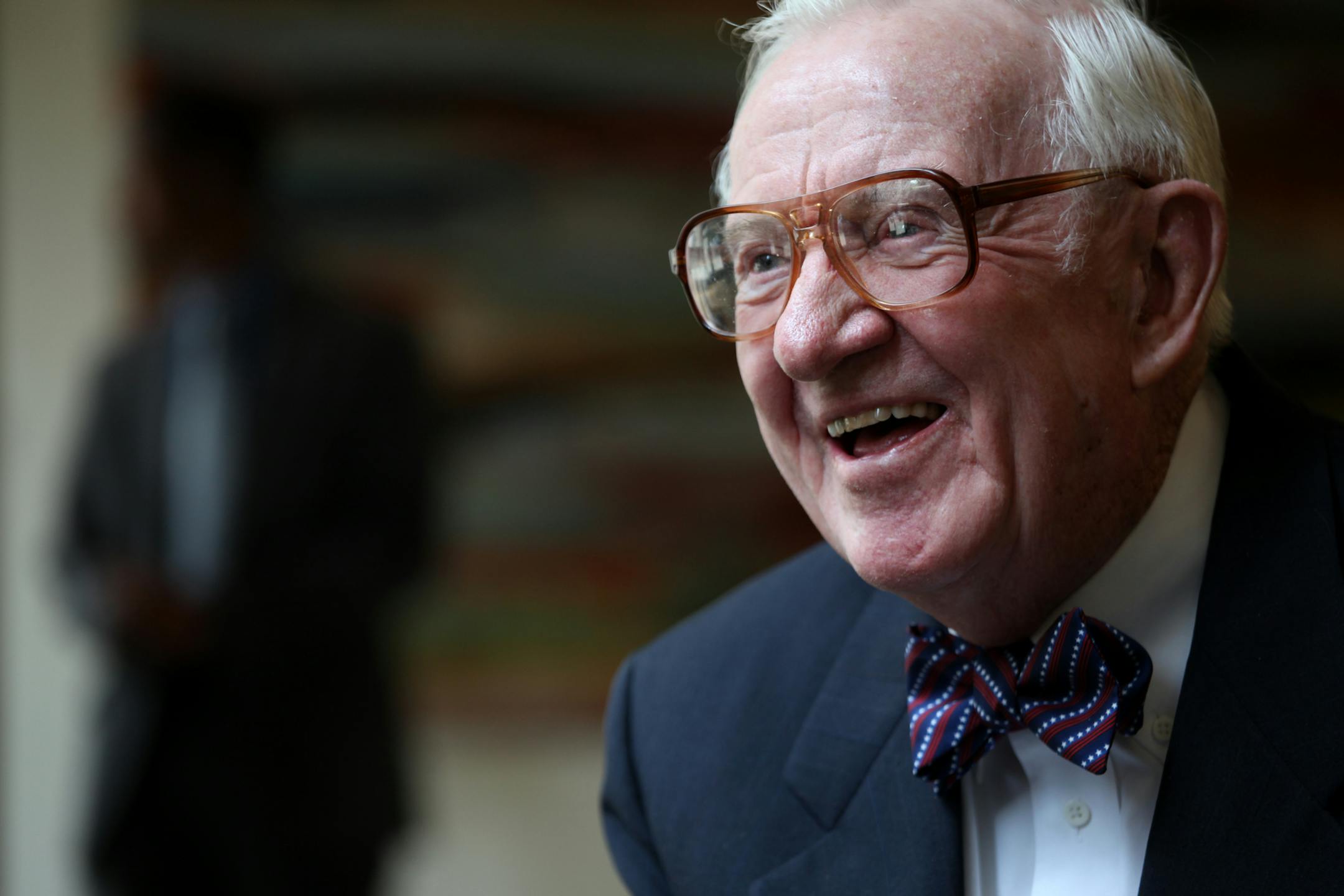
For those of us who enjoyed the rare privilege of clerking for Justice John Paul Stevens, who died Tuesday just months shy of his 100th birthday, there was only one Boss. And it was not Bruce Springsteen.
On a personal level, I will always remember Stevens as the bow-tied Chicagoan who on first acquaintance put me, a nervous clerkship interviewee, at ease by recalling his own visits to my hometown — and who, many years later, would perch at a picnic table and have a grandfatherly chat with my wee son while signing a Justice Stevens bobblehead for him. That quiet kindness is what I will treasure most. It gave me both confidence and a model for comportment that I have tried to follow in my career.
On a professional level, Stevens's imprint on U.S. jurisprudence cannot be captured in a few short paragraphs. I can only try to highlight a few aspects.
Stevens was born in 1920 into a family grown wealthy in the hotel and insurance industries. He joined the Supreme Court in 1975 with a nomination from President Gerald R. Ford. His early years on the court reflected that background, as he sided with other Republican appointees, voting, for example, in favor of reinstating capital punishment and against some affirmative action plans to speed workforce diversity.
But by the end of his career, his views on such matters changed. On the death penalty, Stevens signaled his opposition to "state-sanctioned killing" in a 2008 opinion and urged in a post-retirement book a constitutional amendment abolishing the practice.
With regard to affirmative action, Stevens dissented in 2007 from the conclusion that a school's plan to avoid resegregation harked back to the time before Brown vs. Board of Education, when, the majority wrote, "schoolchildren were told where they could and could not go to school based on the color of their skin." Stevens retorted that "it was only black schoolchildren who were so ordered; indeed, the history books do not tell stories of white children struggling to attend black schools." He added that "children of all races benefit from integrated classrooms and playgrounds." In a way, the dissent returned Stevens to his first service on the court, as the law clerk who had recommended that the court outlaw desegregation in 1948, six years before Brown was decided.
That 1948 memo is evidence that early on Stevens held a view most would call "liberal" or "progressive," and so undermines the linear claim that he began as a "conservative" or "moderate conservative," then moved left to become a "liberal" late in life. Stevens's 1986 dissent in Bowers vs. Hardwick, in which a majority approved criminal punishment for same-sex sexual conduct, further damages that claim. So, too, perhaps, does his opinion in a 1989 abortion case that a state law violated constitutional separation of church and state. That opinion won little favor at the time but seems prescient in light of the so-called heartbeat bills that several states enacted this year.
It is closer to the mark to say that the justice was gifted with a fertile mind, one open to reconsideration when new experiences and new thoughts warranted.


