

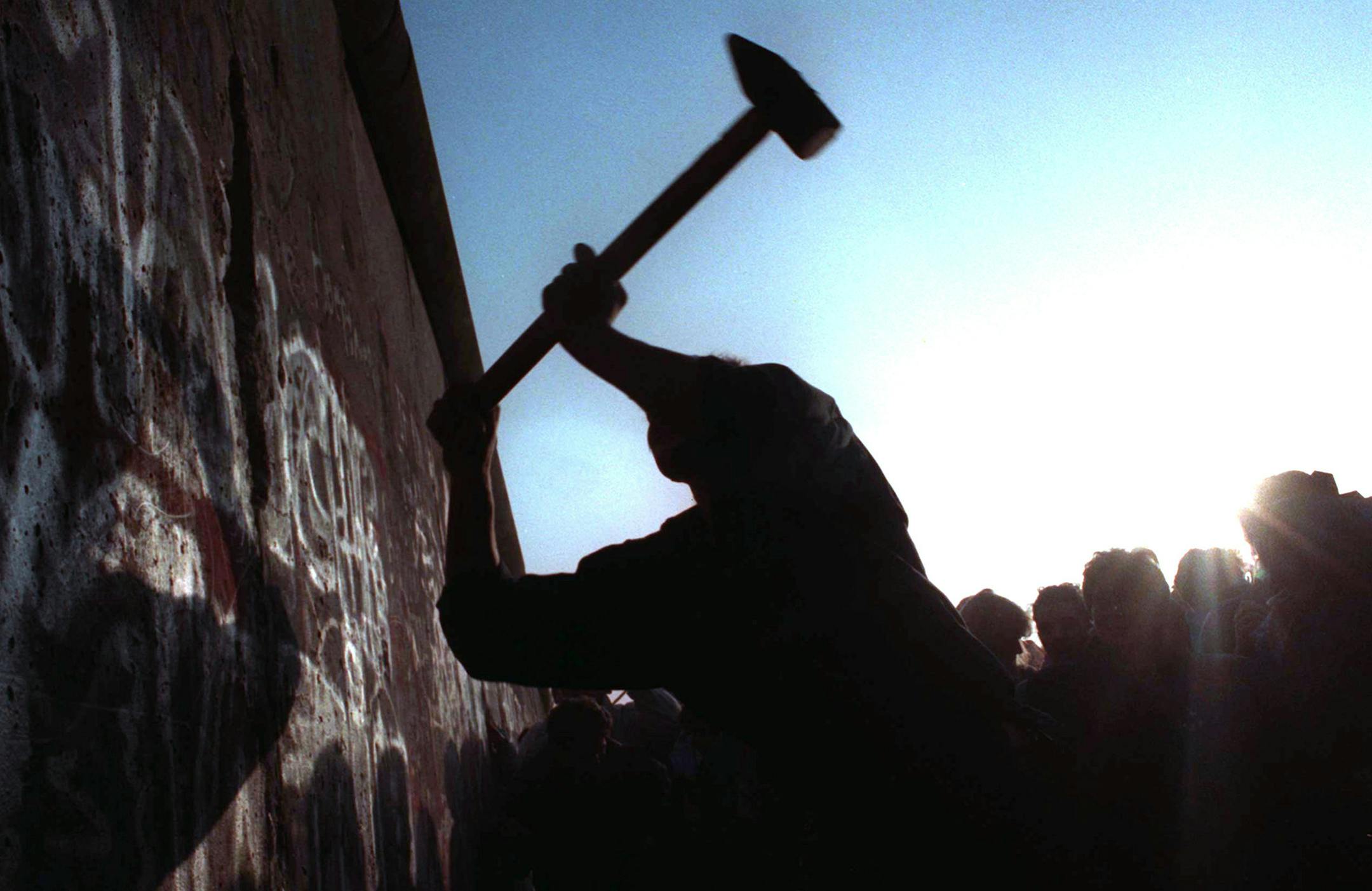
Thirty years ago today, Germans took a hammer to the Berlin Wall. They struck a fatal blow to Soviet communism, too.
Soon the U.S.S.R. dissolved, newly independent Eastern European nations tilted toward the West, and East and West Germany united to become a peaceful, prosperous force for good in the world.
The fall of the wall "was an earthshaking, secular event in the 20th century; I mean it's literally like our 1776 in America and 1789 in France, except there was no bloodshed," said Constanze Stelzenmüller, a senior fellow at the Brookings Institution's Center for the United States and Europe.
"I think it was literally a moment of amazing grace, and I mean that in the theological sense, which is that for my generation of 20-somethings it was an undeserved gift," she said.
Freedom from Communist domination was indeed a gift, given mostly by gutty Germans themselves — as well as other East Europeans with the grit to defy despots in their national capitals and by extension, the Kremlin.
"It was one of those rare occasions where people stuck with it against all realistic expectations and said, 'This is a goal, a dream worthy of pursuit, and it may not seem realistic now but we're not giving it up,' " Stelzenmüller said.
But beyond people power, she added, there were individuals with global power, including one in Moscow, Mikhail Gorbachev, who Stelzenmüller said "was under highly suspicious surveillance from the apparatchiks in his own government."
Among other leaders of continental consequence were Pope John Paul II and his fellow Pole Lech Walesa, as well as Czech dissident Václav Havel. And there were a succession of U.S. presidents who, on a bipartisan basis, resolutely resisted Soviet domination — especially the two who served during that decisive decade, Republicans Ronald Reagan and George H.W. Bush.


