

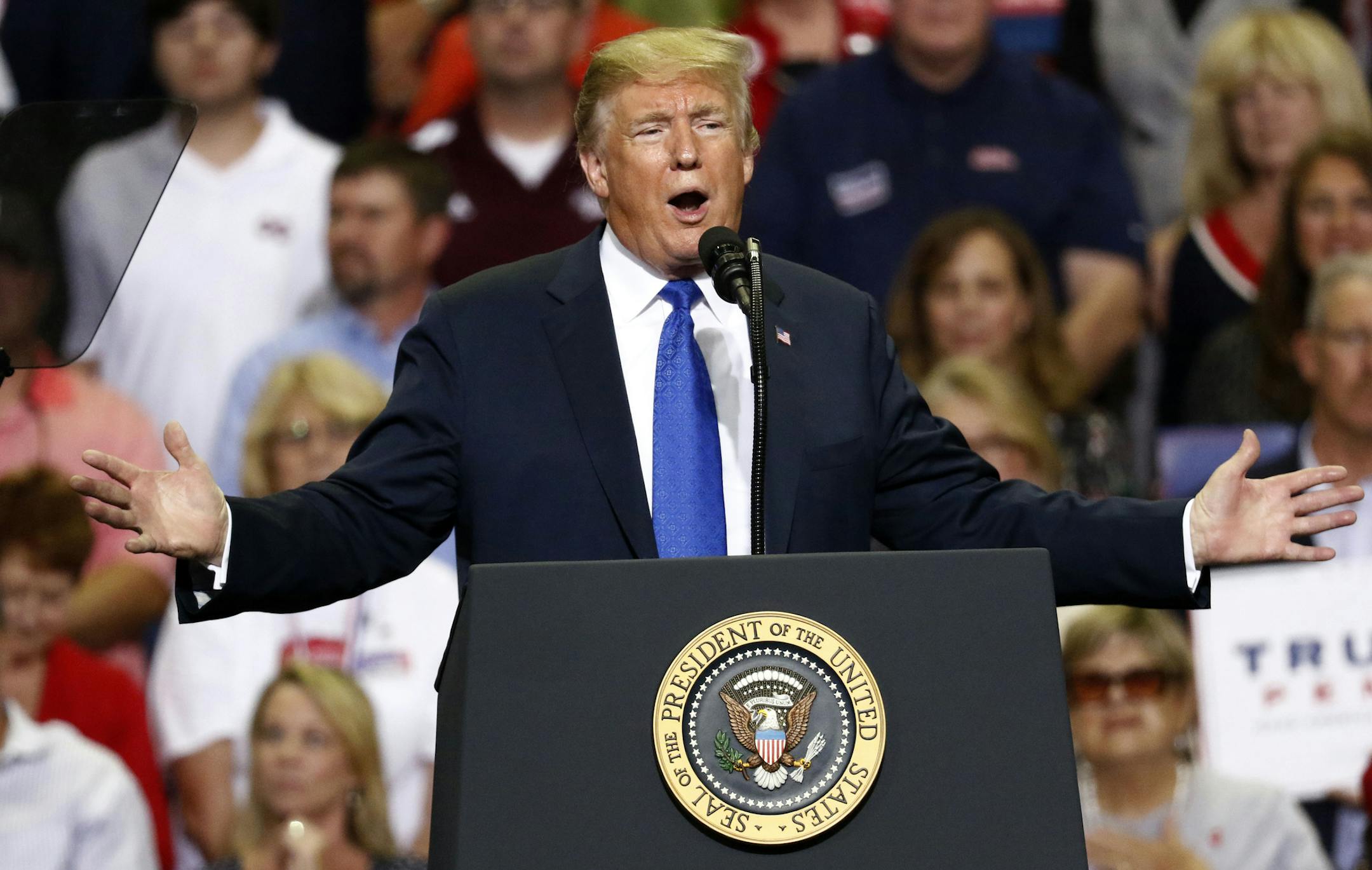
The president of the United States stood on a stage at a political rally in front of thousands of his supporters and openly mocked a woman who claims that she was a victim of sexual assault, while singing the praises of the man who she claims sexually assaulted her, and his adoring supporters cheered and laughed. Let me repeat: His supporters cheered and laughed.
The online dictionary defines "deplorable" as "deserving strong condemnation" and "shockingly bad in quality."
This man and his supporters are deplorable, period.
DOUGLAS BROAD, St. Louis Park
• • •
How can Sens. Amy Klobuchar and Tina Smith believe Judge Brett Kavanaugh's accuser with no evidence and not believe U.S. Rep. Keith Ellison's accuser, who has submitted evidence of harassment and abuse?
WILLIAM CONNELLY, Bloomington
• • •
Those who would reject Christine Blasey Ford's testimony regarding her accusation of sexual assault by Brett Kavanaugh (especially President Donald Trump) because she does not remember the details surrounding the assault would do well to listen to Dr. Richard McNally, a Harvard psychologist who specializes in the effects of trauma on memory.
In a recent National Public Radio interview, McNally says, " … the stress hormones that are released during a terrifying experience tend to render the central features of that experience vivid and memorable … the central features are typically retained … and sometimes at the expense of the peripheral details." He goes on, "With traumatic events, [memories] are fairly stable … you find this with war veterans, rape victims, victims of torture or natural disaster. They don't forget these things. They tend to be recalled quite vividly. … They're often the most threatening, the most terrifying features of the experience; where the day in which it happened or the house or address or the day of the week it happened — these things may get scrambled up, forgotten because they're not really the ones that you are attending to at the very moment of terror."


