

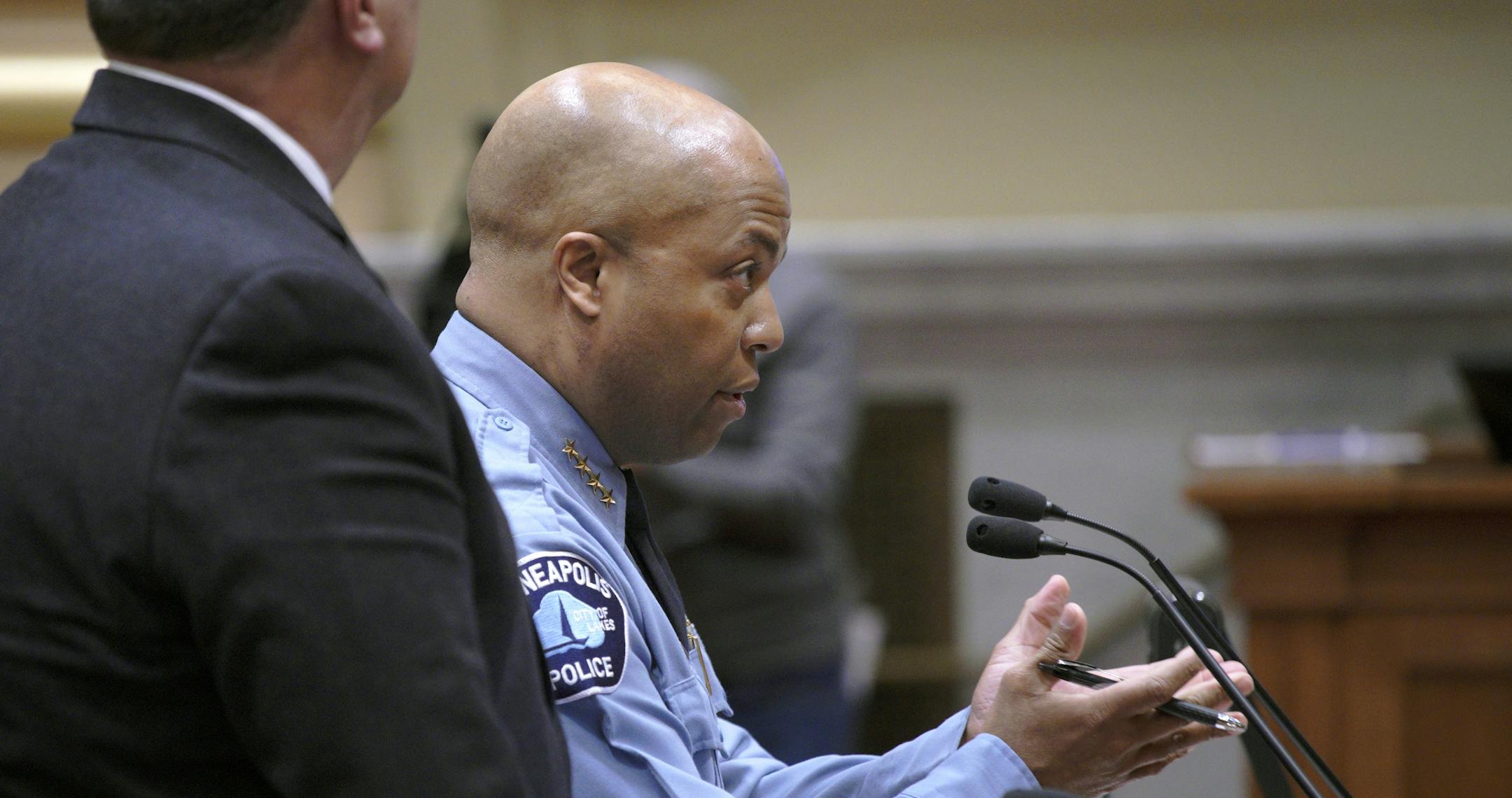
Minneapolis Police Chief Medaria Arradondo's argument that traffic stops for equipment violations are necessary because they help contain or prevent violence in our communities rings hollow and distracts from the real issue, which is inappropriate, inhumane policing ("Mpls. City Council debates temporary freeze on certain traffic stops," Feb. 7).
First, in all of the gaslighting rhetoric about violence, Arradondo and his team have yet to establish a specific correlation between stopping citizens for minor equipment violations and apprehending criminals. To characterize this tactic as a critical tool in fighting crime is grossly misleading. Second, the department's own data show that blacks are more likely to be stopped by police for minor equipment violations than whites and more likely to be searched than all whites who are pulled over. How can this data be interpreted as anything less than racial profiling? While Arradondo acknowledges the very real trauma this perpetuates in the black community, he has made no substantive commitment to disrupting this pattern of overpolicing and holding officers accountable to disciplined, responsible, respectful conduct.
As a concerned white citizen, I support an immediate moratorium on police stops for equipment violations to allow time to more closely examine and dismantle this egregious pattern of policing. It's time.
Cheryl Persigehl, Minneapolis
MAYA MOORE
Perhaps with more equitable pay and attention, she'd play in 2019
Why would a WNBA player as good as Maya Moore want to move to a different career or sit out a season (Sports, Feb. 6)? Could low pay and long hours contribute to the decision? Low salaries force the women players to play overseas in their offseason without a break from playing. WNBA players are paid with 25 percent of the profits. NBA players are paid with 50 percent of the profits. With a salary cap of $115,500, the disparity is truly ridiculous. Start giving women players the recognition they deserve with higher pay, sports page articles, better TV options, more endorsement deals, etc. No more excuses.
Susan Gove, Plymouth
Opinion editor's note: In an article for the Players Tribune announcing her decision, Moore wrote that "my no for the 2019 pro season allows me to say yes to my family and faith family like I never have before."
STATE SENATE VICTOR JASON RARICK
So, the first thing you tout is your intent to be an obstructionist?
It's only one quote among probably many, but it is telling. From Republican state Rep. Jason Rarick, elected Tuesday to the state Senate, comes: "We're going to do great things in the Senate. We are going to stop everything they are pushing through the House." ("GOP's Jason Rarick wins Senate special election," Feb. 6.) More obstructionist politics even on a night when an obstructionist president stated there should be less of it. Given an opportunity to represent all of his constituency, Rarick indicates where he will stand, and invites a similar response from the Minnesota House. Will it never end?
Philip J. Schiller, Eagan
U.S. SEN. AMY KLOBUCHAR
What to take from her track record, her practices, her book
I have a question for the many Minnesotans and editorialists enthused by an Amy Klobuchar presidential run. When, if ever, has Klobuchar taken a public position in opposition to the orthodoxy of her party's establishment faction? As a Minnesotan with food allergies, I am grateful for her work to lower the cost of the EpiPen. Yet I find it telling that this issue was a focus of her advertising during her 2018 Senate campaign. In fact, it seems to mask a risk aversion to and avoidance of the many pressing issues of our political epoch. If this is the case, what does Klobuchar offer to change-oriented Minnesotans who aren't motivated by the prospect of sending a native daughter to the White House?
Brian J. Krause, Minneapolis
• • •
In every election, relationships are key. Don't underestimate Sen. Amy Klobuchar. Each year she visits every Minnesota county, 87 in all. Know who raised $17,000 from ex-boyfriends for her first Senate campaign? If you haven't read "The Senator Next Door: A Memoir from the Heartland" (2015), it's a delight (and at the library). If you're short on time, check out the book's centerpiece gem — a 16-page photo inset (55 photos in all — from Grandpa Mike's fellow miners at the 1936 Ely Zenith Mine to "Arriving in Minnesota on Air Force One").

