

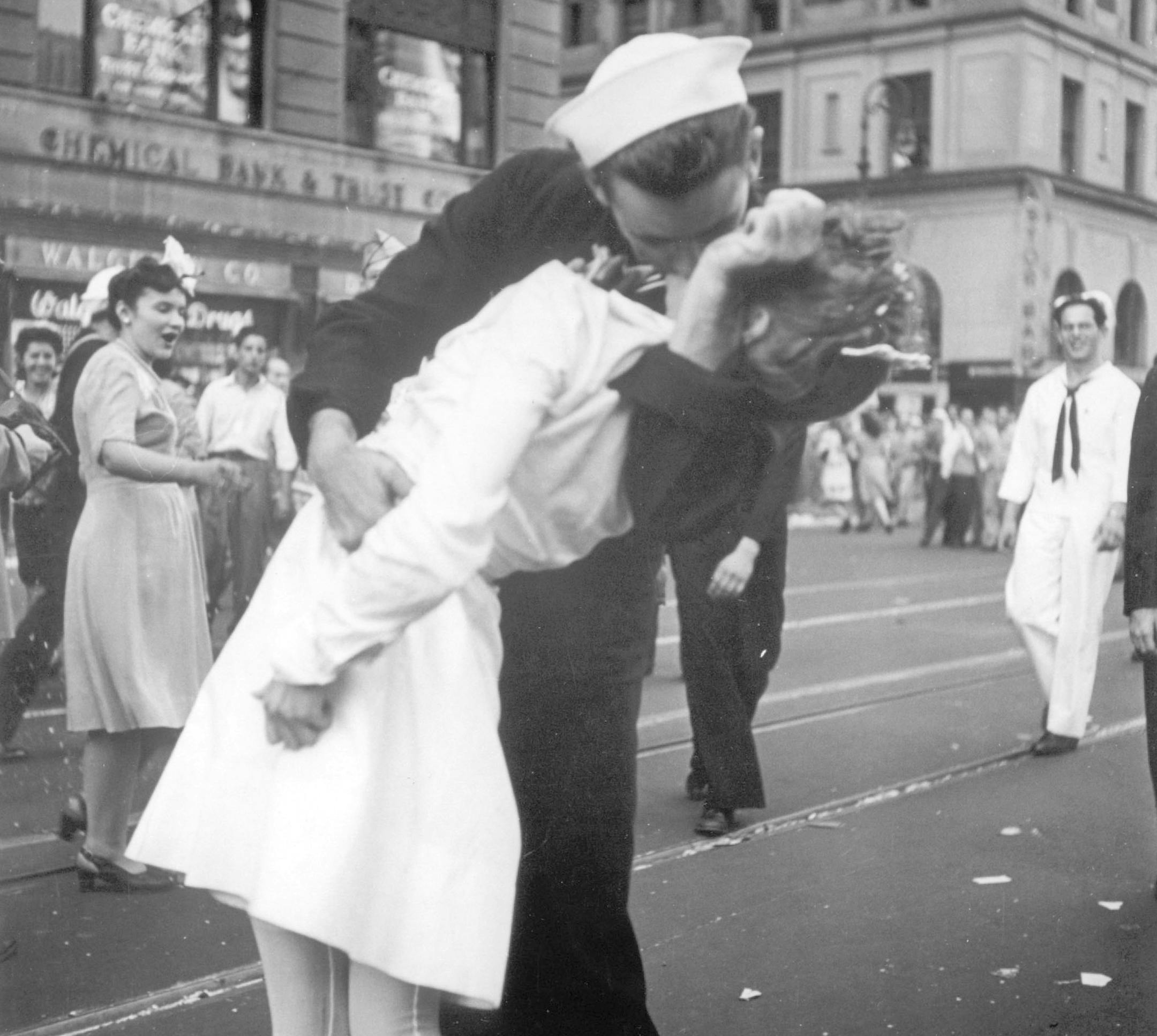
I read Monica Hesse's Feb. 21 commentary about the famous end-of-World-War-II "kiss" photo. ("In the MeToo era, a kiss is not just a kiss. Maybe it never was.") If my mother were alive today, she would be highly offended by anyone who would attempt to make the photo smarmy. She would tell them: "If you weren't there; you don't know what it was like when that war ended."
She was newly married when Pearl Harbor was attacked. Two years later, my father, at 33, was drafted into the Navy and shipped out for the South Pacific, leaving behind my mother and my oldest brother, who was 6 months old. My mother and brother moved in with my grandmother for the duration of the war.
I was a little girl in the 1960s when my mother showed me the well-known kiss photo. She told me that spontaneous celebrations sprang up all over the U.S. on and after V-J Day. She recalled how she got a babysitter for my brother and that she and my grandmother hopped on a streetcar and went to downtown St. Paul to celebrate the end of the war in what became a massive street party. People were laughing and drinking and smooching; spontaneous snake dances broke out and wound through downtown St. Paul's usually sedate streets.
My mother, never one to mince words, would tell individuals who think the kiss photo is akin to men abusing women that their notion is sheer nonsense. That night in 1945, men and women in St. Paul were hugging and kissing one another with joyous abandon. To my mother and, I suspect, a lot of her peers, the kiss photo wasn't just an image of some guy grabbing a girl. It represented the end of the "good war" that wasn't so good to the many people waiting and worried about their husbands, sons and brothers and the end of many other things — of rationing, of fear, of repression, of bloodshed. It also represented a sense of hope, at least for my mother. She was old enough to have lived through both of the 20th century's world wars, with loved ones in both conflicts. The kiss photo with the image of two strangers locked in a celebratory embrace at the end of the second World War reminded my mother that at least for a brief moment, global peace had been achieved.
Sue Rohland, St. Paul
MAIL SERVICE
Decent pay and benefits could go a long way toward easing problems
Regarding the lack of mail delivery ("Mpls asks: Where's our mail service?" front page, Feb. 21, and Readers Write, Feb. 22). The suburbs have also experienced days of no mail delivery. We live in Plymouth. Our mail carrier works very hard. The problem is that the postal workers no longer receive federal benefits. This is a demanding job. Who wants to work for $12 an hour with that type of workload?
I miss the days when we lived in St. Louis Park, where our mail was delivered at the door mailbox. I know that the U.S. Postal Service has not made any money, but there are many who still depend on it. Some of the elderly still depend on the mail service to deliver their bills. If the USPS wants to be fully staffed again, please give the postal workers decent benefits and decent pay, and we may be back to regular mail service. Let's be kind to our postal carriers and give them an incentive to keep their jobs.
Peggy Doran, Plymouth
• • •
I have lived at the same Shakopee address for nearly 24 years and have never had a single issue with mail service. On Feb. 2, I mailed a valentine with a $25 gift card to my daughter in Charlotte, N.C. On Feb. 4, I mailed a valentine with a $25 gift card to my other daughter in Minneapolis. Neither daughter received their valentines or gift cards. Additionally, we did not receive a $1,400 money order from our tenant who rents a home we own in Denver. He provided a receipt for this money order, and we don't at this time know if it has been cashed. This seems entirely too coincidental.
Jessica Wiley, Shakopee
• • •
I find it ironic that there was an article in the Star Tribune about people not receiving their mail. I stopped receiving my daily newspaper on Jan. 22. After I made numerous phone calls, my paper finally came on Feb. 21 and has been intermittent since. I know that my mail is far more important, and we are very lucky to have a great mail carrier (Gary), but what about the newspaper?


