

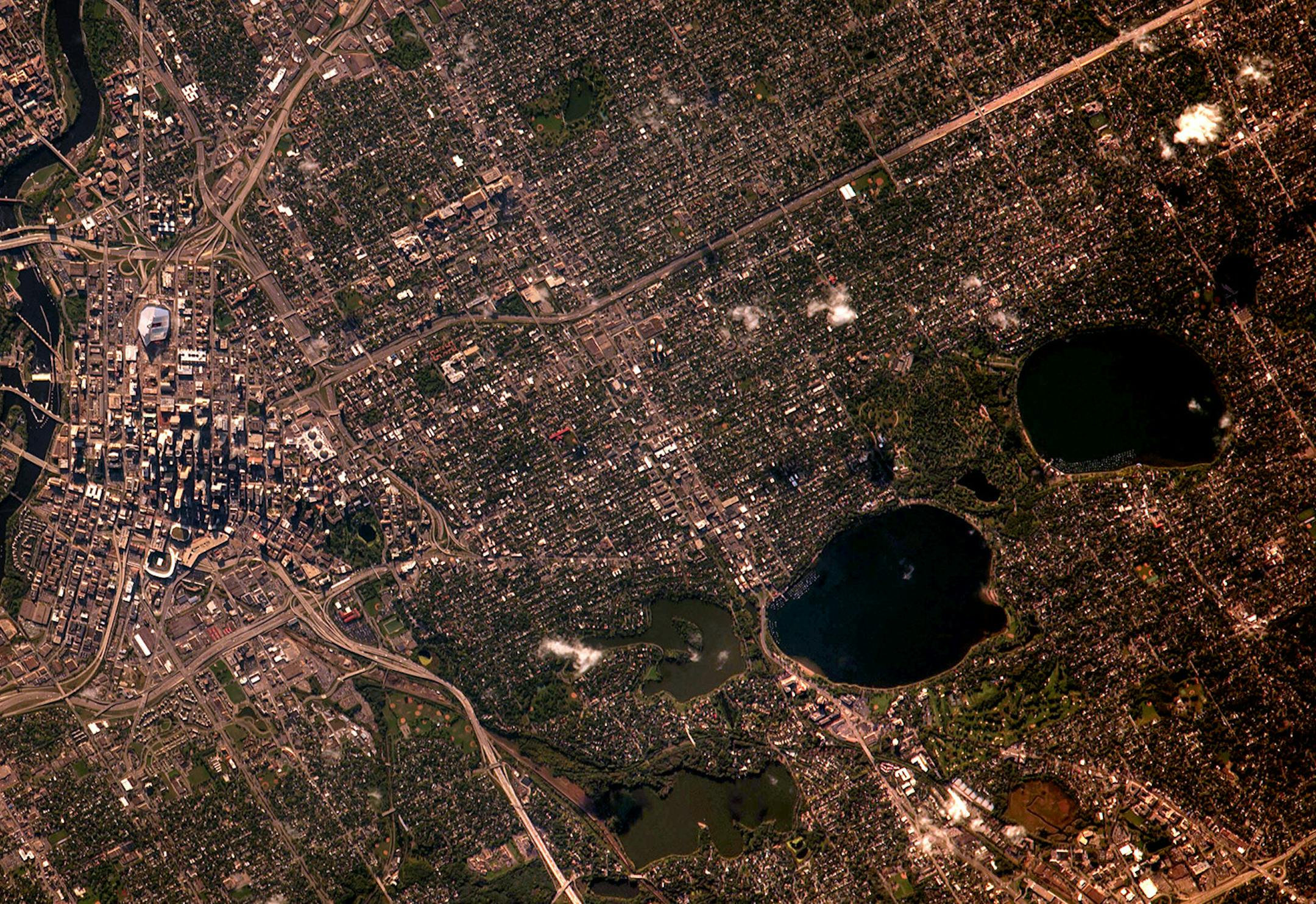
The stunning photo provided by astronaut Kjell Lindgren ("City of Lakes from outer space," Sept. 23) brings to mind the recent issue here in Minneapolis and that is the renaming of Lake Calhoun. It points out two city lakes in the picture: Lake Calhoun and Lake Harriet. The answer is right here before our eyes. We call them Lake 1 and Lake 2, just as we have done with our airport terminals, Terminal 1 and Terminal 2. And then get on with real business.
William Lundquist, Bloomington
• • •
I think Peter Bell's position is correct ("Calhoun name focus prompts resignation," Sept. 23). Let's put the Civil War behind us. With due respect to the Dakota name Mde Maka Ska, it is hard to remember, hard to pronounce and hard to spell. Lake Calhoun is a popular lake in Hennepin County. If a poll were taken in the county, it is my belief that the majority of respondents would favor keeping the name they like: Lake Calhoun. Personally, I have yet to meet a single person who favors this change. My other thought: When you have an advisory panel of 21 people, they have to find something to do.
Richard Doyle, Edina
MIGRANT CRISIS
How my Italian family's story is also the Syrian refugees' story
I have just sent one of my largest donation checks ever. After reading about the Syrian migrant crisis for days with horror and astonishment, today I realized that the crisis belongs to me.
We are a nation of immigrants. Yet, in our comfortable lives, we tend to forget. Oceans separate us from many conflicts. Years separate us from our forebears who arrived with nothing but their wits, the clothes on their backs and hopes for a better life.
Now I remember the Sicilian great-grandmother I almost had. In Sicily, she married a man who went for military service to the Piedmont region near Switzerland. There, he converted to Protestantism. When he returned home, he built a chapel in their hometown outside Palermo. The small congregation suffered antagonism, and the Protestant chapel was soon burned to the ground. Leonardo D'Anna and his wife and child, afraid for their lives, booked passage for the New World.
New York in the 1880s was chock full of immigrants. Leonardo's wife found many hungry families around her. With that Italian propensity for feeding those in need, she began taking meals to less-fortunate neighbors. Inside Little Sicily or out, she was the lady with steam rising from a pan of stew or a loaf of bread. In a few months, she contracted flu and died. My great-grandfather Leonardo D'Anna sent word to her sister. He would marry her when she arrived in New York. She never returned to Italy. From these beginnings grew one side of my father's Italian immigrant family, giving to Scranton, Pa., a Protestant minister and local leader, to Washington, D.C., two granddaughters who worked for the Office of the President and the Public Health Service, and to Charleston, S.C., my father, a professor of U.S. history.
Is it any wonder that I finally see the Syrian migrants as relatives under the skin and feel I must help open doors to their survival?


