

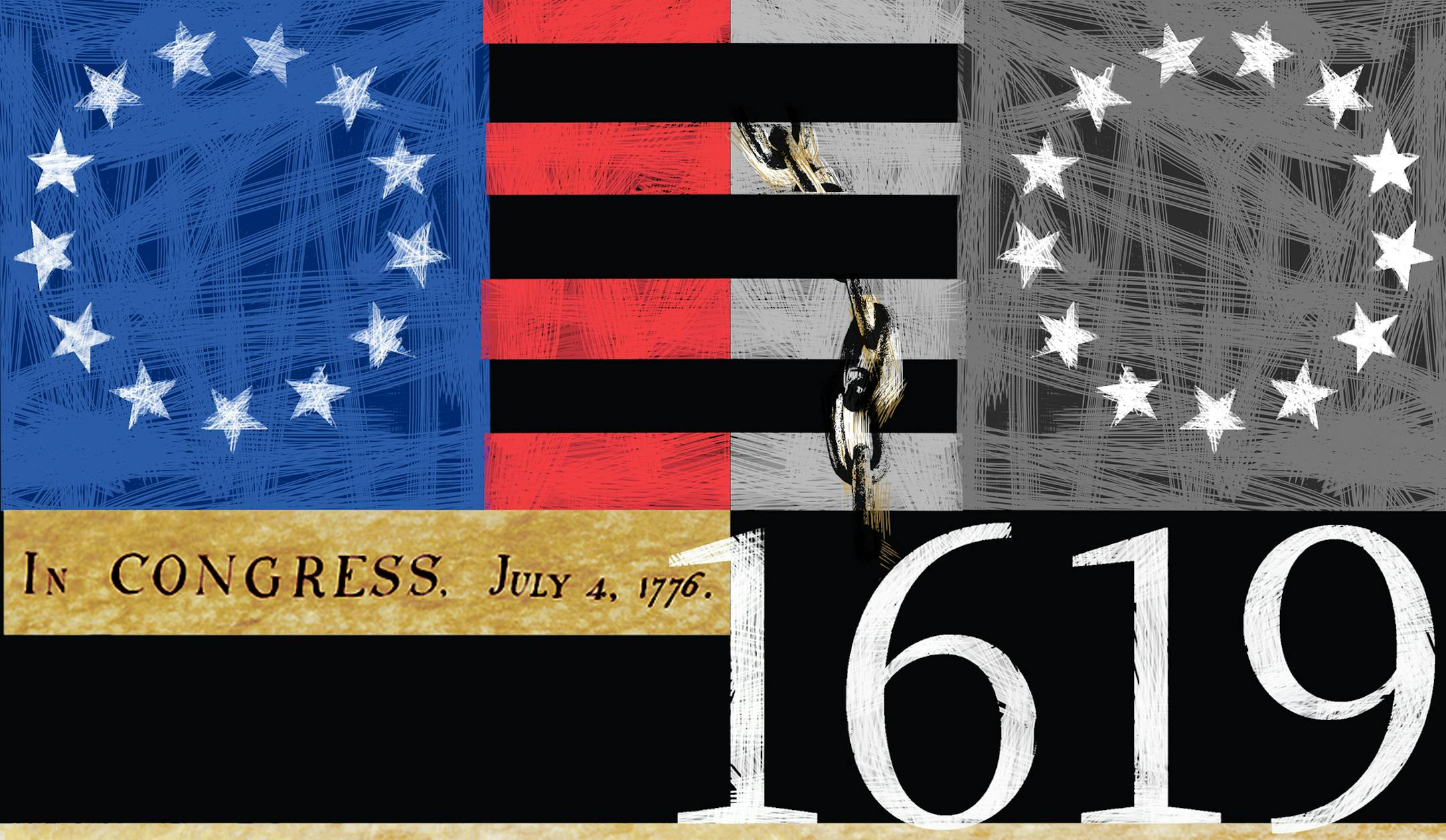
Many thanks to Katherine Kersten for bringing the New York Times' "1619 Project" to our attention in her Dec. 8 commentary "1619 revisited, revisited." Yet, Ms. Kersten does not seem to understand the purpose of the project, which is simply to acknowledge that in the year 1619 early settlers in Virginia purchased the first slaves in our nation's history, setting in motion a power imbalance between our European and African ancestors that persists to this day. No amount of apology or denial can alter the fact that our country's development has been stunted by the extreme racial prejudice arising from slave ownership.
Kersten would like us to forgive our abhorrent practice of enslaving other humans because slave trading has had myriad other practitioners throughout global history. This approach may allay her guilt but ignores the damage wrought on our society by this insidious threat to freedom. We will never be able to truly live by the principles stated in our Constitution unless we acknowledge and rectify our sins of the past, and rebalance power in our country for the privilege of all its people.
Joseph Ehrlich, Arden Hills
• • •
Kersten's disapproval of the 1619 Project says much about the current state of conservative thought. She objects because the project suggests we consider American history through the experiences of the people who bore centuries of slavery, torture, terrorism and government-sanctioned discrimination.
She is telling us: Do not think. Do not consider the lasting legacy of slavery. (Everyone was doing it!) Do not worry about racism. (We're colorblind!) America is exceptional. (There's nothing to fix!)
The 1619 Project was a stunning piece of reporting precisely because it provokes us to think critically and to consider the experiences of people whose lives are different from our own.
Kersten clearly doesn't want us to think critically. So she gives permission to ignore hard truths, and offers comfort to the comfortable.
Holly Ziemer, Edina
• • •
Every reader of American history learns about the Revolutionary War and the Founding Fathers who were so paramount to its success. What they don't read about is that slavery was essential to that success. Colonial society, over generations, produced the leaders who aped their forbearers in England. Because of the slave workforce that they controlled, and the wealth it produced, these generations of white men had the education, the training and the free time to devote themselves to fighting a war and creating a government. Without the slaves, this group of men would not have evolved, and names like Washington, Jefferson, Madison, Monroe and Lee might not be so well-known in our history. That is the great "what if" of that history. If there had been no slaves, would there be a Washington, D.C.? It was serendipitous that slavery helped create a democracy. As terrible as slavery was, without it, this nation would not be what it is today. Black Americans can take pride in what their ancestors helped accomplish.
Tom Obst, Wyoming, Minn.
• • •
Kudos to Kersten for reminding us that the history of the United States is not entirely a narrative of slavery and evil oppression, but also righteous liberal movements that eventually helped improve conditions for persecuted people who stood up and demanded equity and equality. These other progressive causes ranged from suffrage and equal rights for women, to better pay and benefits for all workers, to economic security and health care for the elderly and all manner of other vulnerable people, to environmental justice. National opinion writer Timothy Egan makes a similar case in a recent column ("America the Hot Mess," New York Times, Dec. 6) for celebrating our better angels of the past in a recent column, calling all of us to a more "progressive patriotism" as we look in the rearview mirror.

