

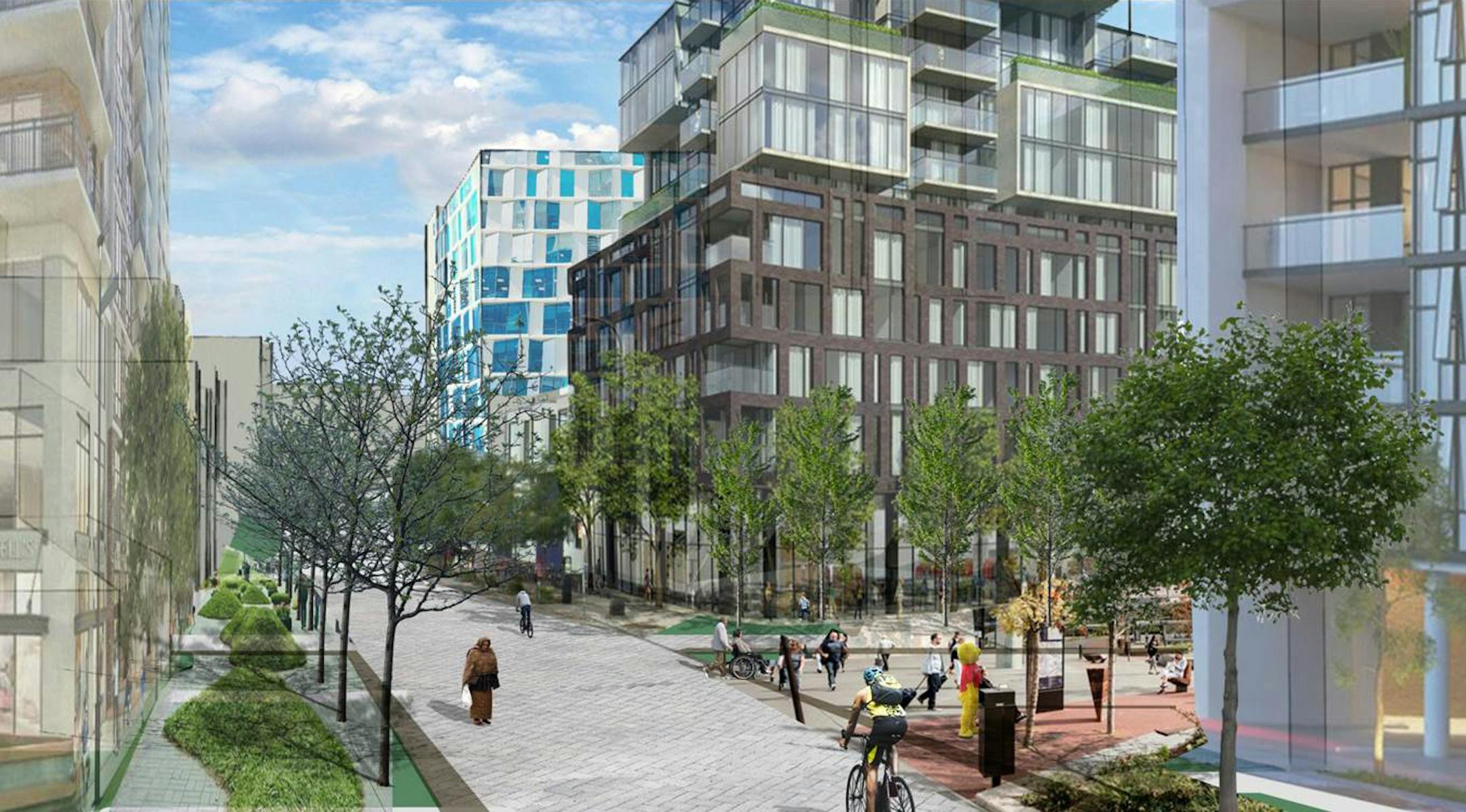
I am glad Neighbors for a Livable St. Paul has taken the time to identify some of the glaring transit flaws surrounding the development plan for the Ford site ("Plan for Ford site has serious flaws," editorial counterpoint, Aug. 18). The group has identified "crowding, congestion, pollution, noise, traffic and overtaxing of community services" as the main issues with this plan. Incidentally, most of these issues are not problems with humans, development or housing, but cars. Community services tend to scale with additional humans, becoming more efficient with larger communities.
The truth is that Neighbors for a Livable St. Paul would prefer to retain a system in which a few can drive as they please throughout our lovely city, keeping additional folks out. A more just and equitable solution would be to design our communities around humans so that everyone can go about their business without degrading local air quality, mowing down other humans, and rendering our communities increasingly toxic and unlivable. In these days of mass migration toward urban areas, we are going to have to learn to cooperate with each other and welcome newcomers into our communities. The Twin Cities have plenty of space for all of our bodies, but not necessarily all our vehicles. Consider prioritizing humans over convenience.
Mickey Rush, St. Paul
• • •
When a city can no longer grow out, it must grow up. I mean this both literally and philosophically.
After news of property tax increases and the loss of right-of-way fees, it's crucial — now more than ever — that St. Paul expand its tax base. Mixed-use developments in walkable neighborhoods like Highland Park outperform lower-density and auto-oriented developments and have a higher return on investment. The Ford site is a prime opportunity to add to our city's bottom line while adding new housing and new businesses. I encourage the City Council and mayor to approve the proposed zoning and public realm plan, and I look forward to seeing development finally occur on the brownfield site.
Nathaniel Hood, St. Paul
FOOTBALL AND BRAIN INJURIES
As with addressing any problem, self-reflection is key first step
I never liked football, so am not a good spokesperson for boycotting the sport, but Richard Lawson is, in his Aug. 23 commentary "Football and brain injuries: We spectators bear the blame, too." I love his analogy to a new game called "Brickhead." Hopefully, in 20 years, football stadiums will be converted into homes for the rising worldwide refugee population, also driven by our refusal to face reality. But, hey, I still think humans are capable of learning and acting from our better selves. The kind of action Richard is taking — looking inside and changing himself — is what it will take.
Nance Kent, Minneapolis
REGIONAL RACISM
It's too easy to blame the South when the North is so flawed
The poorly chosen title of the Aug. 15 commentary "Southern culture is spring from which racism erupts" continues the tradition of giving us Northerners, particularly white Northerners, the common escape that "racism is mainly a Southern problem." This could not be further from the truth. From the Twin Cities' history of residential segregation in the form of redlining to its latest disgrace in the Philando Castile case, the only thing Minnesota does better when it comes to racism than the South is hide it from plain view. Just look at the Legislature's response to valid concerns about police-involved shootings and other brutality that sparked protests last summer. It was to try to pass legislation penalizing protesters. And in North Dakota, where legislation was introduced that would have protected the driver in Charlottesville's deadly attack. It therefore should come as no surprise that a recent study by 24/7 Wall Street found that the top five states with greatest racial inequality are in the North, with Minnesota ranking second-worst.
It is not Southern culture from which racism springs but the American culture of institutionalized racism. Being from the North should therefore offer no solace to anyone when reflecting on the events in Charlottesville, Va. I only hope that instead it motivates us to do better here.


