

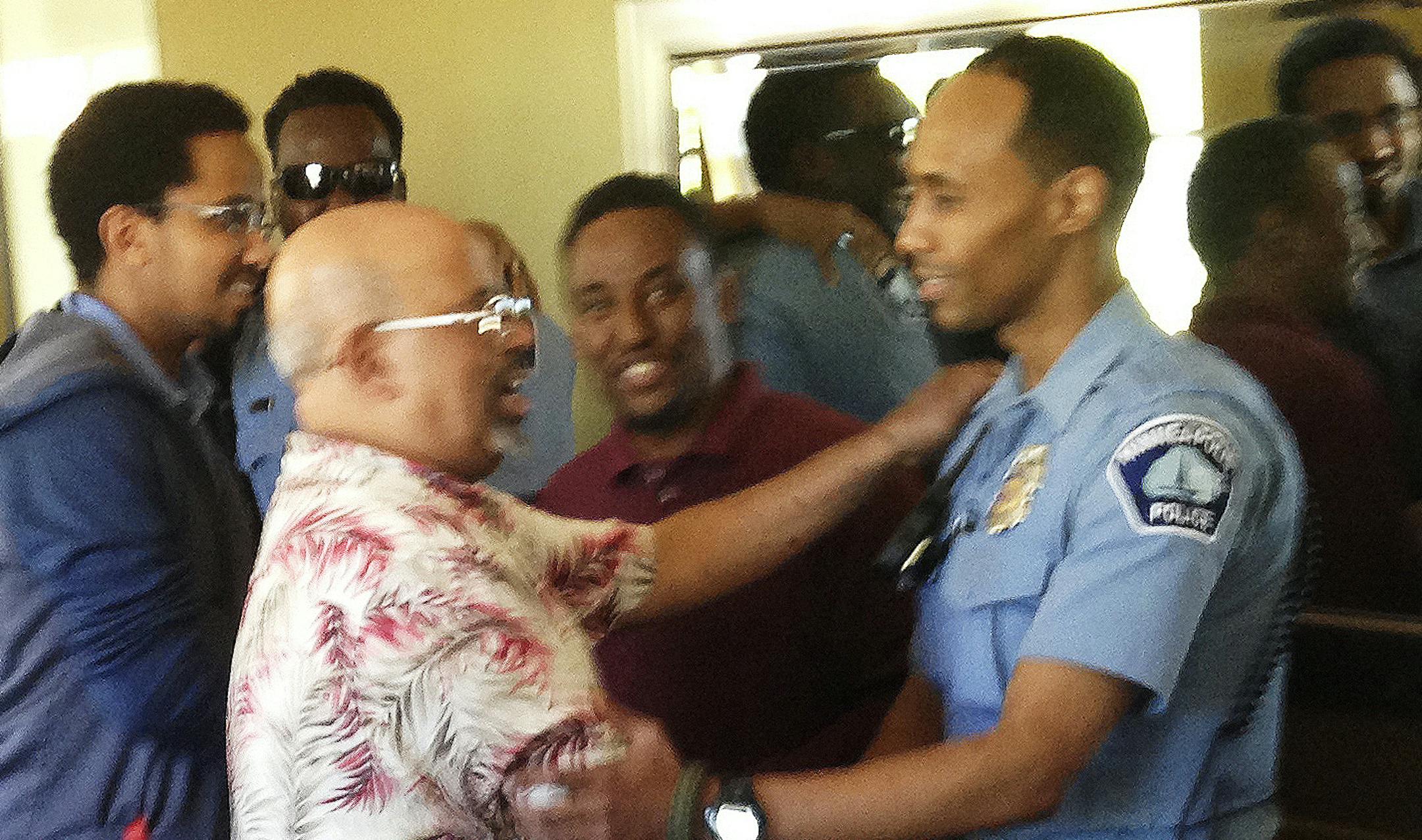
Ahmed Tharwat ("Somali-American officer caught in the crosshairs," July 27) is insistent that we not lump all Somalis into one homogeneous category and that Mohamed Noor, the Minneapolis police officer who shot Justine Damond, be judged as an individual, a very sound principle that we can agree on.
It makes me wonder why Tharwat is so quick to do this himself and is fairly blind to the fact that he does it nonstop throughout his commentary. He writes at the top that a headline from "Fox News U.S., a right-wing-nut media outlet … encapsulates the general reaction of all media, police leaders and the community at large." So we conclude that everyone who watches Fox News is a right-wing nut, but more damning that we ALL fall in line with its conclusion. The rest of the piece follows suit, implicating large groups based on a few scattered examples. I also find it difficult to deal with an issue honestly and root out the problems if we're all considered guilty and on the defense from the start, which is exactly the point he's making about the Somali community.
One of the most interesting aspects of the Noor-Damond case is that many of us have had our preconceived ideas about race and police thrown completely upside down and have been forced to think about those ideas in different ways. I have observed this being done for the most part by individuals on all sides of this issue in honest fashion. Tharwat would certainly have more credibility if he were willing to do the same.
Tim Turner, Coon Rapids
• • •
Minneapolis mayoral candidate Raymond Dehn's statement at the mayoral forum the other night wherein he called for disarming Minneapolis police officers is yet another reminder of how far my Democratic Party has veered from the common-sense center ("Mayoral candidates clash over cop reform," July 26). Being a Democrat always meant to me that you were pro-middle-class-America — you supported labor rights, individual rights, the social-safety net and the rule of law. It meant that there was nothing incongruous with supporting the police and civil rights, or wanting to expand social programs and controlling immigration, or supporting free trade and keeping jobs in the U.S. And most of all, you used and acted upon your common sense. But today, all we see are people who want to increase our property taxes, grant illegal immigrants all the rights of citizenship, and diminish the authority of the police and government.
Look at some of our Democratic leaders' positions on issues within my lifetime. Mike Dukakis (1988 presidential candidate) supported America-first trade policies and was against the "free trade" agreements of the day; Walter Mondale, during his 1984 presidential campaign, was criticized by Republicans for advocating that all cars sold in the U.S. contain a certain percentage of American-made parts; President Bill Clinton in 1996 strenuously advocated for an additional 100,000 police officers; Al Gore, as a presidential candidate in 2000, supported a tough street-crime-fighting platform that included an additional 50,000 police officers; U.S. Sen. Dianne Feinstein (who has always been considered a very liberal Democrat) in 1993 argued for tighter controls on our borders because the influx of illegal immigrants was costing taxpayers billions in public services; and President Jimmy Carter (probably the most liberal president in the past 50 years) pushed through new regulations controlling undocumented aliens in the U.S. because they caused a depression in working-class wages and a decrease in unionization. These used to be good Democratic ideas, but in present-day Minneapolis they would be labeled anti-trade, anti-immigrant and fascist.
And we Democrats wonder why we're losing so many elections. Wake up. Our party has lost its way and it's time we right our own ship.
Joe Tamburino, Minneapolis
AFTER HIGH SCHOOL
Don't find yourself caught with just one path through life
Regarding coverage of the respective values of various types of postsecondary education: My father, a career Army officer who had experienced the Great Depression, said it was wise to have a craft and a profession. That way you can fall back on one if there are no opportunities for the other.


