

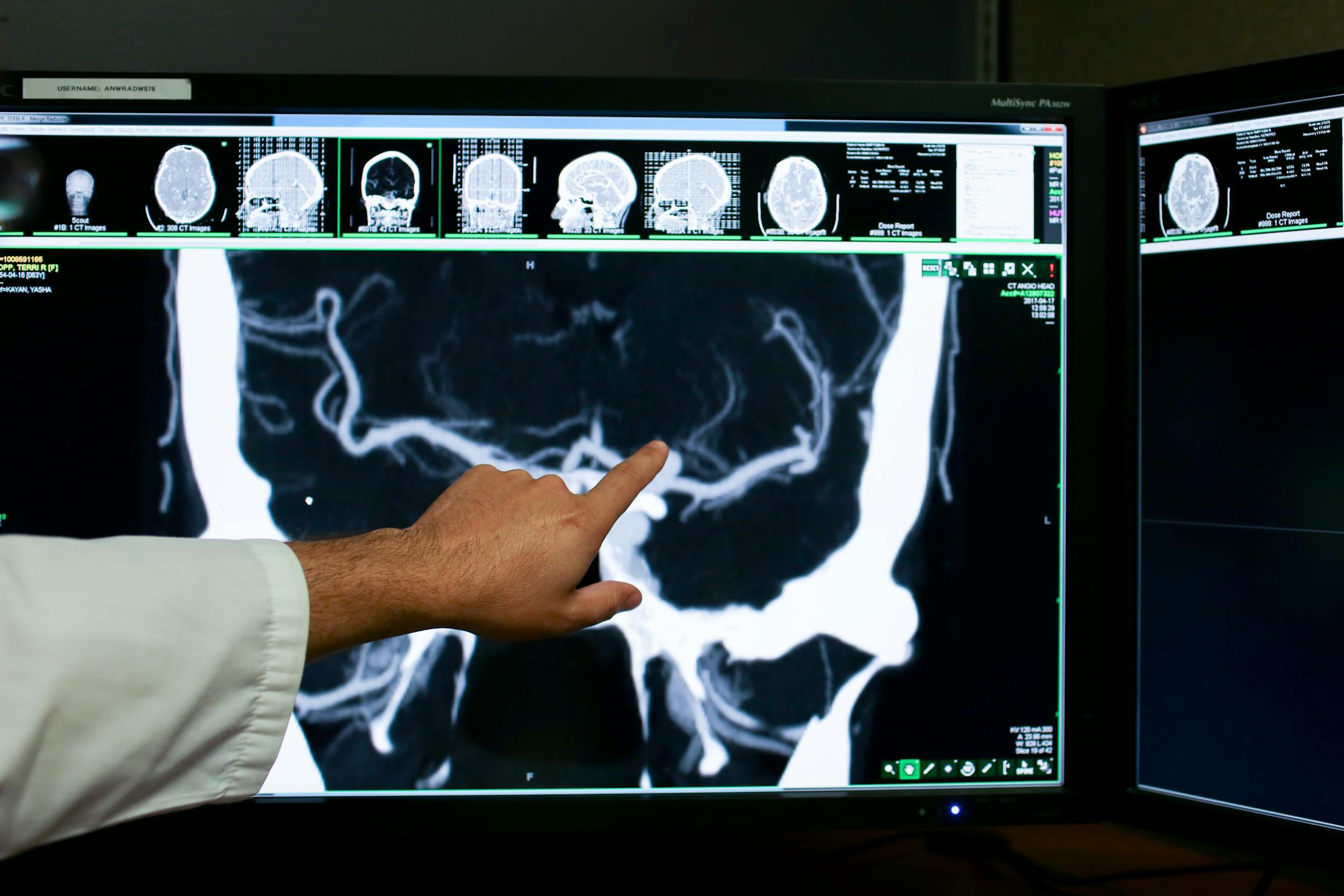
When minimally invasive brain surgery was being invented, pioneering doctors like Minneapolis' David Tubman would sometimes slice off the ends of the flexible tubes used in heart surgery and use them in operations to fix potentially catastrophic problems in the brain.
"Honest to God, you should see what we used to use," recalled Tubman, who performed some of Minnesota's first minimally invasive brain-aneurysm repairs in the 1990s, in clinical trials at the University of Minnesota and later in regular practice at Abbott Northwestern Hospital. "It's come a long way since then, there's no doubt about that."
The skinny tools that can reach deep into the brain to treat aneurysms and strokes without cutting through the skull have advanced far enough to spur new medical specialties known as endovascular neurosurgery and interventional neuroradiology, whose practitioners wield devices backed by clinical evidence and a robust commercial market.
The market for minimally invasive tools and equipment to treat brain problems like strokes and aneurysms is worth more than $500 million in the United States today and is likely to surpass $1 billion by 2025, according to estimates from analyst Beata Blachuta with Decision Resources Group. Those estimates were considered conservative by another source.
Industry analysts say the dominant player in the neurovascular-device market is Minnesota-run Medtronic PLC, by virtue of its 2015 acquisition of industry forerunner Covidien, which had neurointerventional devices once owned by Plymouth-based firm ev3. Stacey Pugh, a registered nurse and general manager of Medtronic Neurovascular, said periodic acquisitions by larger and larger companies show the clear market appetite for the technology.
"We're just beginning to scratch the surface I think of what is possible in terms of endovascular medicine," Pugh said. "Making these devices smaller, softer, capable of being delivered in more distal regions of the brain without complication, I think we'll find ourselves in a position where you're going to get well above 90 percent of aneurysms being able to be treated without someone having to have their skull opened."
Today about 70 percent of brain aneurysms are treated with skinny tubes inserted in blood vessels lower in the body and then advanced through the blood vessels until they reach the brain. Now similar types of tools are being used to reach stroke-causing blood clots as well, but the process of rolling out that technology has been slower than for aneurysms — only about 1 in 10 stroke patients who would benefit from the highly recommended therapy get it.
Minimally invasive endovascular neurosurgical tools are built on the idea that it's possible to perform brain surgery using only surgical tools that are inserted through a small incision in the groin. The doctor uses live-motion X-rays to guide the tools to targets just a few millimeters wide in the brain. Doing it this way allows the surgeon to fix a problem from inside the vessel, avoiding the need to cut into skull to reach the exterior of the vessel.
![Neurointerventional Radiologist Dr. Josser Delgado, MD shows web devices used for preventive surgery on brain aneurysms. ] COURTNEY PEDROZA • courtney.pedroza@startribune.com June 13, 2017 Minneapolis, MN Abbott Northwestern Hospital; performed by Dr. Josser Delgado, MD; patient Terri Hopp; preventive surgery on a brain aneurysm](https://arc.stimg.co/startribunemedia/S5LMMS6NYLBCVODUF4HLHGGXMY.jpg?&w=1080)


