

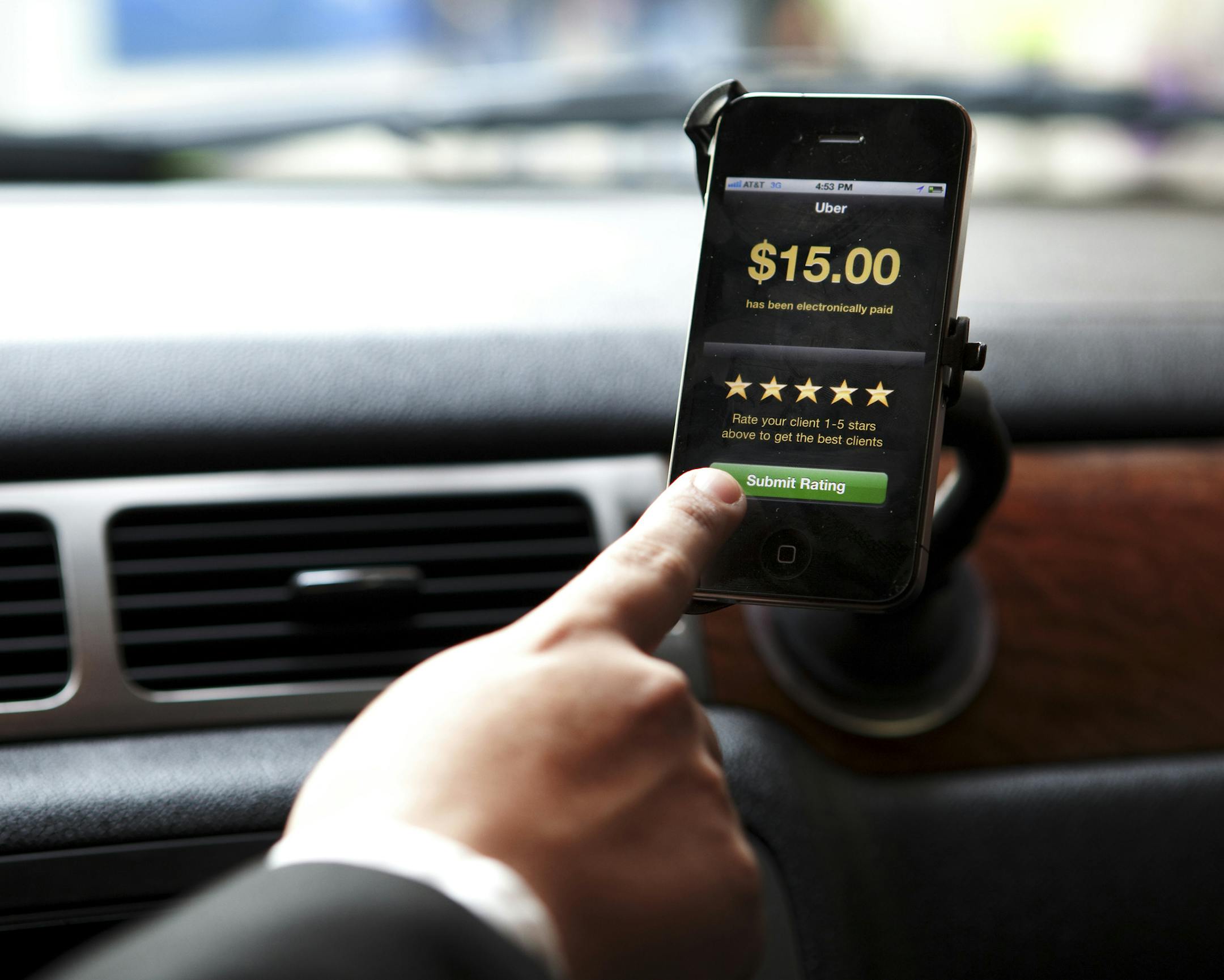
Online rideshare companies like Uber may soon have to cover their drivers' private vehicles with $1 million auto policies even before drivers accept a fare, in what would be the most stringent standard in the nation if adopted.
Lawmakers supporting the measure say it would close dangerous lapses in coverage for the drivers, while an Uber representative said Monday that such a proposal could seriously jeopardize the fast-growing rideshare industry.
"This type of legislation affects whether Uber will be able to operate in the state, and certainly impacts whether we would be able to expand to other cities in the state," Uber Midwest General Manager Michael White said shortly after the Senate Commerce Committee passed the measure. "We've never operated under legislation as onerous as the legislation in Minnesota. We would have to seriously look at whether this is a model under which we could operate."
Minneapolis, St. Paul, and six other cities and states across the country, have already passed their own ordinances mandating $1 million in commercial insurance policies for drivers of the companies, who connect fares exclusively through smartphone apps. But that coverage does not kick in until the driver accepts a ride request through the app.
A bill sponsored by Sen. Kari Dziedzic, DFL-Minneapolis, goes a step further, requiring that commercial coverage begin as soon as a rideshare driver turns on the app, indicating that he or she is willing to pick up a fare. When the app is off, drivers revert to their personal policies, which have a minimum coverage of $30,000.
The legislation is a response to concerns from 26 state commerce commissioners about insurance coverage gaps. The concerns stem from the 2013 death of 6-year-old Sophia Liu of San Francisco, who was struck and killed in a crosswalk by an Uber driver who was awaiting a fare request. That incident led to a lawsuit against Uber over insurance liability. As a result, California became the first state to pass a measure requiring that Uber supply its drivers with $50,000 in death and injury liability coverage, $100,000 in total coverage and $30,000 in property damage, along with an additional $200,000 in excess liability coverage. Minnesota's legislation, which advocates say is modeled after that, goes significantly farther.
"What we cannot have in Minnesota is a situation similar to what we saw in California," said Commerce Commissioner Mike Rothman, who testified on behalf of the bill. Senate Commerce Committee Chairman James Metzen, DFL-South St. Paul, is a cosponsor of the bill.
The proposed policy requirement is more stringent for than for taxicab companies, who in Minneapolis must offer $300,000 in coverage. The Metropolitan Airports Commission requires cabs to carry $600,000 in coverage. Cap O'Rourke, a lobbyist for taxicab companies, told the committee that the larger cab companies he represents voluntarily take on insurance policies averaged at $2 million.


