

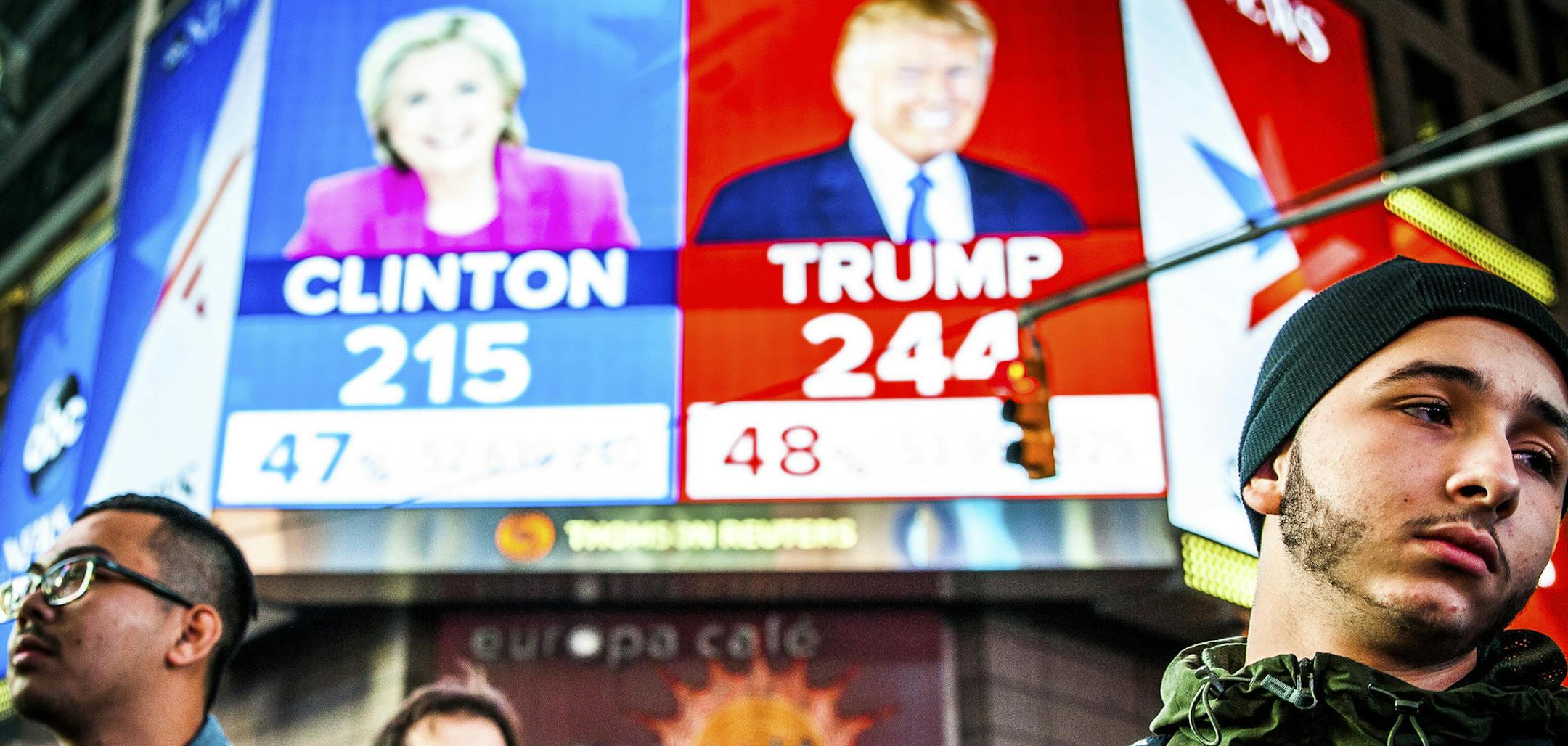
Reviewing the presidential election results, many commentators note that Donald Trump — like several previous Republican presidential candidates — prevailed in the Electoral College without winning the popular vote. This is true, but it's also irrelevant. It's irrelevant legally, of course, because the Constitution provides for the election of a president through the Electoral College. But it's also irrelevant in terms of the democratic legitimacy of the result.
In the election concluded Tuesday, Hillary Clinton received more popular votes than Trump. This does not mean that Clinton would necessarily have prevailed in an election that was determined solely by the popular vote. This is because the popular vote total is itself a product of the Electoral College system. As a consequence, we do not know what the result would have been under a popular vote system, let alone whether Clinton would have prevailed.
The reason for this is because the Electoral College system encourages the campaigns (and their surrogates and allies) to concentrate their efforts on swing states — those states in which the electoral votes are up for grabs — at the expense of those states in which one party or the other has no meaningful chance to prevail. The presidential campaigns make no significant effort to turn out votes in populous, but noncompetitive states such as California, New York and Texas. There is no advantage to running up the score in a state that is solidly in one camp, nor is there much benefit in trying to drive up turnout in pursuit of a hopeless cause.
So, for instance, a GOP campaign would invest little in trying to drive up the vote total in Texas or reducing the margin by which its candidate loses in New York or California, and ditto the Democratic campaign in reverse. Under a popular-vote system, on the other hand, every vote in every state would count equally, and campaigns would be likely to devote substantial resources driving up turnout in these same states. We don't have any particularly reliable guide as to what vote tallies such efforts would produce. Voter knowledge as to whether they are in a competitive state may also affect voter behavior, such as the willingness to support a third-party candidate or to cast a protest vote, further altering the result we would see under a different system.
What all this means is that when the popular vote is reasonably close — as it was this year, as it was in 2000 and 2004 — we cannot say with confidence that the candidate who won the popular vote under the Electoral College system would also have won the popular vote under a popular-vote system. It's possible, but anything but certain. So while it's true that Clinton won the majority of popular votes cast, we don't know that she was actually the candidate voters would have picked were we to rely on the popular vote.
Jonathan H. Adler teaches courses in constitutional, administrative and environmental law at the Case Western University School of Law, where he is the inaugural Johan Verheij Memorial Professor of Law and Director of the Center for Business Law and Regulation. He wrote this article for the Volokh Conspiracy, an independent blog anchored by a group of law professors from universities around the country and hosted by the Washington Post.


