
Claes Oldenburg's 1960s work at Walker Art Center

Walker Art Center revisits Claes Oldenburg's 1960s art and finds the germ of today's polished Pop in his rougher, more acerbic early work.With his "Spoonbridge and Cherry," New York-based artist Claes Oldenburg gave Minneapolis a photogenic icon with astonishing staying power. Bright, playful and easy to like, the fountain-sculpture has been the beloved centerpiece of the Minneapolis Sculpture Garden since it opened in 1988.

September 19, 2013 at 8:10PM
The early career of Pop artist Claes Oldenburg is reprised in "The Sixties," opening September 22 at Walker Art Center in Minneapolis, MN. September 13, 2013. ] JOELKOYAMA•joel koyama@startribune
In his “Street” installation, Oldenburg used cardboard and stains to suggest urban grit. (The Minnesota Star Tribune)

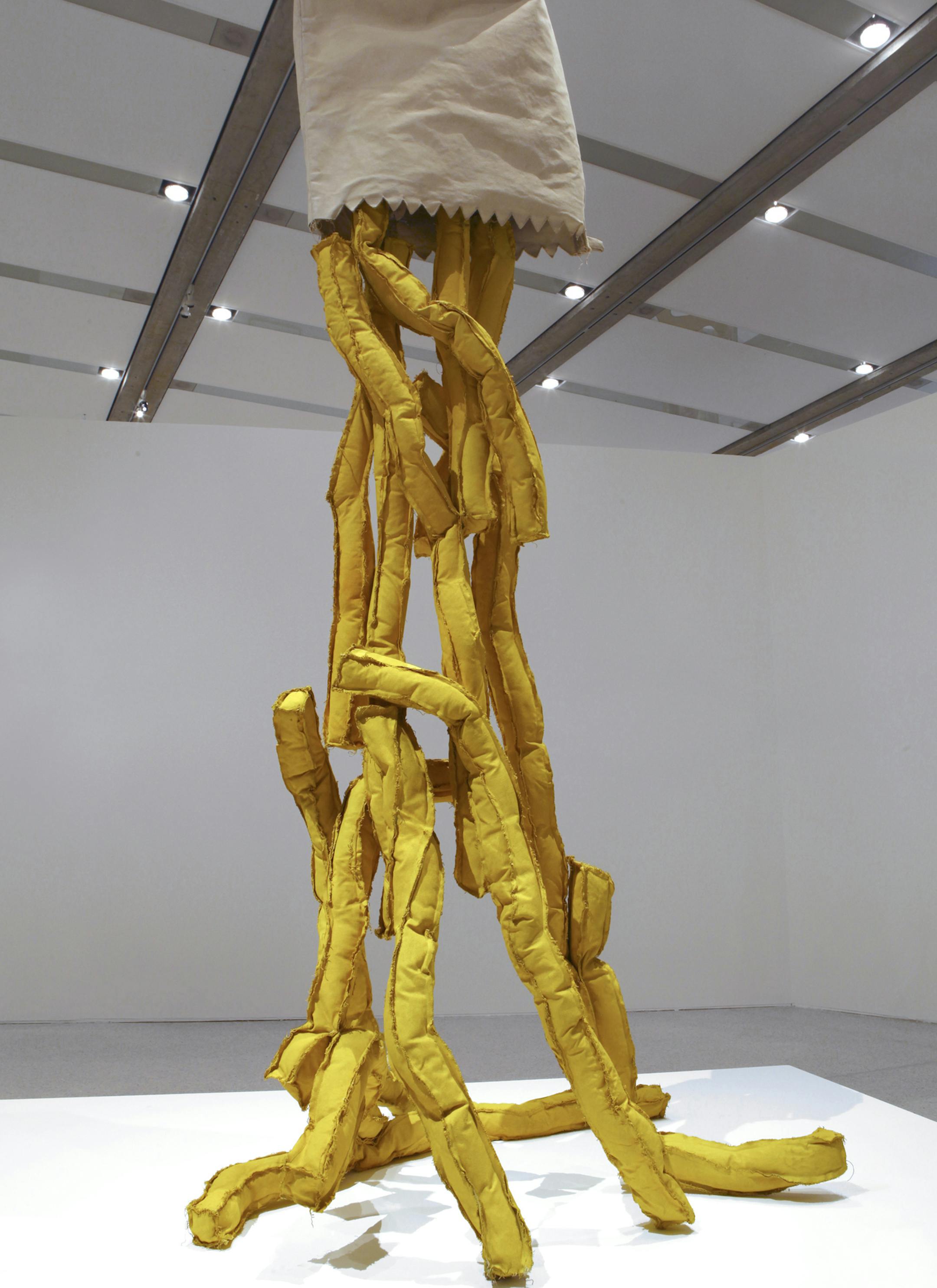
For years, a cheerful blue-and-yellow mouse sculpture by the artist peered down on the garden from the rooftop terraces of nearby Walker Art Center, and visitors to the museum often would encounter Oldenburg's eccentric soft sculptures — a 9-foot-tall bag of shoestring potatoes tumbling onto the floor, or a gigantic electrical plug dangling over a stairwell.

Given the bold scale and whimsical charm of such art, it's natural to think of Oldenburg, 84, as just a clever jokester having fun with Pop culture. That's not wrong, but there's a whole lot more to the guy as seen in "Claes Oldenburg: The Sixties," a deep-dish survey of his work from a protean decade that was way messier, more rambunctious and improvised than his polished later art suggests.

Organized by Vienna's contemporary art museum, the 300-piece show opens at the Walker on Sunday and will be on view through Jan. 12. Minneapolis is the last stop on a tour that debuted in Vienna and included venues in Cologne, Germany and Bilbao, Spain, as well as the Museum of Modern Art in New York.

The '60s represented a legendary era in American art, an explosive decade when Roy Lichtenstein turned comic book scenes into million-dollar paintings, Robert Indiana made LOVE into a logo and Andy Warhol fashioned soup cans into art.

Somber-minded Abstract Expressionism was on the wane by 1960, its loopy gestures, lyrical effusions and high-minded theory increasingly out of touch with the gritty reality of life in Manhattan, then the world's art capital. Plus there were new kids in town, eager to knock the establishment off its pious pedestal and launch something different.

Oldenburg was among the fresh faces. Born in Sweden, he grew up mostly in Chicago, where his father was a diplomat. After studying at Yale and the Art Institute of Chicago, he settled in New York in 1956 and has lived and worked there ever since.

Street, Store and Home

The Walker's three-gallery show opens with crude drawings and rough cardboard cutouts from "The Street," a 1960 installation of graffitilike figures and bruised body parts whose edgy chaos conveyed a sense of urban decay. Snapshots from the artist's notebooks of the time footnote Manhattan's shabby industrial underbelly.

Around the corner are relics from his famous "The Store," a 1961 installation-shop in his storefront studio where for several months he sold sloppy, paint-splashed wire-and-plaster sculptures shaped like shirts, ties, cigarette packs, baked potatoes, cheeseburgers, pastries, lingerie and other commodities. A simultaneous critique and celebration of American consumerism, "The Store" was a guerrilla-theater performance in which the slapdash sculptures also poked fun at the grand gestures of Abstract Expressionist paintings.

He began making "The Home" objects, displayed in the next gallery, around 1963 and continued through the decade. Here's where his genius really soars, as he transforms ordinary objects — light switches, toilets, a bathtub, a fan and a vacuum cleaner, electrical plugs — by enlarging them to monstrous proportions and fashioning them from hard or incongruously soft materials such as canvas or vinyl that deliberately provoke fanciful, often sexual associations.

In a series of drawings and sculptures, a soft vinyl electrical plug suggests a cow's gigantic udder, while a half-buried hard plug morphs into a house. Likewise, a 5-foot-square double light switch, made of canvas, droops and sags like an old woman's breast, its light switches protruding from their sockets like distended nipples.

"His forms are transmuted and tend to have a human reference," said former Walker director Martin Friedman, who bought or commissioned many of the museum's Oldenburg works. "The hard forms have a skeletal association and the soft ones are like skin and flesh; that's very important."

Imaginative transformations

Throughout the show, the artist applies his protean imagination and remarkable drawing skill to surreal effect, transforming women's legs into shoestring potatoes, lipsticks or cigarettes; proposing a gigantic-drill-bit fountain for a London square; turning stylized mice heads into film projectors, a cannon, an electrical plug and even ray guns — a sci-fi toy whose mutability became a metaphor and curious alter ego for the artist.

Because "The Sixties" focuses primarily on a single decade early in Oldenburg's career, it unfortunately doesn't trace his formidable influence on contemporary art, with its obvious echoes in the dysfunctional plumbing fixtures of Robert Gober and the scale shifts of Jeff Koons, to cite just two examples. He introduced humor and play into the previously somber field of sculpture, was a proto-feminist who sewed fabric sculptures, and pioneered happenings and multimedia performances.

"His early art still seems very fresh today," said Walker curator Siri Engberg. "He did all of it ­­— installation, performance, drawing, painting, sculpture — they all had equal weight to him. From the start, he was just an artist."

Mary.Abbe@startribune.com • 612-673-4431


Claes Oldenburg watches as his sculpture "Paint Torch" is installed by the George Young Company at the Pennsylvania Academy of the Fine Arts Saturday, Aug. 20, 2011, in Philadelphia. The prestigious art school and museum commissioned the celebrated 82-year-old artist to make the outdoor sculpture for its new public plaza, located two blocks north of his celebrated “Clothespin.” (AP Photo/Alex Brandon) ORG XMIT: MIN2013091616211397
Claes Oldenburg (The Minnesota Star Tribune)
Walker Art Center; Shoestring Potatoes 1966 by Claes Oldenburg
“Shoestring Potatoes,” 1966 (The Minnesota Star Tribune)
The early career of Pop artist Claes Oldenburg is reprised in "The Sixties," opening September 22 at Walker Art Center in Minneapolis, MN. September 13, 2013. ] JOELKOYAMA•joel koyama@startribune
For his installation and performance “The Store,” Oldenburg sculpted clothing, food and other commodities that he sold out of his studio for several months in 1961. (The Minnesota Star Tribune)
The early career of Pop artist Claes Oldenburg is reprised in "The Sixties," opening September 22 at Walker Art Center in Minneapolis, MN. September 13, 2013. ] JOELKOYAMA•joel koyama@startribune
A pastry case holds his faux food. (The Minnesota Star Tribune)
The early career of Pop artist Claes Oldenburg is reprised in "The Sixties," opening September 22 at Walker Art Center in Minneapolis, MN. September 13, 2013. ] JOELKOYAMA•joel koyama@startribune
Note the eccentric head at right in this colorful early Oldenburg drawing. (The Minnesota Star Tribune)
about the writer

about the writer

Mary Abbe, Star Tribune

More from Minnesota Star Tribune

See More
card image
J. SCOTT APPLEWHITE, ASSOCIATED PRESS/The Minnesota Star Tribune

The "winners" have all been Turkeys, no matter the honor's name.

In this photo taken Monday, March 6, 2017, in San Francisco, released confidential files by The University of California of a sexual misconduct case, like this one against UC Santa Cruz Latin Studies professor Hector Perla is shown. Perla was accused of raping a student during a wine-tasting outing in June 2015. Some of the files are so heavily redacted that on many pages no words are visible. Perla is one of 113 UC employees found to have violated the system's sexual misconduct policies in rece