

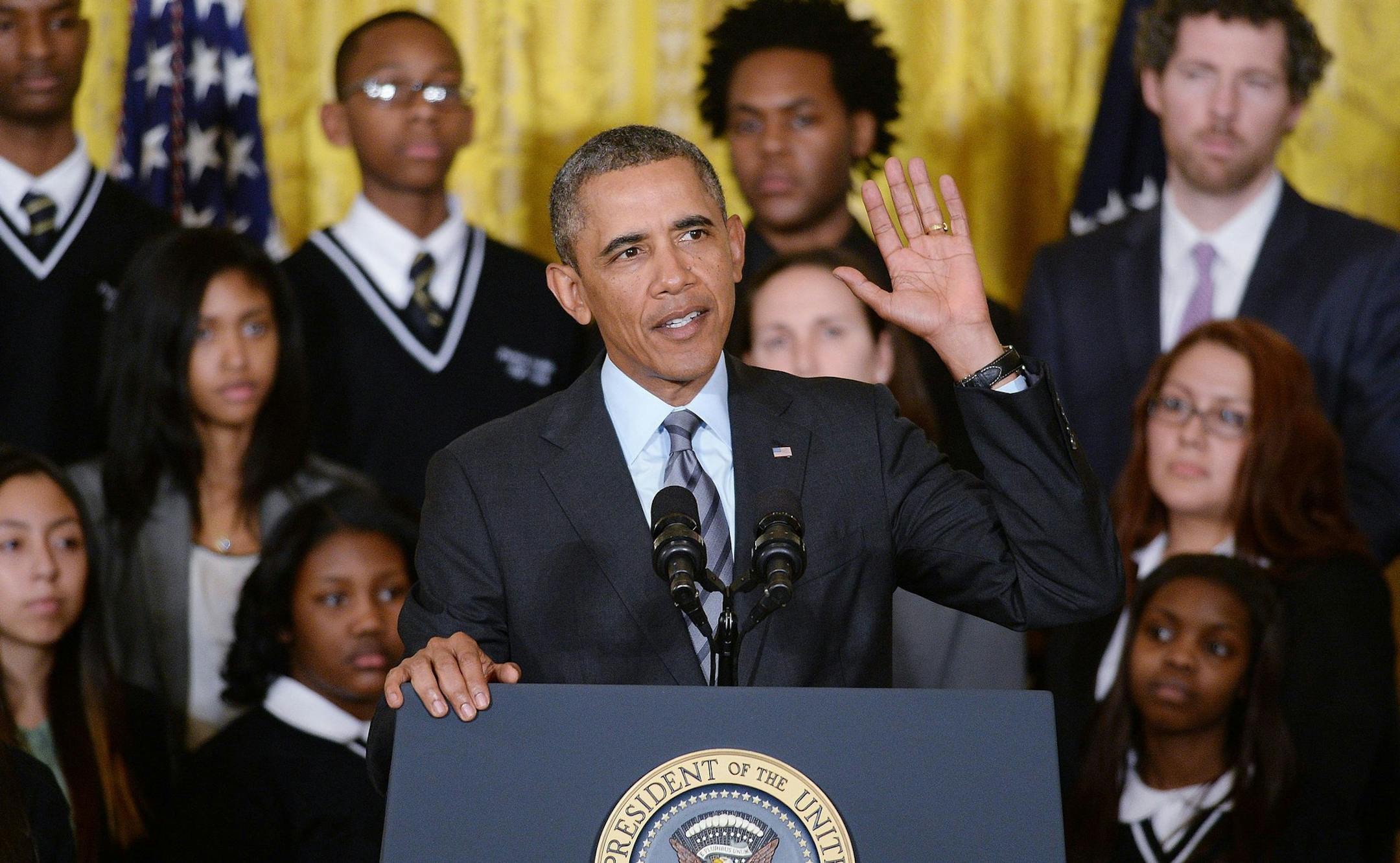
Invoking his life, President Obama made a plea for bipartisan work to combat poverty and declared, after a 2013 marked by struggles and disappointments, that "this is going to be a year of action."
Obama on Thursday offered a glimpse at his coming State of the Union address and its expected emphasis on economic disparities while announcing five communities that will be targeted for tax incentives and federal grants under a government "Promise Zone" program. "We've got to make sure this recovery — which is real — leaves nobody behind," he said. "And that's going to be my focus throughout the year."
Obama named the new zones — a blend of rural, urban and tribal communities — at a bipartisan White House assembly, underscoring the type of administrative actions Obama wishes to employ that don't all require congressional action.
'A challenge that unites us all'
Amid a slow recovery that has not reached many at the lowest rungs of the economy, addressing poverty has become an emerging issue in Washington. Obama has made it a central part of his agenda, and leading Republicans, including potential 2016 presidential contenders, are using the 50th anniversary of President Lyndon B. Johnson's War on Poverty to offer policy proposals aimed at the poor and struggling workers. Obama welcomed the bipartisan interest, saying, "this should be a challenge that unites us all."
In a rare public reference to his upbringing, Obama compared himself to a young man invited to the White House event on Thursday who graduated from high school under a 1997 Harlem program and become the first member of his family to attend college. As described by Obama, the student, Roger Brown, was the son of a single mother and was nearly expelled from school before deciding to make a change in his life.
"There was a period of time in my life where I was goofing off," Obama said. "I was raised by a single mom, I didn't know my dad. The only difference between me and Roger was my environment was more forgiving than his. That's the only difference. If I screwed up, the consequences weren't quite as great."
Thursday's five zones are the first of 20 that the administration intends to announce the next three years. They're in San Antonio, Philadelphia, Los Angeles, southeastern Kentucky and the Choctaw Nation of Oklahoma. Under the program, communities in the zones would have a leg up in applying for federal grants, benefit from more coordinated government assistance and would be singled out for possible congressionally approved tax incentives.
Thursday's announcement was part of an orchestrated White House lead-up to the State of the Union address. Next week, Obama will go to North Carolina to showcase programs that connect companies and colleges to boost high-tech manufacturing. He also plans two meetings with CEOs this month to identify ways to give workers more skills and to make commitments to hire long-term unemployed Americans.


