

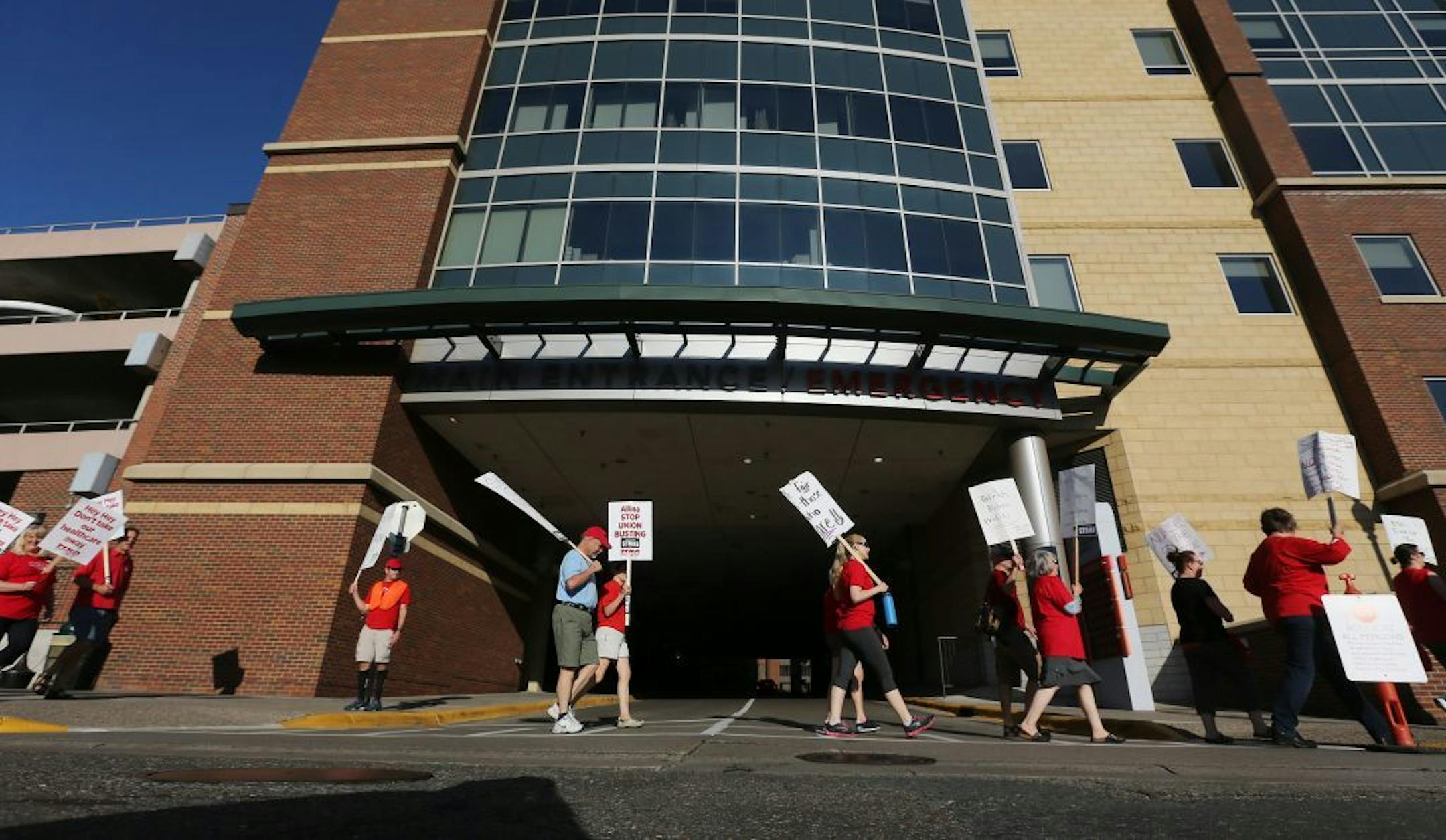
Union officials will meet today to decide when as many as 4,800 nurses should strike against five Allina Health hospitals in a dispute over health benefits and workplace safety and staffing.
The lingering question is whether an announcement of an open-ended strike will serve to push Allina and its nurses into productive talks, or simply serve as an extension of an increasingly bitter labor dispute. A union official said late Friday that the two sides have agreed to talk again on Tuesday.
"Strike votes happen with much greater frequency than actual strikes," said John Budd, a labor relations expert at the University of Minnesota. "It's easy to imagine that any time there is a strike authorization vote, it's almost always going to pass. It doesn't mean a strike is necessarily going to occur, but the rank and file doesn't want to pull the authority out from under its negotiators."
Hospital nurses from across the Twin Cities went on a one-day protest strike in 2010, then voted for an open-ended strike that was avoided when negotiations resulted in a last-minute deal.
But nurses believe a prolonged strike is more likely this time because they are as adamant about preserving existing health benefits as Allina leaders are about eliminating four union-protected health plans and moving nurses to its corporate plans.
"We didn't come to the table to negotiate the removal of our health care," said Bernadine Engeldorf, a veteran nurse at Allina's United Hospital in St. Paul.
Compromise seemed tantalizingly close in July — after nurses went on a one-week strike in June that cost Allina more than $20 million. Allina bent on its demand that nurses give up all four plans and offered to keep two of the plans for existing nurses if they agreed to pay the lion's share of future cost increases.
The union countered with agreements to higher copays and deductibles in order to keep those two plans, but balked at Allina's conditions that they felt would ultimately doom the plans over time by making them unaffordable.


