

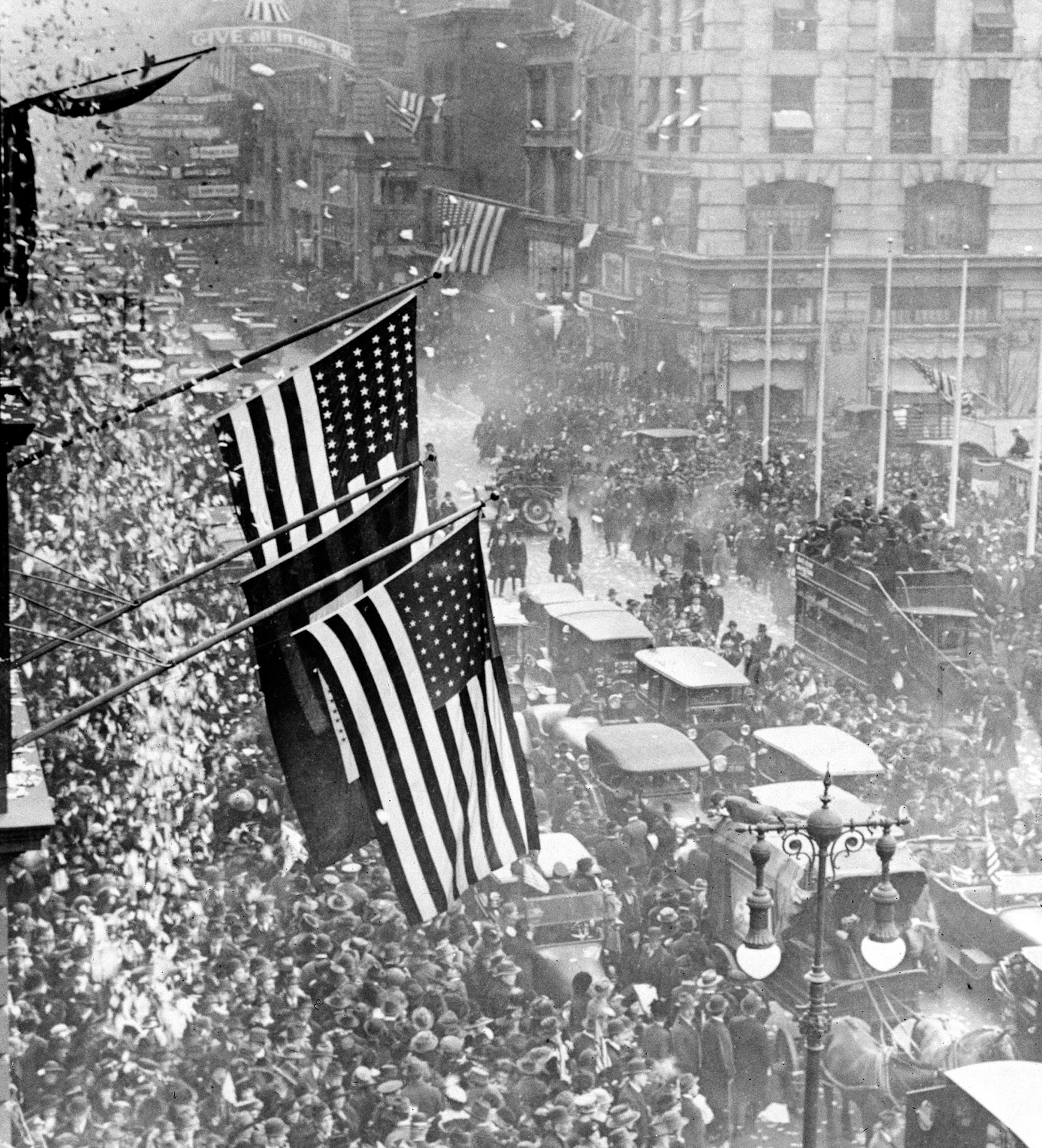
Exactly a century ago today, one American crusade ended and another began. The first was America's intervention in Europe's "Great War," inspired by President Woodrow Wilson's grandiloquent call for America to "make the world safe for democracy."
The second crusade, which began on Armistice Day — Nov. 11, 1918 — was Wilson's effort to convert the defeat of Germany into a new international world order, shaped by a Wilson-inspired peacemaking institution, the League of Nations.
Once in place, Wilson believed, the league would ensure that the Great War really would prove to be what people hopefully called it: "the war to end all war." (It's a measure of Wilson's tragedy that instead the struggle has gone down in history as the 'First' World War.)
America wasn't always a crusader nation. We were never one — at least not beyond our borders — in the 19th century, save perhaps briefly at the very end with the 1898 Spanish-American War effort to liberate Cuba from Spain. Crusading passions have waxed and waned in more recent times.
"Crusade" is a loaded word these days. But there is no better term to capture the expansive moral vision Wilson pursued in war and peace. Even today, to characterize an American war effort as "Wilsonian" is to conjure up notions of a zealous idealistic mission — a crusade.
When war broke out in Europe in the summer of 1914, President Wilson called upon the American people to be neutral in "thought, word and deed." But what did neutrality mean? Did it mean trading goods and lending with no warring country, or with any and all warring countries? From its founding, the United States had positioned itself as the great neutral trading power, vis a vis an ever-warring Europe. Therefore, Wilson was in accord with America's past when he continued trans-Atlantic trade.
Both England and Germany violated U.S. neutral rights. But German U-boats sank not just American goods, but American citizens. Eventually, the Germans' unrestricted use of the U-boat led to Wilson's decision for war.
But the meaning he gave his call for war had little to do with a defense of practical American interests, economic or otherwise, and much to do with upholding and spreading American ideals.


