

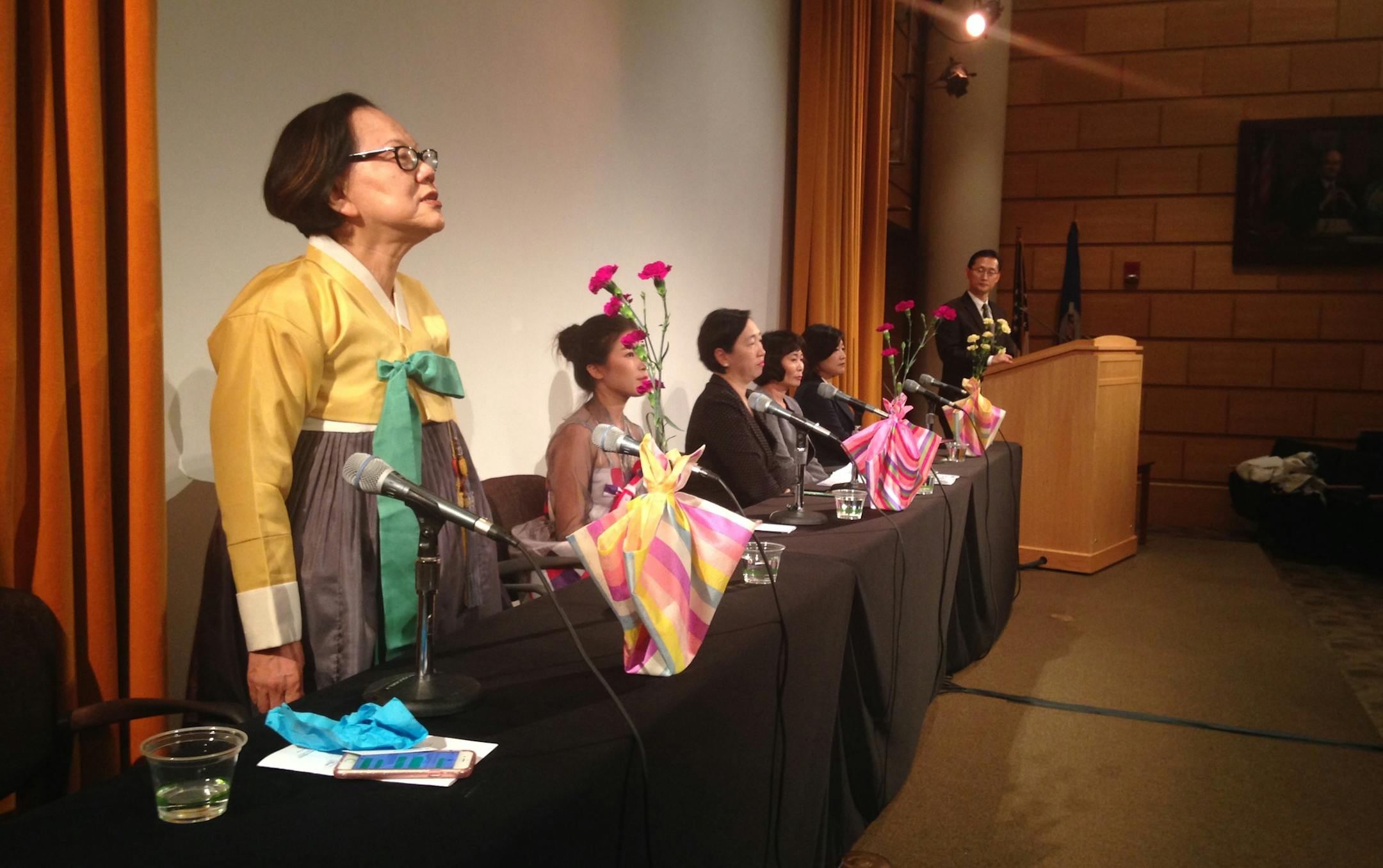
Na-ra Kang was on a bus in China two years ago, on the trip of her life, when a policeman got on. If he asked her for papers, he would find out she was North Korean and send her back, likely to her death.
"I prayed with all my heart that he wouldn't notice me," Kang told a rapt audience at the U on Thursday. "Fortunately, he got off."
It was the closest call in an escape that took Kang to Thailand and eventually to South Korea, where she joined a refugee community that, since 2000, has grown from a relative handful of people to approximately 30,000.
As Americans near the end of a presidential campaign that has been influenced by the crisis of refugees fleeing the Middle East and Africa for Europe, a group of Minnesota activists put the spotlight on another ongoing, harrowing migration from misery: the one flowing out of North Korea.
Hyon Kim, a Roseville construction executive and president of Freedom for North Korean Refugees of Minnesota, tries to bring attention to the North Koreans' plight because she has two brothers still in the country whom she hasn't seen in 66 years, she told the seminar, which attracted about 70 people at the Humphrey School of Public Affairs.
In the 12 years since Congress passed a law permitting North Korean refugees to settle in the U.S., only 203 have come. Speakers at the seminar had mixed feelings about whether the U.S. should do more to encourage defectors to move here.
"A country like the United States is so far away," said Sung-min Kim, president of Seoul-based Free North Korea Radio, who advocates for more movement to the U.S. "It would be so helpful if they heard North Korean success stories from the U.S. and how much interest Americans and the U.S. government paid toward them."
Jiyeon Ihn, an attorney and leader of human rights organization in Seoul, said South Korea is the more natural place for North Koreans to settle. But she noted that they often encounter discrimination in the South, where society adheres to hierarchical structures. "We sometimes treat them as inferior," she said. "I worry that I unconsciously am not respecting North Koreans. But they are heroes. They survived the most oppressive regime in the world."


